Automate deduction workflows with ease
Keep the claim, evidence, decision and financial outcome connected in one case.














Catch the claim, build the case, prove the facts
Automatic case creation
Invoice challenges, claim references and deduction details are detected across emails, tickets, portal records and remittance. The customer, invoice, amount and asserted reason are extracted, and related evidence merges into an existing case rather than duplicating it.
Reason classification
Separate pricing, GST-related billing, discounts, quantity, damage, returns, delivery and service issues. Prioritise each case by value, age, deadline and recovery opportunity.
Evidence collection
Pull the relevant contract, PO, invoice, remittance, prior credits and delivery or service records into the case. Keep every item tied to the specific claim and period.
Claim validation
The claimed price, quantity and discount are compared against approved terms, delivery evidence and timing. Supporting facts, conflicting facts and missing evidence are shown, so a similarity to a past case is a signal, not a decision.
Outcome recommendations
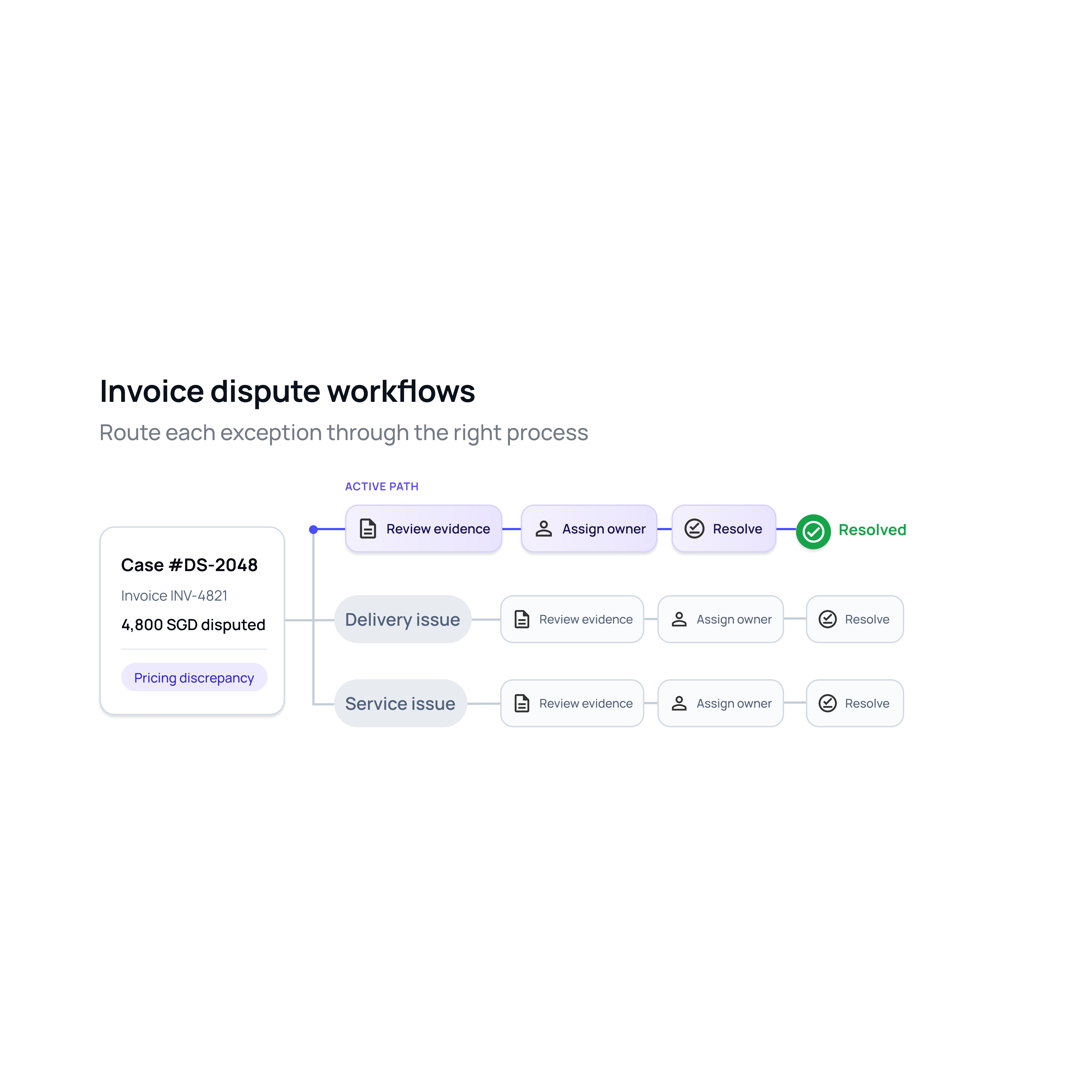
Accept, reject, partial acceptance, correction, or escalation is presented with supporting evidence and financial impact. A partial decision separates the accepted and recoverable amounts, so uncertainty is never hidden behind a single confidence badge.
Deduction recovery
For unsupported deductions, prepare the evidence-backed response and track acknowledgement, appeal deadlines and promised repayment. Recovery stays open until the financial outcome is confirmed.
Executed adjustments, verified in the ledger
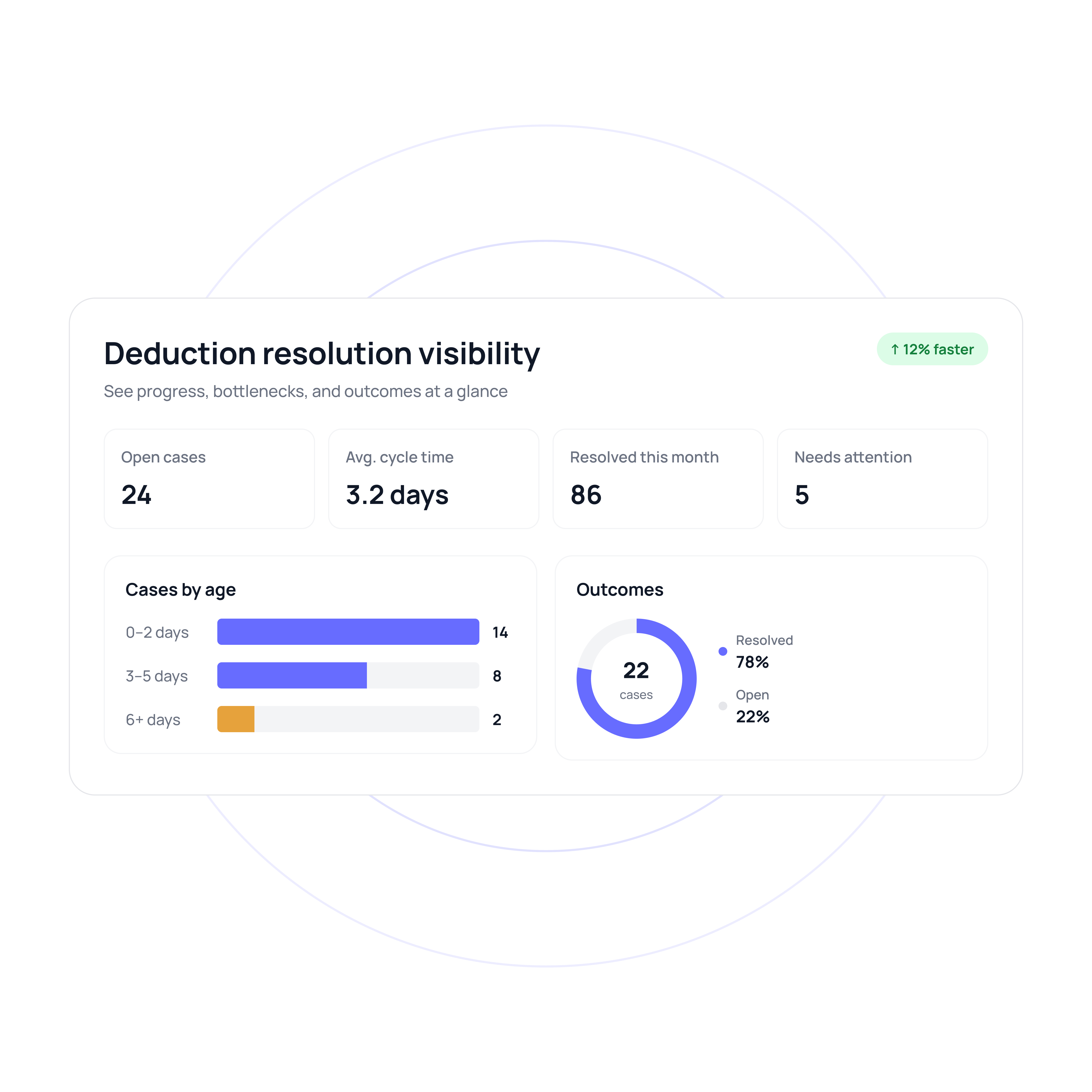
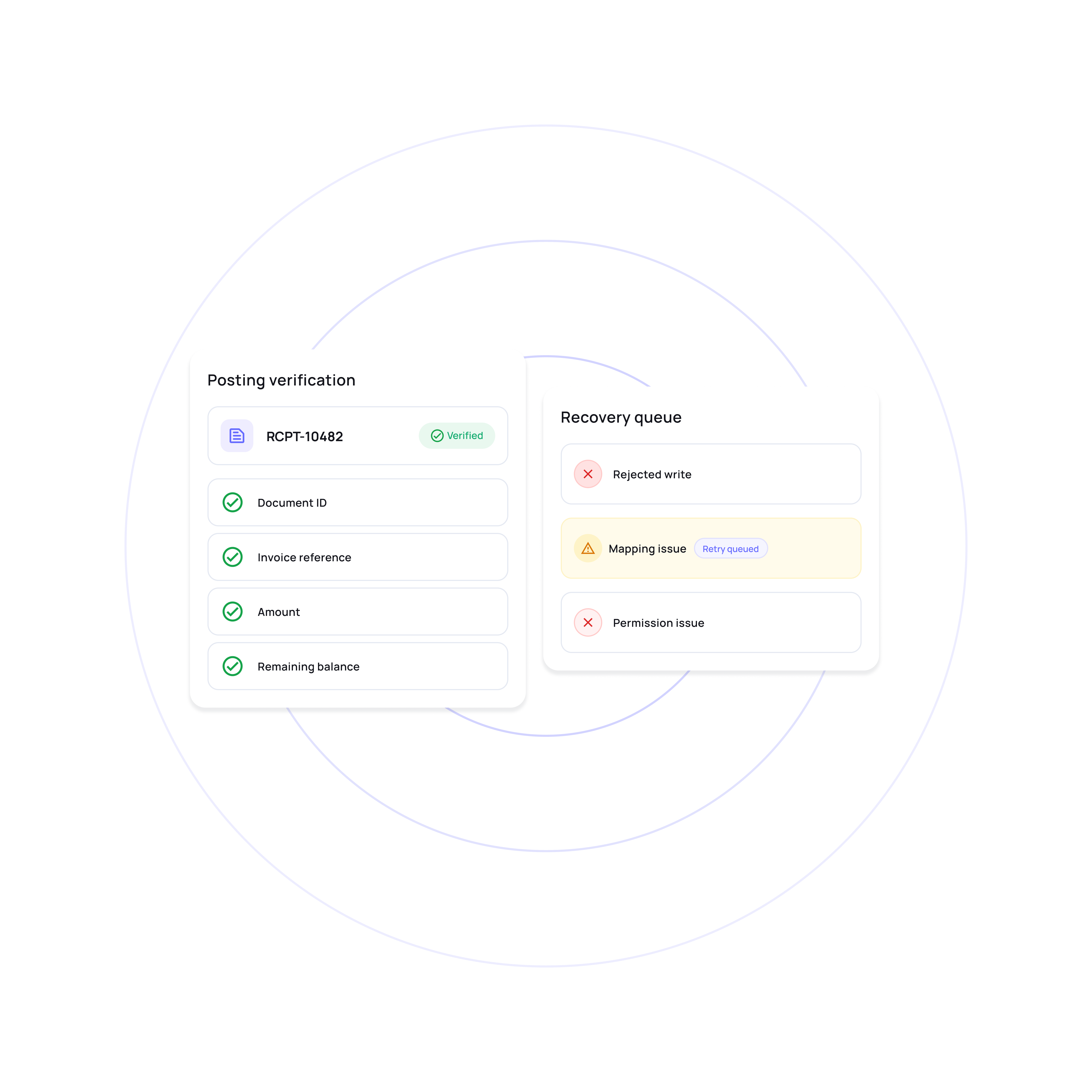
Approved credits, invoice corrections or write-offs are created with the correct reason codes and mappings, linked to the case. The accounting document and residual balance are verified, so a write-off stays a controlled decision, not a default clear-out.
Streamline your disputes and deductions process
The operating discipline around each case
Approval routing across teams
Pricing and concession decisions route to commercial owners, service facts to operations and accounting treatment to finance, under amount thresholds and separation of duties. Overdue approvals escalate, so an unattended queue is never the terminal state.
A lifecycle that reflects real work
Cases move through new, investigating, awaiting input, awaiting decision, resolution in progress, and financially verified. A rejected claim awaiting repayment stays distinct from a recovered one, with explicit reopened and failed-action states when a result no longer holds.
Undisputed balance coordination
The contested portion remains under its policy while clear amounts stay eligible for collection and application. When a decision changes the balance, the collection plan and cash allocation update, avoiding contradictory messages on the same customer.
Audit trail and prevention
Retain original evidence, later versions, rationale, policy version, approver, and the actual financial documents, including failed writes. Confirmed outcomes suggest better evidence checklists and can raise a billing-process change request, validated before deployment.
The dispute scenarios teams face day-to-day
Pricing differences, returns, delivery issues and trade claims can all create short-pays. Match each claim to the relevant commercial and delivery evidence before approving a credit or pursuing recovery.
One dispute may involve commercial, operations and finance teams across several entities. Keep ownership, evidence, approvals and financial actions attached to the same case until resolution.
Pricing, discounts, duplicate billing and service-performance issues need a different evidence set from physical-goods claims. Adapt the reason taxonomy to the business instead of forcing one model across every customer.
Dispute automation compared with an inbox process
Manual or legacy handling | The Volopay approach |
|---|---|
A dispute lives in an inbox, with reason, owner and deadline recorded inconsistently | Every claim holds its amount, reason, owner, deadline and evidence in one case |
A short payment becomes an unexplained residual | The deduction is separated from a fee, withholding or payment error before treatment |
One contested line stalls the whole balance | The disputed portion holds while undisputed amounts keep moving |
A rejection is recorded without showing whether cash was recovered | A rejected claim stays distinct from a recovered one, tracked to the actual cash |
A customer agrees, but the credit never reaches the ledger | The commercial decision and the verified posting are tracked as separate states |
They loved Volopay, you will too
FAQs
Volopay captures invoice challenges and deductions from connected emails, tickets, portals and remittance, then classifies them by reason and routes them into the appropriate case workflow.
Yes. Volopay brings the relevant contract, invoice, PO, remittance, prior credits and delivery or service records into the case, tied to the specific claim and period.
Pricing and concession decisions go to commercial owners, service questions to operations and accounting treatment to finance. Approval thresholds, entity boundaries and separation of duties determine the required owner for each case and action.
Cases move through defined states, from investigation and awaiting input to decision, resolution and financial verification. Reopened and failed-action states stay visible with their deadlines, owners and escalation paths across the full lifecycle.
Material credits, concessions, write-offs and legal positions remain with authorised reviewers. Teams can also require review by amount, entity or decision type.
Bring Volopay to your business
Get started now