Collections software for smarter recovery
Use account context, promises and blockers to decide what happens next.














Everything that decides the next collection action
Prioritised worklists
Accounts are ranked by overdue value, age, payment history, broken promises and active blockers, with the reason shown. Work is assigned by entity, collector or segment, and finance can override a priority without losing the rationale.
Promise-to-pay management
The promised date, amount and covered invoices are captured from a reply. A vague "next week" prompts a request for specifics. Outreach pauses for the covered amount, and actual receipts are checked against the commitment.
Two-way outreach across approved channels
Two-way outreach: Continue the same customer conversation across approved channels, with invoice references and account history intact. Replies update the next collection action.
Classify and resolve payment blockers
A missing PO, invoice-copy request, onboarding requirement, incorrect billing detail or service issue each becomes a task with an owner. The blocker is worked until satisfied, because sending a message is not the same as resolving a blocker.
Customer-specific playbooks
Set timing, contact hierarchy, language, tone and escalation by customer or segment. Strategic accounts, regional customers and routine receivables can follow different collection paths.
AR support that performs the next action
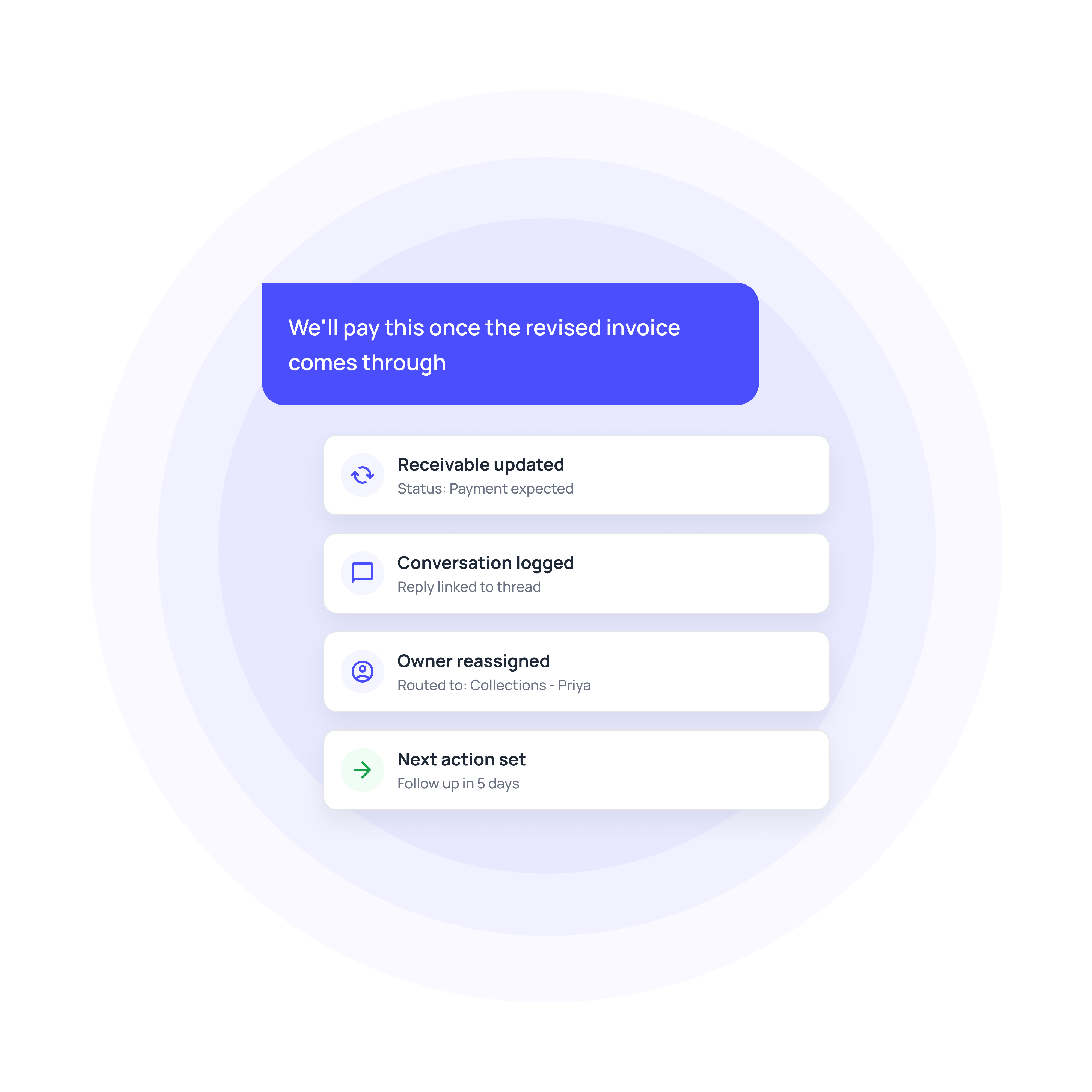
Requests for invoices, statements, credit notes or payment instructions are understood, the approved document is retrieved, the recipient verified, and the reply sent. New PO numbers and remittance are captured. Bank-detail changes require separate verification and authority.
Collect around a dispute, not through it
The contested amount is held under its policy while undisputed balances stay collectible. The dispute agent investigates, and collections communicates the agreed status. On resolution, remaining collectible cash is recalculated rather than restarting the original sequence.
Automate collections without losing human control
Automation with a hold on the risky actions
Autonomy configured per action
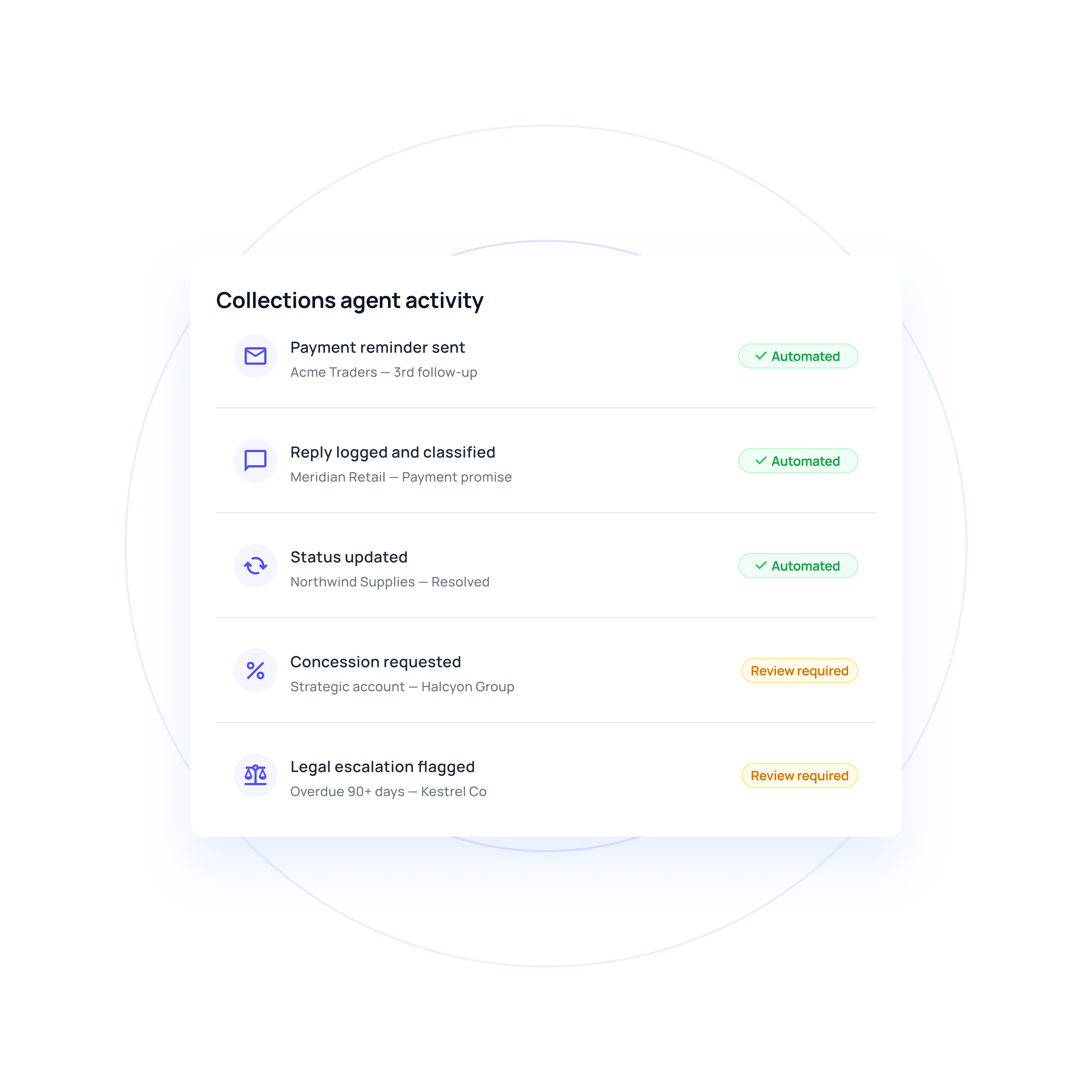
Routine document replies and standard reminders can run automatically, while strategic accounts, negotiated terms and sensitive wording require review. Discounts, write-offs and legal threats escalate. Late fees and external recovery are never default autonomous actions in this collections software.
Stop and resume conditions for collection activities
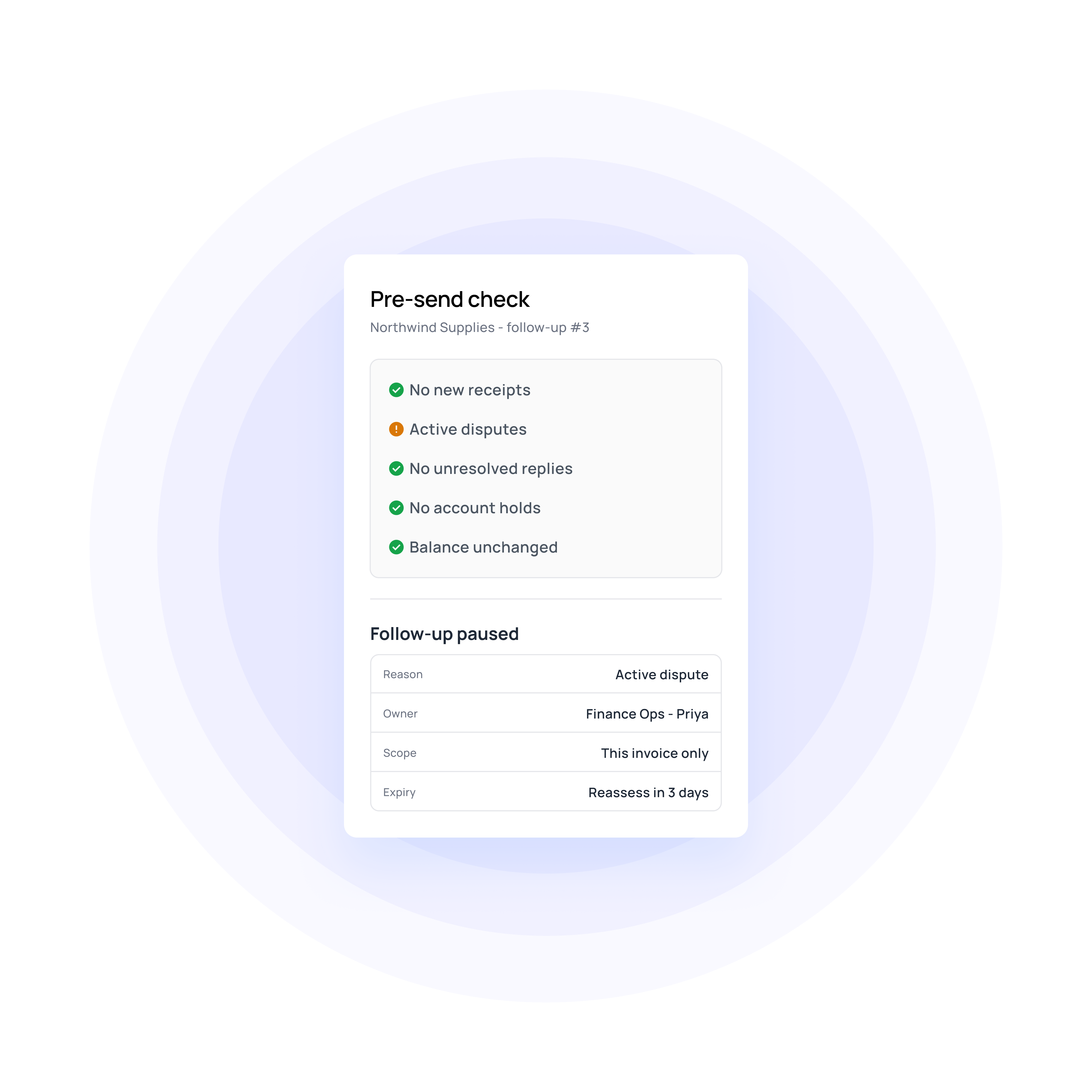
New receipts, active disputes, unresolved replies, holds and changed balances are checked immediately before any send. A pause records its reason, scope, expiry and owner. A human takeover stops agent replies until the team hands the thread back.
Customer AP portal follow-up
Invoice details and attachments are submitted or verified in authorised customer portals, with submission references captured. Received, rejected, awaiting-approval and scheduled states stay distinct. An accepted invoice is not paid, and a portal's payment schedule is not a confirmed receipt.
Reporting the team can act on
Aging, average days to pay and DSO are tracked with their definitions kept separate, alongside promise performance and an AR cash forecast with labelled assumptions. As automated collections software, it separates cash received from activity performed.
Handling receivables across hubs and portals
Central finance teams in Singapore may collect for several Southeast Asian entities from one hub. Assign work by entity, region or segment while keeping customer context, ownership and priority intact.
Customers across Southeast Asia may use different procurement processes and AP portals before an invoice reaches payment approval. Track submission, rejection and approval states without treating portal activity as confirmed payment.
Large regional customers may need careful handling, while routine receivables need scale. Segment playbooks by relationship, language, timing and escalation so collectors do not apply one cadence to every account.
Collections automation compared with the old way
Manual or legacy collections | The Volopay approach |
|---|---|
A reminder sent is treated as progress | A reminder is activity; payment is confirmed only when financial evidence arrives |
Every overdue invoice gets the same cadence | Follow-up reflects value, history, promises and the blockers on each account |
Sales, support and finance send conflicting messages | Conflicting outreach is suppressed while a reply or hold is being handled |
A promise disappears into an inbox, untracked | Promises are tracked against a date, an amount and the eventual receipt |
A contested amount freezes the whole invoice | The disputed portion holds while the undisputed balance stays collectible |
They loved Volopay, you will too
FAQs
Accounts are ranked using overdue value, age, payment history, broken promises, relationship sensitivity and active blockers, with the reason shown. Finance can override a priority, and the original rationale is retained for review.
Volopay keeps balances, recent conversations, promises, disputes, contact ownership and customer segment together before the next action. Collectors work from the current account state instead of rebuilding context across systems.
Yes. Routine reminders and document responses can progress within configured policy. Teams can vary timing, language, contact hierarchy and escalation by customer, while sensitive accounts and higher-risk actions stay behind review.
Volopay records the promised date, amount, covered invoices and conditions, then compares the commitment with confirmed receipts. Disputed amounts follow their own case policy, while eligible undisputed balances remain collectible.
Escalation applies to discounts, write-offs, legal threats, high-value concessions, repeated silence and sensitive accounts. Each escalation includes the amount, invoice, customer message, and recommended next step, assigned to a named owner with an explicit return condition.
Finance retains negotiation beyond approved limits, material concessions, write-offs, late-fee application and external debt recovery. Bank-detail changes and disclosure of another entity's data require separate verification, rather than being decided independently by the agent.
Bring Volopay to your business
Get started now