Simplify dispute and deduction management
Give every deduction a reason, every dispute an owner, and every resolution a verified financial outcome.














Resolve disputes without losing the bigger picture
Automatic case creation
Detect invoice challenges, claims, and deduction details across connected channels, then create or update the right case without duplicate records.
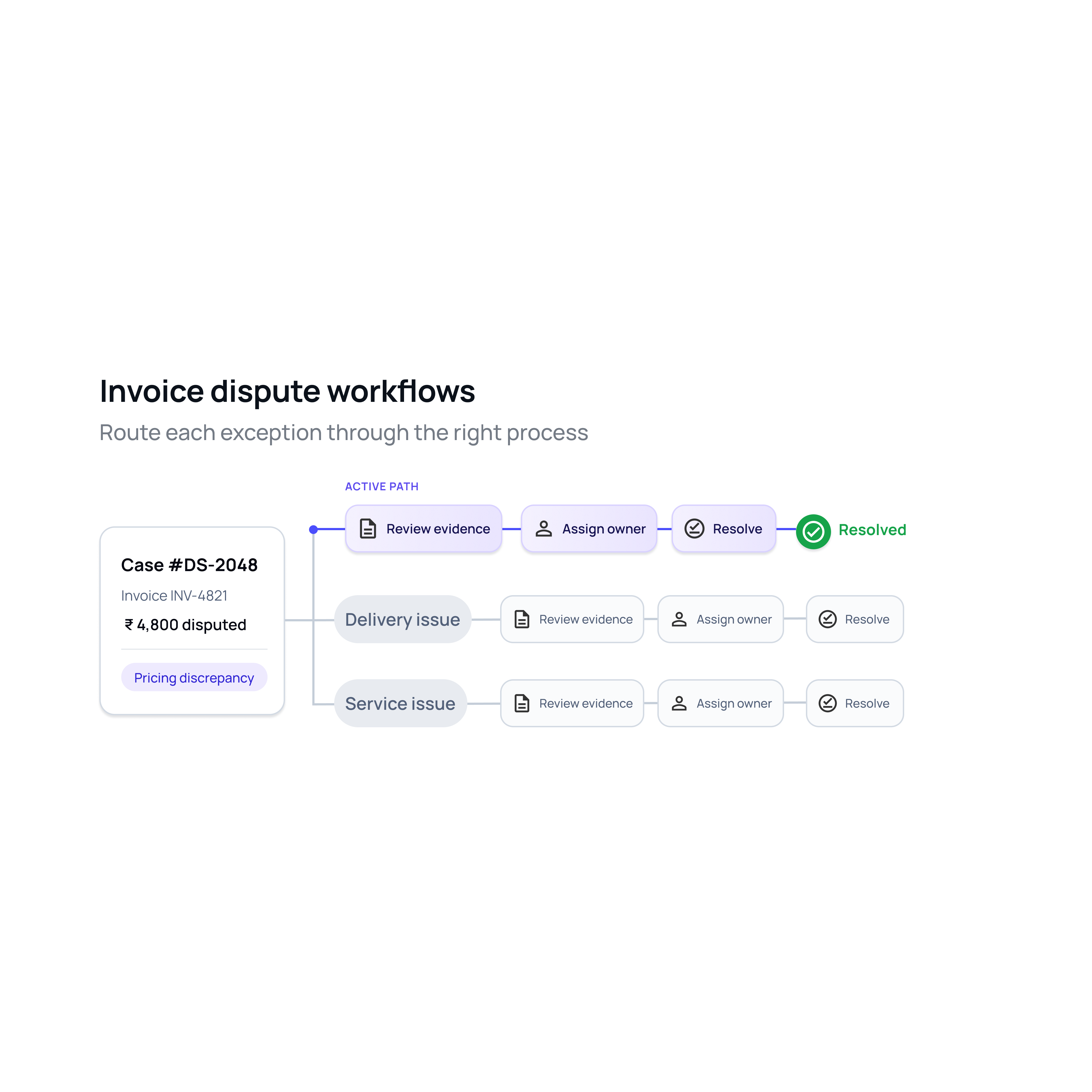
Reason classification
Classify pricing, GST-related billing, quantity, delivery, service, duplicate billing, and other issues, then prioritise cases by value, age, deadlines, and recovery opportunity.
Evidence collection
Bring contracts, invoices, remittances, customer conversations, delivery records, and other relevant evidence into the claim for faster investigation.
Approval routing
Route commercial, operational, and accounting decisions to the right owners using configured thresholds, entity boundaries, and separation-of-duties controls.
Outcome recommendations
Deductions management software presents supported outcomes with the relevant evidence and financial effect. Teams can accept, reject, partially accept, correct, recover, or escalate without hiding uncertainty.
Customer communication controls
Keep customer requests, responses, and internal decisions connected to the case. Agents follow configured communication rules while sensitive disputes and commercial concessions remain subject to review.
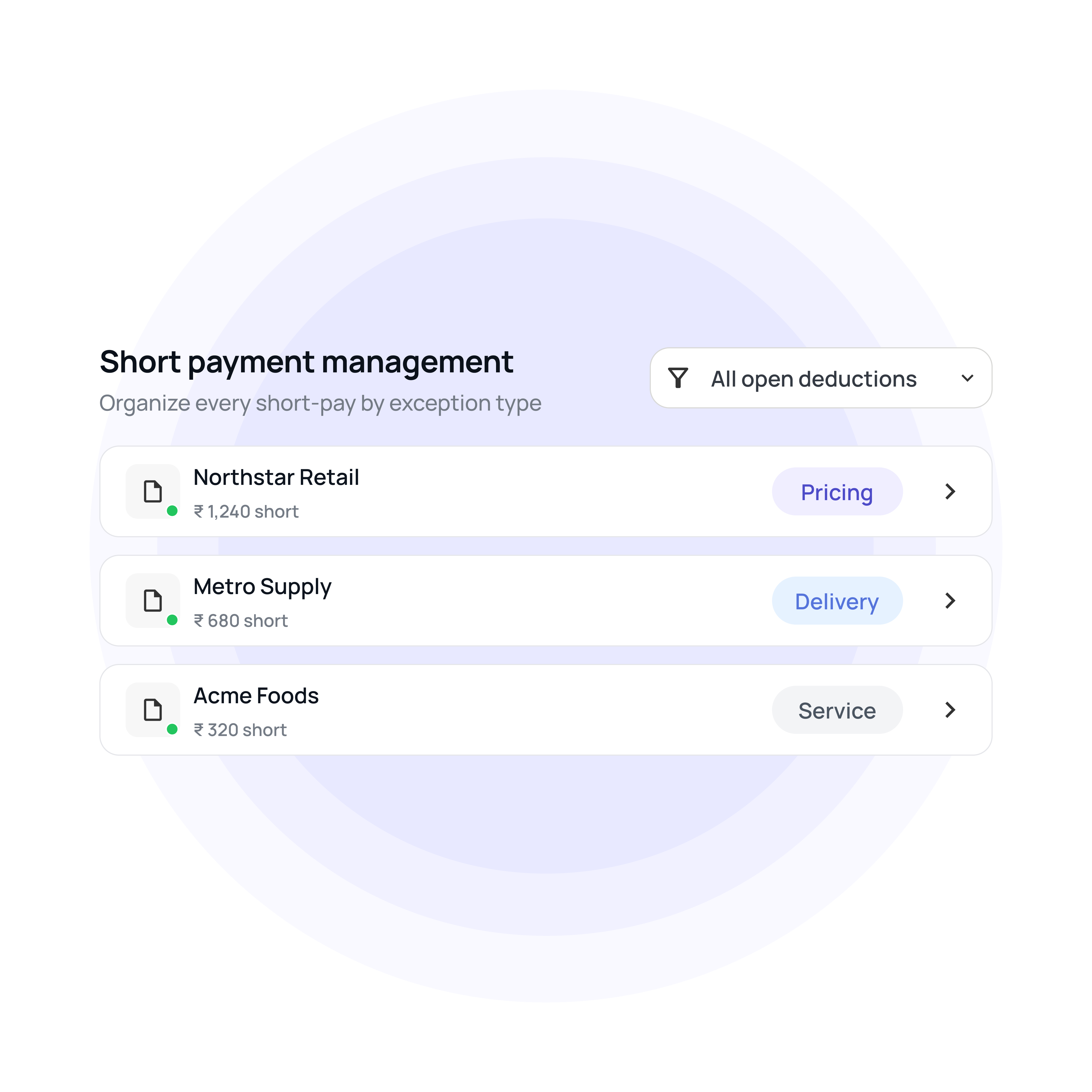
Coordinate the undisputed balance
Prevent one contested amount from stopping the rest of the receivable. Clear balances remain collectable and applicable while the disputed portion follows its required hold process.
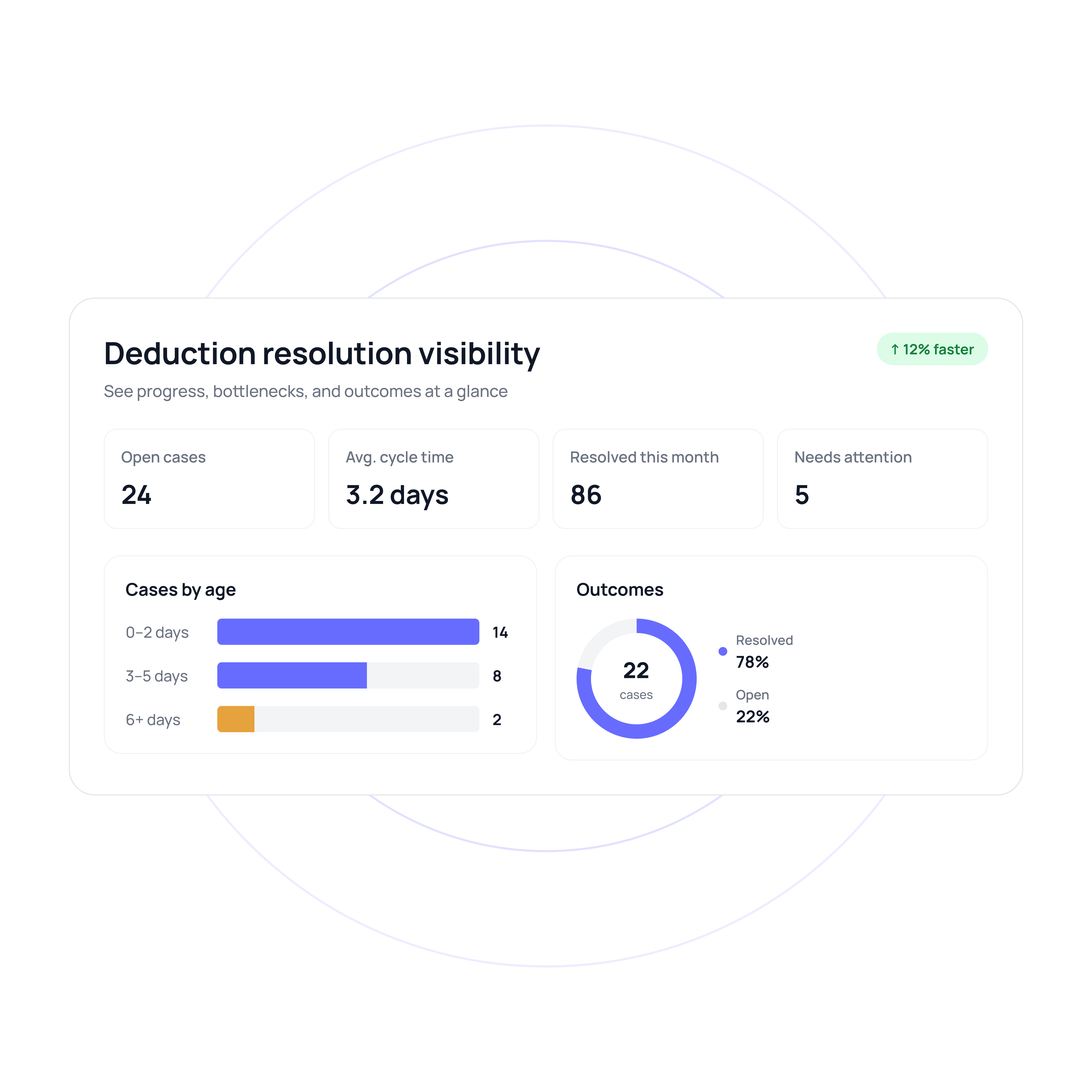
Streamline your disputes and deductions process
Keep every resolution accountable
Lifecycle management
Track each case from investigation through financial verification, with explicit reopened and failed-action states. Teams can distinguish a pending decision from a genuinely completed resolution.
Actionable service levels
Set the requested item, owner, deadline, and escalation path for each waiting state. Follow-ups stay assigned instead of leaving unresolved customer or internal requests in a queue.
Governed autonomy
Allow routine actions within configured authority while requiring review for material credits, concessions, write-offs, and sensitive disputes. Entity-scoped access and external-message review keep control with authorised teams.
Audit and accounting proof
Retain evidence, decision rationale, policy versions, approvals, communications, and financial documents together. Finance can trace a credit or write-off back to the original claim and verify failed actions.
Dispute management across high-friction AR workflows
Indian distributors and wholesalers may face recurring deductions around pricing, GST-related invoice issues, quantities, returns, schemes, and delivery. Route each claim through the relevant evidence and approval path while collections continue on undisputed receivables.
A customer relationship may span several Indian legal entities with different approval paths, accounting mappings, and commercial arrangements. Keep the correct entity attached to each dispute so finance can review and resolve the claim without splitting the case history across separate workflows.
A short payment may reflect TDS, another withholding, a commercial deduction, a fee, or a genuine dispute. Keep those causes distinct, route commercial claims into dispute handling, and send non-dispute payment differences through the appropriate cash application path.
How Volopay approaches dispute resolution
Manual/legacy approach | The Volopay approach |
|---|---|
Disputes move between ERP records, emails, portals, and spreadsheets | Disputes automation software connects the workflow around the finance stack already in use |
Deductions sit across different teams, with no consistent operating process | Ownership, decisions, and financial outcomes stay aligned within a controlled workflow |
Fixed processes make different entities, customers, and claim types harder to handle | Deduction automation software adapts to business-specific rules, evidence requirements, and authority limits |
Large automation programmes make it difficult to isolate early value | A workflow can be measured against its own baseline before broader automation is introduced |
“Resolved” often stops at a decision, leaving financial completion unclear | Commercial outcomes and financial completion remain distinct, giving finance a clearer view of what is actually closed |
They loved Volopay, you will too
FAQs
Volopay detects invoice challenges, claim references, and deduction details across connected emails, portals, tickets, and remittances. It classifies issues such as pricing, tax, quantity, delivery, service, and duplicate billing, then prioritises each case using value, age, deadlines, recovery opportunity, and customer sensitivity.
Yes. Volopay can retrieve relevant contracts, invoices, remittances, prior credits, customer conversations, and operational records. It also identifies missing evidence and requests specific information from customers or internal teams before reassessing the case when needed.
Volopay routes pricing and concession matters to commercial owners, operational evidence to relevant teams, and accounting treatment to finance. Configured thresholds, entity boundaries, and separation-of-duties rules determine the appropriate approval path for each case.
Volopay tracks each case from investigation and missing evidence through decision, financial action, and verification. It also keeps reopened cases and failed actions visible, so Indian AR teams can distinguish a commercial decision from a financially completed resolution.
Finance and commercial teams retain authority over material credits, concessions, write-offs, sensitive disputes, and legal positions. Volopay handles permitted routine work within configured boundaries and sends decisions outside those limits to the appropriate authorised owner.
Bring Volopay to your business
Get started now