Simplify cash application across complex payments
Bring bank activity, remittance and customer context together to resolve multi-invoice payments, parent-company receipts and short-pays without holding receipts back.















Beyond payment matching, into controlled cash application
Evidence-backed allocation
Support each allocation with the receipt, remittance, invoice and customer context behind it. Keep references, amounts, dates, tolerances and confidence thresholds visible before execution.
Short-pay and deduction treatment
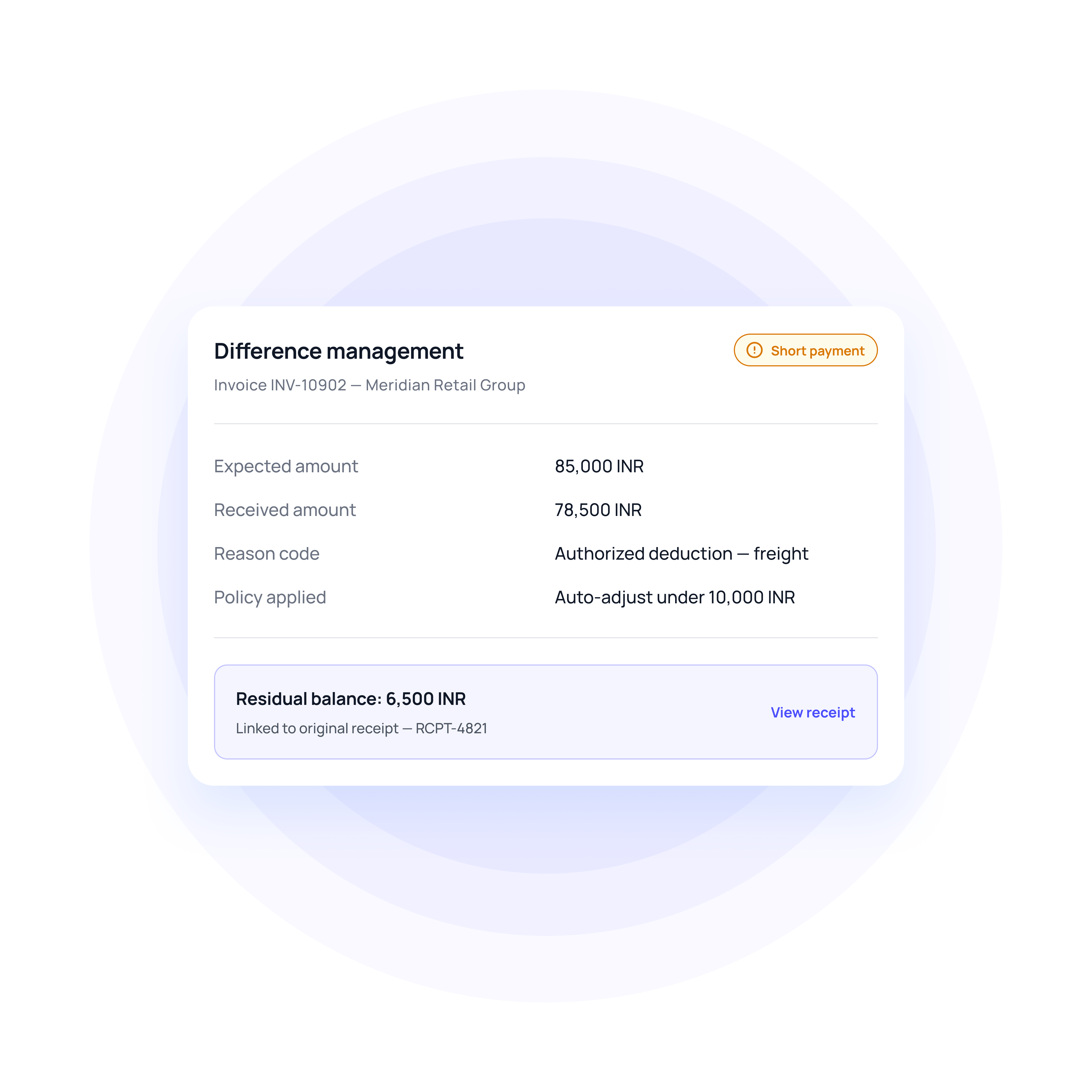
Separate supported cash from residual balances and distinguish deductions, discounts, TDS-related withholding, fees and errors. Keep reason codes, supporting evidence and approved accounting treatment connected to each difference.
On-account credit handling
Preserve overpayments as on-account amounts or eligible credits when required. Keep credit allocation, refund approval and refund payment separate when customer intent or treatment remains unresolved.
ERP-native accounting execution
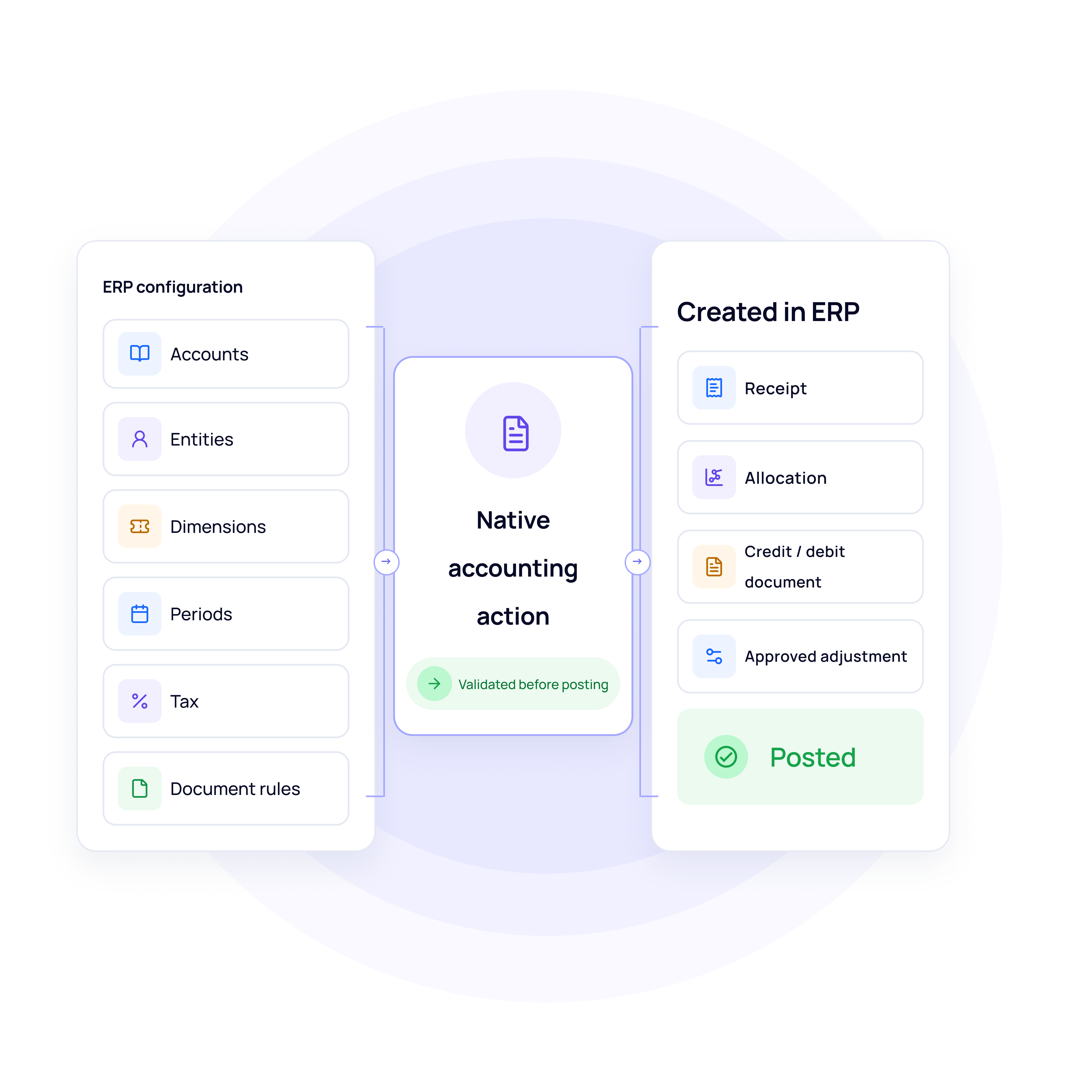
Work with the customer's chart of accounts, entities, dimensions, periods, tax configuration and document rules. Preserve approvals and source references alongside each permitted accounting action.
Remittance exception handling
Open a linked request when allocation evidence falls short. Ask for specific invoice references or payment advice, then update the same receipt as new information arrives and reassess the allocation.
Action-level automation
Set different handling for automatic, review and manual work based on amount, entity, customer and evidence quality. Keep sensitive adjustments, cross-entity transfers and refunds behind explicit approval boundaries.
Approved learning loops
Use confirmed analyst corrections to suggest payer aliases, extraction improvements or matching rules. Review material changes before activation and retain earlier versions so finance teams can compare results safely.

Clear cash faster. Keep every exception under control
Built for finance teams that need the full record
Source-to-posting history
Keep the original receipt and remittance alongside extracted fields, selected allocations, reviewer decisions and accounting results. Failed attempts and later corrections remain visible throughout the application lifecycle.
Duplicate and reversal detection
Catch repeated source records, duplicate posting attempts, reversals and returned payments before they create additional reconciliation work. Preserve the connection to the original transaction throughout.
Exception mix reporting
Break down missing remittance, unidentified payers, deductions, overpayments and posting failures by amount and count. Give finance teams a practical view of the work behind unresolved cash.
Reconciliation packs with source links
Create operational summaries with filters, as-of dates and direct links to supporting documents. Keep the evidence available for review without reconstructing the application trail manually.
Cash application across real finance workflows
Centralised finance teams may process receipts across several Indian entities while working with bank activity, ERP records and remittance from different sources. Evaluate the payer, entity, open invoices and allocation history before moving each supported amount into accounting.
Customer receipts may arrive below invoice value because of commercial deductions, TDS-related withholding, fees or other differences. Apply the supported amount, keep the residual visible and give finance the evidence needed to determine the remaining treatment.
Subscription businesses may receive one remittance covering several invoices, accounts or billing periods. Evaluate references, open balances and customer intent before allocating the receipt, then keep any unsupported residual separate for further review.
Get the Volopay difference in cash application
Traditional cash application software | Volopay |
|---|---|
Built around the finance application where matching happens | Works as an operating layer around the ERP, bank, remittance, CRM, portals and other systems already in use |
Relies mainly on predefined matching rules for automation | Uses the simplest reliable mechanism for each case: deterministic logic, customer rules, agentic reasoning or human authority |
Automation often applies broadly across the workflow | Set authority by action, amount, entity, customer and evidence quality, keeping higher-risk work behind review |
Moving beyond the initial use case can mean another large systems project | Start with one high-value finance workflow, measure the baseline, then expand when another value pool is proven |
The finance system remains the place where exceptions are investigated | Routine work progresses automatically while exceptions reach people with the context, evidence and ownership needed to act |
They loved Volopay, you will too
FAQs
Volopay brings bank receipts, remittance, invoices and customer context together. It runs automated cash application using configured matching rules, customer policies and confidence thresholds. Uncertain cases move to finance review before permitted accounting actions are taken reliably.
Yes. Volopay supports one-to-one, one-to-many, many-to-one, instalment and consolidated payment allocations. It checks candidate matches against current open balances before execution, reducing the risk of applying a receipt against an invoice finance has already cleared.
When remittance is missing or unclear, Volopay creates a linked request for invoice references or payment advice. New customer information updates the same receipt. The allocation workflow then reassesses available evidence before moving forward carefully.
For short-pays, Volopay applies the supported amount and keeps the residual against the invoice or open item. Finance can distinguish TDS-related withholding, commercial deductions, discounts, fees and errors using the available evidence and approved treatment. For overpayments, Volopay can preserve the excess on account or as an eligible credit, depending on policy.
Volopay does not force a match when several allocations remain plausible. It surfaces the uncertainty or requests additional remittance, then sends the case to finance with the supporting receipt, invoice and customer context.
Volopay can automate routine matching within configured thresholds, while finance keeps authority over low-confidence matches, material adjustments, write-offs, refunds, tolerance exceptions and sensitive cross-entity transfers.
Bring Volopay to your business
Get started now