Collections software for smarter receivables
Give every follow-up a clear purpose with account context, customer responses, payment commitments, and blockers connected in one workflow.














Know what to chase, who to contact, and what comes next
Prioritised worklists for receivables
Combine ageing, overdue value, payment history, broken promises, risk signals, and active blockers to prioritise receivables. Finance can override priorities while retaining the rationale.
Customer-specific collection playbooks
Configure cadence, contact hierarchy, frequency, business hours, time zones, language, tone, and escalation rules by customer or segment.
Two-way communication across approved channels
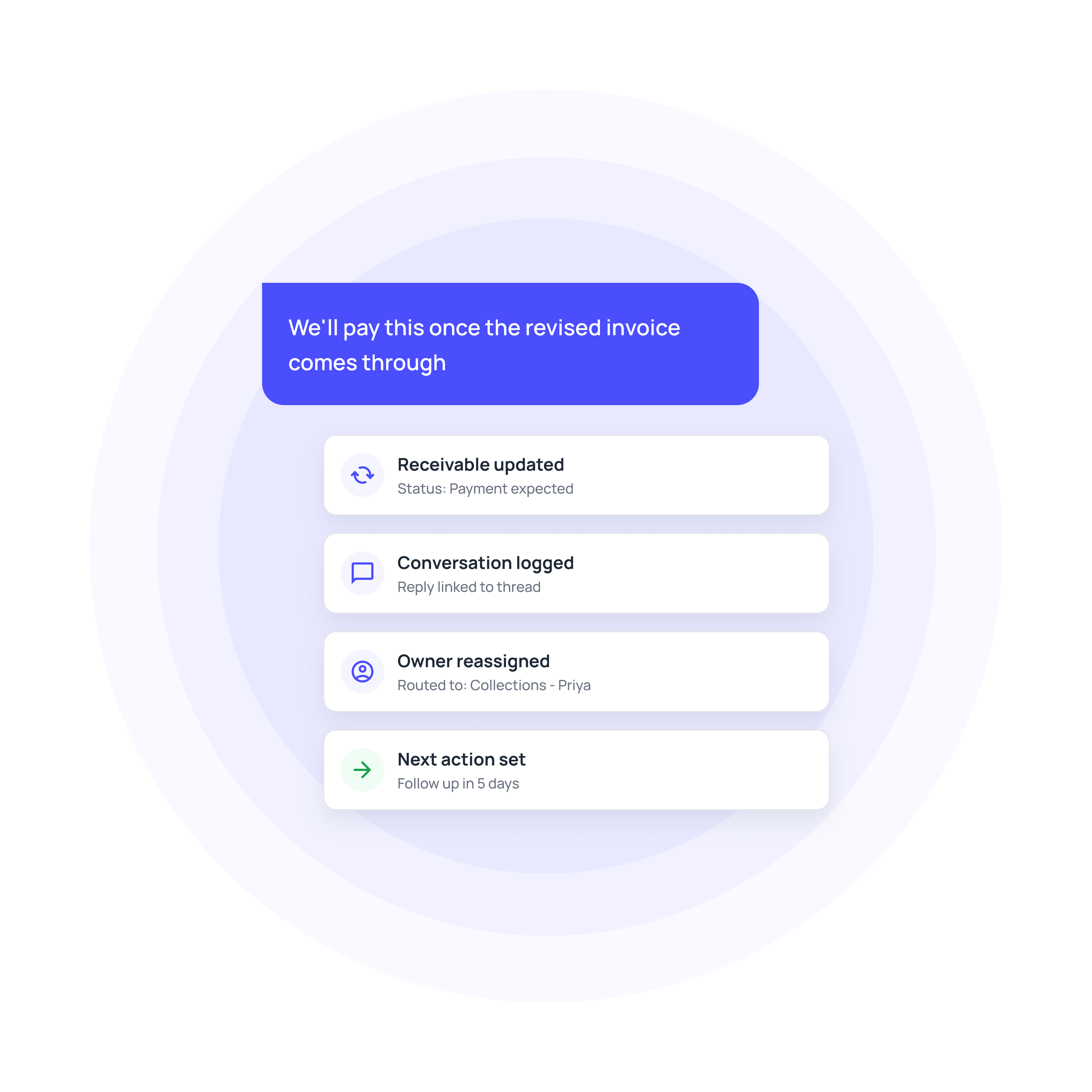
Keep customer replies, invoice references, and conversation history connected. Responses can trigger document requests, PO follow-up, payment commitments, or dispute handling.
Track promise-to-pay management
Capture promised dates, amounts, covered invoices, and conditions. Track commitments against actual receipts, including partial, revised, and broken promises.
Document and remittance handling
Handle requests for invoice copies, statements, credit notes, payment instructions and supporting documents within the collection workflow. Retrieve approved records, verify the recipient and capture new PO or remittance details before deciding the next step.
Customer AP portal follow-up
Track invoices as they move through customer AP processes. Capture submission references and distinguish between received, rejected, awaiting approval, and scheduled-for-payment states. Use each status to determine the appropriate follow-up instead of treating every overdue invoice the same.
Closing the loop after payment
Pass payment claims and remittance details to cash application once payment evidence is available. Suppress duplicate chasing while receipt is verified, then restore the appropriate collection step if a payment fails or reverses.
Automate collections without losing human control
Automation with controls built for finance teams
Action-level autonomy
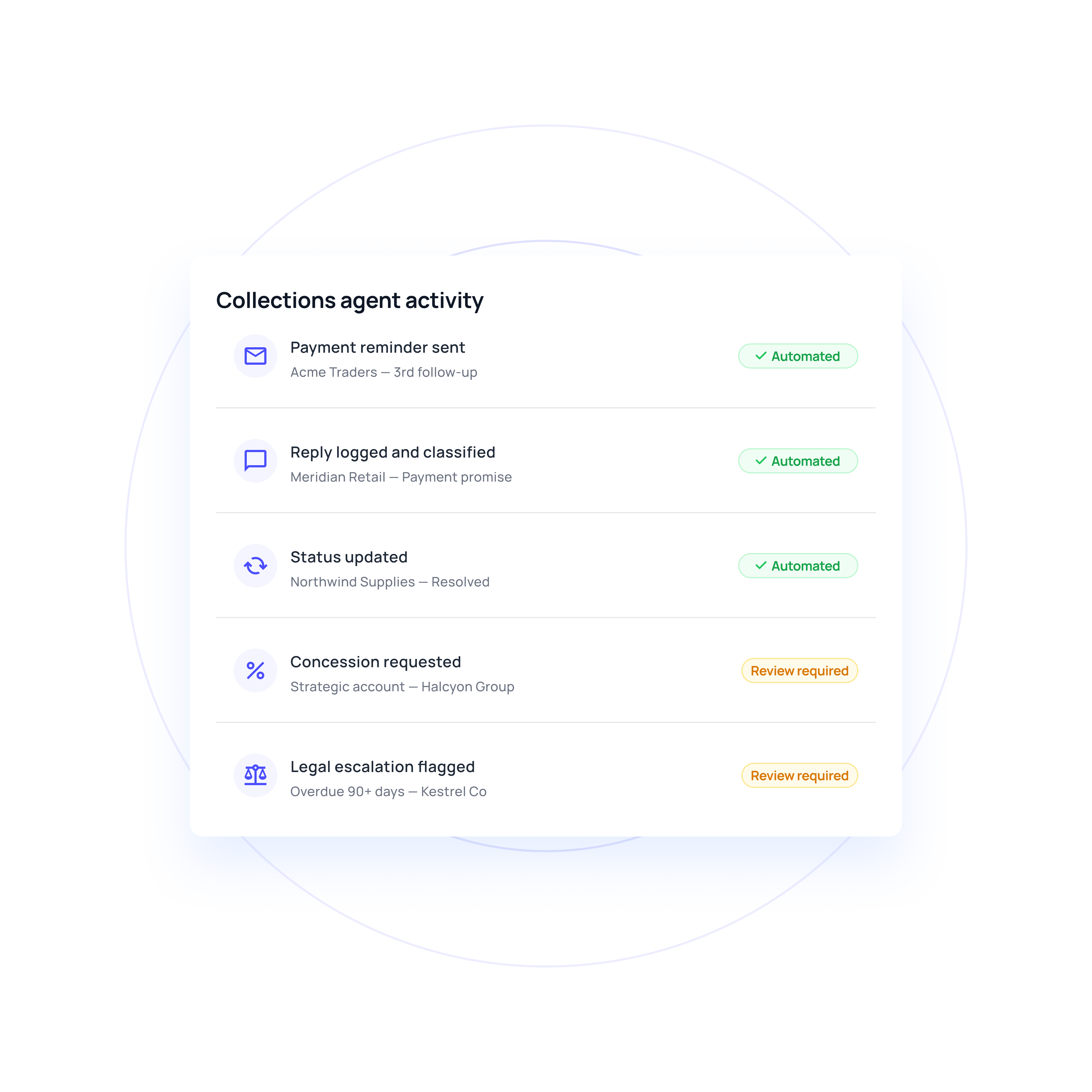
Configure automation around each collection action. Run routine reminders and document replies automatically within approved boundaries, while routing sensitive financial decisions to people.
Stop-and-resume conditions
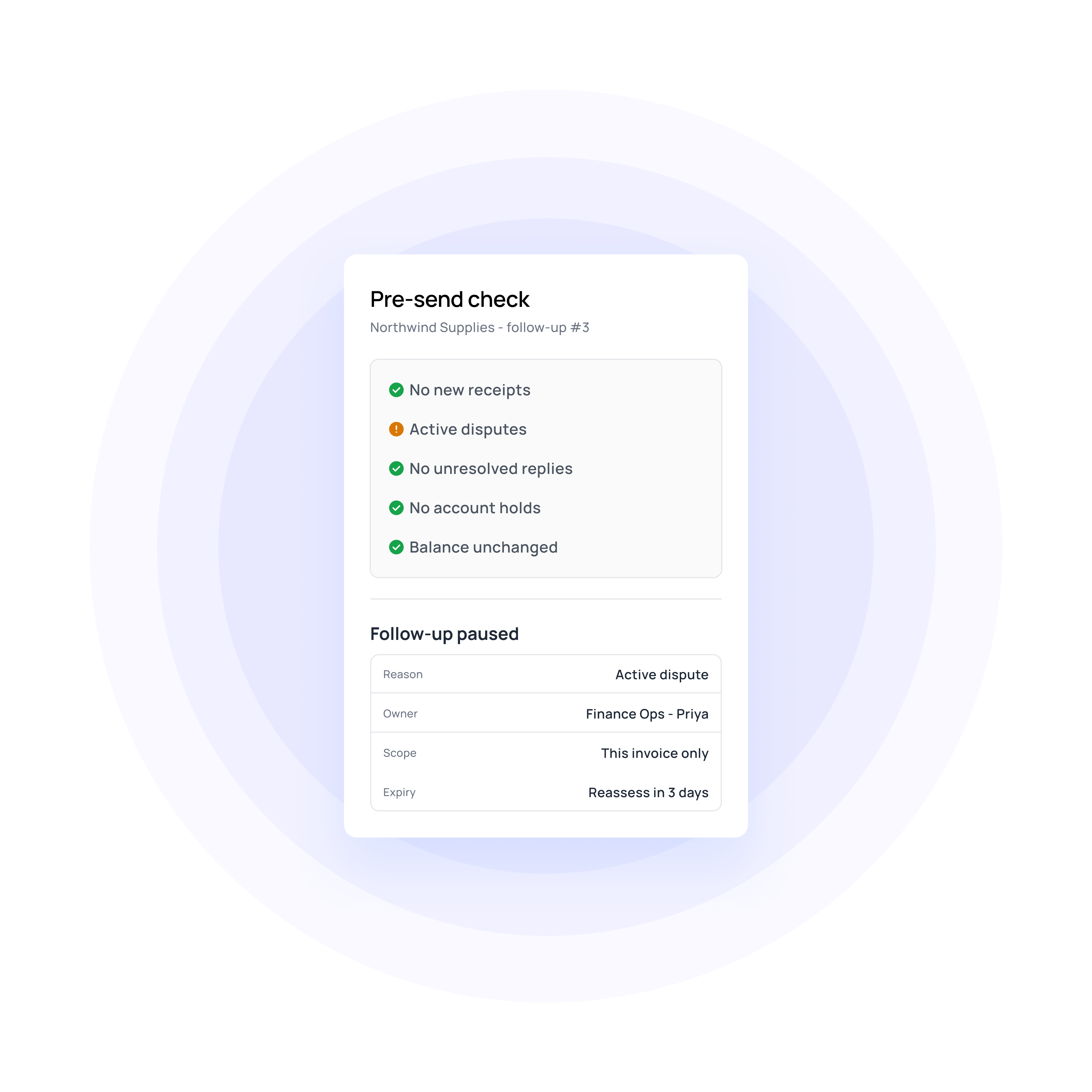
Recheck receipts, disputes, replies, holds, and invoice balances before sending. Pause with a defined reason, scope, owner, and expiry, then reassess the account before resuming.
Collections workflow reporting
Use collections workflow software to track ageing, Average Days to Pay, DSO, promise performance, blocked work, and financial outcomes across customers, entities, and collectors.
Versioned collection playbooks
Use approved edits, response outcomes, and resolved blockers to improve dunning automation over time. Test proposed changes against previous conversations and sensitive cases before activating a new version.
Collections use cases across complex B2B receivables
Large manufacturers may collect from buyers with different PO requirements, approval chains and customer AP processes. Prioritise overdue accounts using payment history, broken promises and active blockers. Keep missing documents, disputes and internal approvals tied to the receivable before deciding the next collection step.
Indian distribution businesses may manage large customer books across regions, branches and dealer networks. Bring ageing, overdue value, payment commitments and account history into one worklist, then focus collectors on receivables where the current context calls for action.
A customer may confirm payment while the amount received differs from the invoice because of TDS or another deduction. Keep the conversation, payment claim and remittance context together, then pass the payment evidence to cash application instead of treating the customer’s message as confirmed settlement.
Move beyond reminders with context-led collections
Traditional collections software | Volopay |
|---|---|
Fixed collection paths leave teams working through standard sequences, even when account circumstances change | Context-led workflows adapt permitted actions to customer history, commitments, blockers, and account conditions |
Manual context gathering forces collectors to switch between systems before deciding what deserves attention | Connected receivables context brings the relevant information together while working around existing finance systems |
Broad automation can blur the line between routine follow-ups and decisions requiring finance judgement | Bounded automation handles permitted routine work while keeping strategic accounts and sensitive decisions with people |
Disconnected handoffs leave collections, disputes, and payment confirmation operating as separate activities | Connected AR workflows carry relevant updates between collections, disputes, and cash application as receivables change |
They loved Volopay, you will too
FAQs
Volopay prioritises open receivables using ageing, overdue value, payment history, customer risk signals, broken promises, relationship sensitivity, and active blockers. This helps high-volume B2B finance teams focus collector effort where account context calls for action.
Volopay connects recent conversations, invoice references, payment commitments, disputes, account history, and contact information within one collection workflow. Finance teams can work across existing ERP, email, CRM, and customer portals without manually piecing together account context.
Yes. Routine follow-ups can run automatically through customer-specific playbooks covering cadence, contact hierarchy, frequency, business hours, and escalation rules. This supports finance teams managing large customer books while keeping strategic accounts and sensitive cases within defined human oversight.
Volopay captures promised dates, amounts, covered invoices and conditions, then compares the commitment with later payment evidence. If a customer disputes part of the balance or reports a deduction, collections can hold the relevant amount under the applicable workflow while continuing appropriate follow-up on undisputed receivables.
Volopay can escalate cases involving missed internal SLAs, repeated customer silence, disputed policies, high-value concessions, strategic accounts, or sensitive relationships. Owners receive the relevant invoice, amount, customer message, evidence, and recommended next action to resolve the case.
Finance teams retain control over strategic-account treatment, negotiated payment plans, legal issues, write-offs, material concessions and sensitive customer relationships. Finance also reviews any action that falls outside configured authority.
Bring Volopay to your business
Get started now