Airwallex vs. Aspire: Which platform to choose?
Airwallex vs. Aspire comes down to one question: are you building across borders, or managing spend for a growing team? Airwallex gives you global payment infrastructure. Aspire gives you a clean, all-in-one finance tool built for Southeast Asian startups.
Both are solid, but which one is right depends on your business. In this guide, we break down pricing, FX fees, cards, integrations, and more to help you decide.












REVIEWED BY

Akanksh Muniyappa
Head of Product
WRITTEN BY

Yashvi Tiwari
Content Writer
Quick summary: Airwallex vs. Aspire
Airwallex is a good fit for businesses that make a lot of international payments. It works well if you need bank accounts in different currencies, good exchange rates, and financial tools that can grow with you across many countries.
Aspire is a good fit for small businesses and startups in Southeast Asia. It works well if you need a simple business account, easy expense tracking, company cards that earn cashback, and basic finance tools that are not hard to use.
| Key factors | Airwallex | Aspire |
|---|---|---|
Best for | Global Infrastructure | SMB Finance Suite |
Multi-Currency | 20+ currencies | 20+ currencies, local accounts |
FX Rates | 0.4–0.5% markup | 0.18–0.23% outbound |
International Payments | 200+ countries | 130+ countries |
Corporate cards | Unlimited, 0% FX fees | Unlimited + 1% cashback |
Expense Management | Available | Strong & often free |
Pricing | Free base, paid tiers | Mostly free, per-user extras |
Accounting Integrations | Xero, QuickBooks, NetSuite | Xero, QuickBooks + automation |
Airwallex
Airwallex is a global financial infrastructure platform that helps businesses send and receive money around the world. Started in 2015 in Melbourne, Australia, it initially focused on helping companies make payments across borders. Now it has grown into a complete financial tool used by businesses in more than 50 countries.
It works well for online stores, software companies, marketplaces, and growing startups. These businesses use it to get paid faster, spend less on currency exchange fees, and keep a better track of their money worldwide. The platform lets businesses open local bank accounts in different countries, use company cards, manage employee spending, and connect financial tools through an API. Everything is in one place.
If your business operates in more than one country and needs a reliable way to manage money across all of them, Airwallex is designed to help with that.
| Pros | Cons |
|---|---|
Strong multi-currency infrastructure | Lengthy onboarding for some users |
Low FX fees | Complex for small businesses |
Fast international transfers | Features may vary by country |
Solid API and developer tools | Best value needs high volume |
Aspire
Aspire is a money management platform for small businesses and startups. It is based in Singapore and was started in 2018. Since then, it has become one of the most well-known business finance tools in Southeast Asia. Thousands of businesses across the region use it today.
Aspire puts everything in one place. Businesses can use it to open a business account, get company cards, pay bills, track spending, and set up approval steps for purchases. It is popular with startups in Southeast Asia because it is simple to set up and easy to use. You do not need a complicated bank account or a bunch of different tools to get started.
Finance teams use Aspire to keep track of expenses, pay vendors, and see where money is being spent across the whole company. If you run a small or growing business and want a simple way to manage your finances, Aspire is built for that.
| Pros | Cons |
|---|---|
Easy for non-technical teams | Limited international payment infrastructure |
Fast account setup | Weaker FX capabilities |
Strong spend controls | Not for complex treasury needs |
Good expense tracking | Limited API and developer tools |
Simple pricing structure | May not scale globally |
Helpful onboarding support | Limited ERP integrations |
Strong Southeast Asia focus | Basic reporting and analytics |
In-depth comparison: Airwallex vs. Aspire
This section breaks down Aspire vs. Airwallex across the key factors that matter most when choosing the right business finance platform.
Which tool is right for you?
Airwallex
Airwallex works best for e-commerce businesses, SaaS companies, online marketplaces, and fast-growing startups.
Aspire
Aspire works best for small businesses and growing companies that need a simple, all-in-one finance management solution.
Get your team working with Volopay
Key factors to consider in choosing the right product for you
Multi-currency accounts & support
If your business works with international clients or pays overseas suppliers, holding money in multiple currencies is important. It reduces unnecessary conversions and helps you manage cash flow more easily across different markets.
To choose well, look at how many currencies each platform supports, whether you can hold balances without forced conversions, and how smoothly the platform handles settlements across the countries where you actually operate.
FX rates
Foreign exchange costs affect your margins every time you move money across borders. Even a small difference in conversion rates adds up when you process payments regularly. To evaluate this properly, look beyond the headline rate.
Check whether the platform charges a markup on top of the mid-market rate, how that markup compares across different currency pairs, and whether costs stay consistent at higher transaction volumes.
International & cross-border payments
Not every platform handles global payments the same way. Some are built for simple one-off transfers, while others support structured payouts to vendors, employees, and partners across multiple countries.
Think about how often you send or receive international payments and how many markets you operate in. Then choose a platform that can handle your current payment flows and still keep up as your business grows.
Corporate cards & spending controls
When employees make purchases on behalf of the company, you need clear visibility and control over where money goes. Without proper spending controls, costs can get out of hand quickly.
Look for platforms that offer virtual and physical cards, customizable spending limits, merchant category controls, and real-time transaction tracking. The right setup lets your team spend what they need while keeping your finance team fully informed.
Business account features
The type of account your business needs depends on how complex your daily finance operations are. A small startup may only need a simple account to send and receive payments.
A growing company may need multi-currency accounts, multi-entity support, or API-driven workflows. Before choosing, map out exactly how your finance team operates day to day and match that against what each platform actually offers at its core.
Fees & pricing plans
Unexpected fees can quietly push your monthly costs higher than you planned. Monthly platform fees, transfer charges, FX margins, and card issuance costs all contribute to your total spend.
To make a fair comparison, list out your typical monthly activity, including how many transfers you send, which currencies you use, and how many cards you need. Then calculate the real cost on each platform before making a decision.
Expense management
Managing employee expenses manually takes time, creates errors, and slows down your finance team. A platform with strong built-in expense management can automate receipt collection, approvals, and reimbursements in one place.
To decide what you need, think about how many employees submit expenses each month, how your approval process currently works, and whether your team is losing time on tasks that a better system could handle automatically.
Accounting & ERP integrations
Your finance platform should connect smoothly with the accounting tools your team already uses. Poor integrations mean more manual work, more chances for errors, and slower month-end closes.
Check whether the platform integrates directly with your accounting software, such as Xero, QuickBooks, or NetSuite. If your business has a more complex finance stack, also check whether the platform supports deeper ERP connections or offers open API access for custom setups.
Company budget & size
The best platform for a ten-person startup is not always the best platform for a fifty-person company scaling into new markets. Your current size and growth plans both matter when making this decision.
Think about your transaction volume, how many team members need access, and how your finance needs will change over the next two years. Pick a platform that fits where you are now and can grow with you without major disruption.
Customer support & onboarding
A difficult setup process wastes time and creates frustration for your whole team. Good onboarding support helps you get running faster and reduces early mistakes.
Look at what each platform offers during the setup stage, how easy the interface is to navigate, and how quickly their support team responds when something goes wrong. If your finance team is small or new to these types of platforms, accessible and responsive support becomes even more important.
Security & compliance
Any platform handling your business money must meet strict regulatory standards. Weak security or poor compliance practices put your funds and your business at risk.
Check that the platform follows KYC and AML procedures, uses secure payment infrastructure, and holds the right licenses in the regions where you operate. If your business sends or receives money across multiple countries, make sure the platform has compliance coverage that matches every market you work in.
They loved Volopay, you will too
Financial stack for business
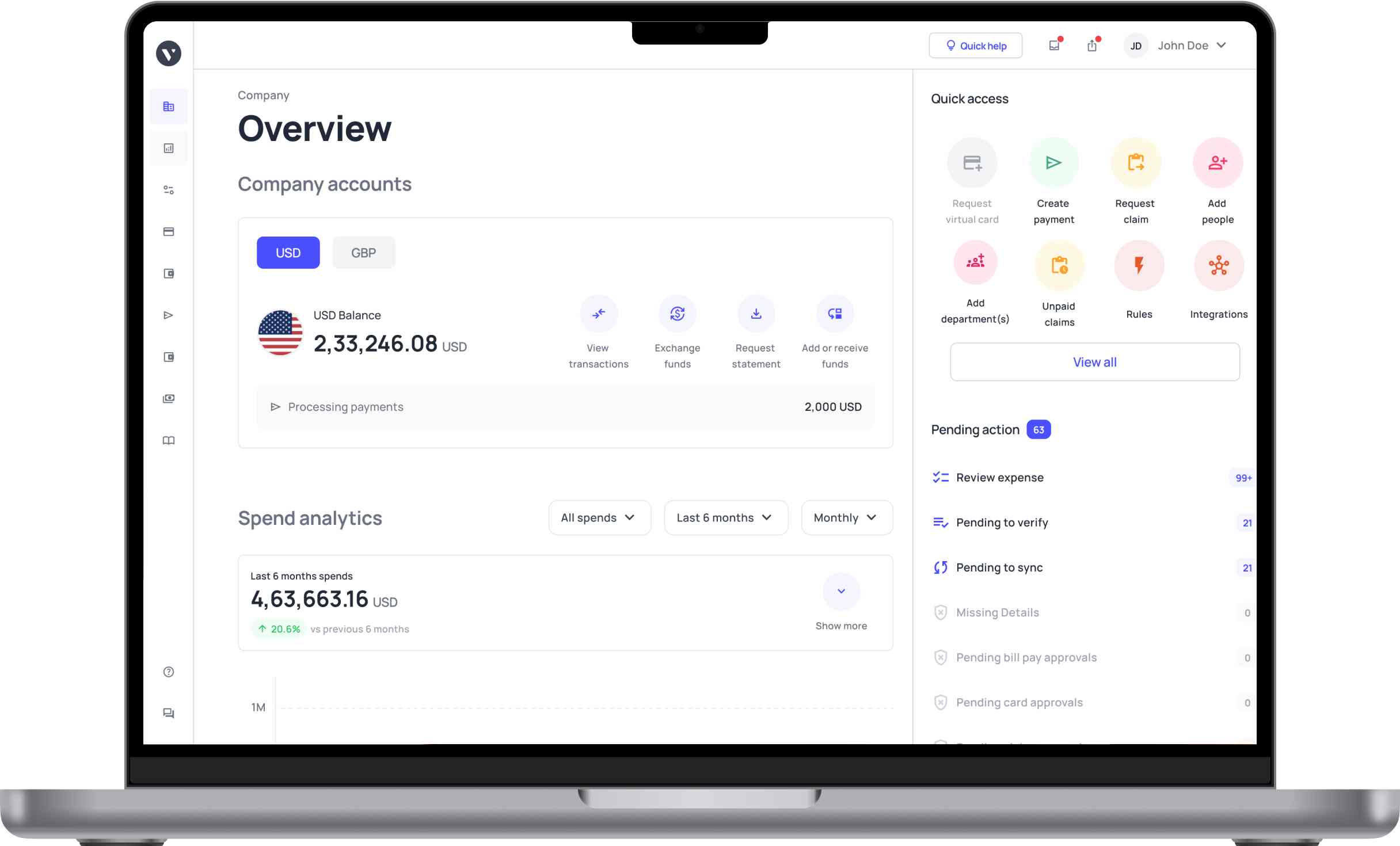
No more switching between multiple bank accounts and tools to run your smart business. We have combined great software with every service you are using a bank for, to produce a state-of-the-art financial platform, Volopay.
Less time spent on manual reconciliations
Faster month-end book closing turnaround
Accurate receipt matching with automation
FAQs
Airwallex is a global financial infrastructure platform built for cross-border payments, multi-currency accounts, and FX optimization. Aspire is an all-in-one SMB finance tool focused on business accounts, cards, and expense management for smaller teams.
Airwallex has lower FX fees. It offers more competitive exchange rates for businesses handling high volumes of international transactions. Aspire provides straightforward FX conversion but works better for smaller or less frequent cross-border payments.
Airwallex is better for multi-currency accounts. It supports businesses operating across multiple regions with complex currency needs. Aspire offers multi-currency support, too, but it is designed more for operational simplicity than advanced treasury management.
Yes, both platforms offer corporate cards. Airwallex cards are built for global teams and international spending. Aspire cards are better for startups managing employee expenses and budgets with straightforward spending controls and approvals.
Airwallex is stronger for international payments. It offers a wider global network, faster settlements, and more currency corridors. Aspire supports cross-border payments but is more suited for regional or limited international activity rather than large-scale global operations.
Aspire is better for SMBs in Southeast Asia. It is designed around regional startup workflows and localized finance needs. Airwallex is also active in the region, but it works better for businesses planning to scale beyond Southeast Asia into global markets.
Airwallex is better for accounting integrations. It connects with Xero, QuickBooks, and NetSuite, making it suitable for structured finance teams. Aspire integrates with common SMB accounting tools but focuses more on operational ease than deep enterprise system connections.
Aspire is better for predictable pricing. It offers simpler plans that work well for startups on tight budgets. Airwallex uses usage-based pricing that can be cost-efficient at scale but may vary depending on transaction volume and FX activity.
Aspire is better for early-stage startups. It is easier to set up, includes built-in expense tools, and is designed for smaller teams. Airwallex becomes the stronger choice once a startup begins scaling internationally and needs more advanced financial infrastructure.