Reduce unapplied cash with automation
Move supported receipts out of unapplied cash sooner. Volopay identifies payers, allocates payments across open invoices, and keeps unresolved differences tied to the evidence, owner, and next action.













Give every receipt a defensible next action
Matching confidence
Set thresholds around evidence quality, amount, entity, customer, and approval limits. Different accounting actions can require different certainty levels before execution, keeping higher-risk treatments behind the right review controls.
Customer context
Combine remittance, CRM and ERP relationships, historical allocations, and approved aliases before acting on uncertain account associations. Keep entity and currency boundaries intact when evaluating the correct customer relationship.
Exception workflows
Keep unresolved receipts aged and owned while agents request missing information, follow up with customers, and update the original case. New information can trigger fresh eligibility checks before further action.
Accounting treatment
Create receipts, on-account credits, approved adjustments, and other permitted documents using the customer's accounting structure and controls. Preserve supporting evidence and approvals with each accounting action for stronger auditability.
Multi-source payment capture
Bring bank activity, statement files, payment-provider reports and remittance into the same workflow. Preserve the original source and processing status so Australian finance teams can trace each receipt before allocation.
Difference investigation
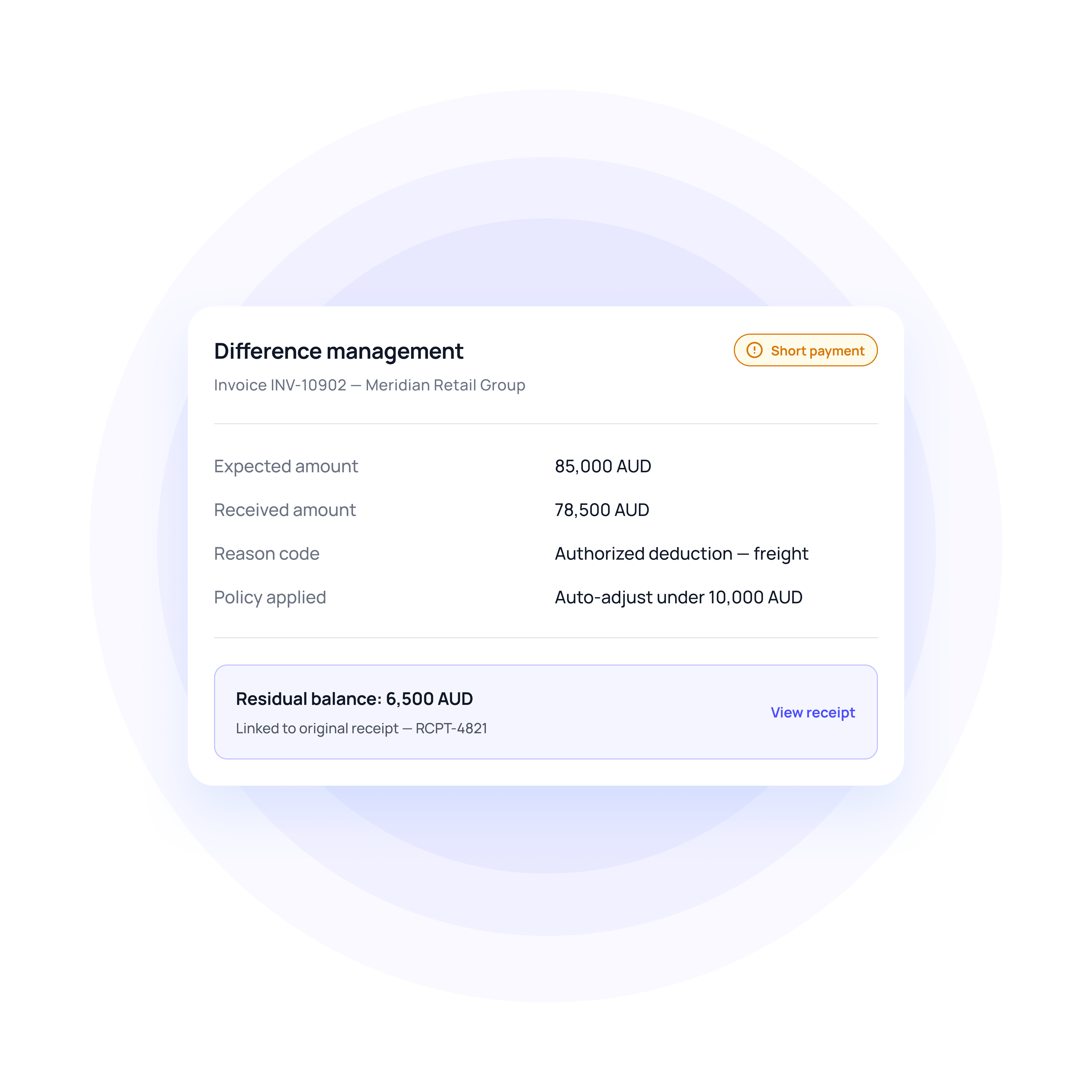
Investigate residual amounts using commercial terms, customer evidence, payment history, and approved policies. Clear portions can move forward while genuinely unresolved balances remain open.
ERP-native execution
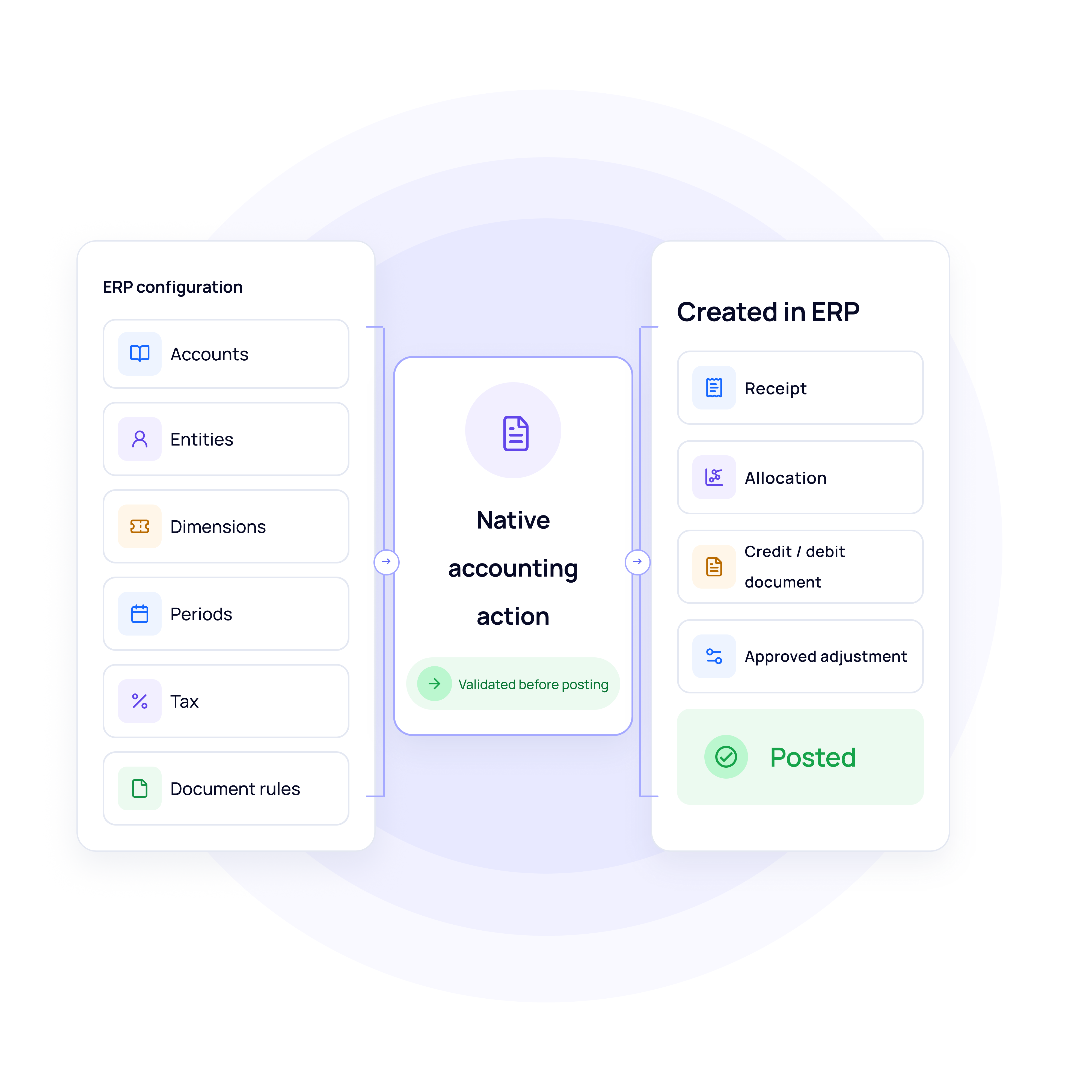
Work with the customer’s chart of accounts, legal entities, dimensions, periods, currencies and accounting rules. Create permitted accounting actions within those structures, then verify the resulting documents and balances before completing the workflow.
Clear cash faster. Keep every exception under control
The controls behind autonomous cash application
Action-level automation
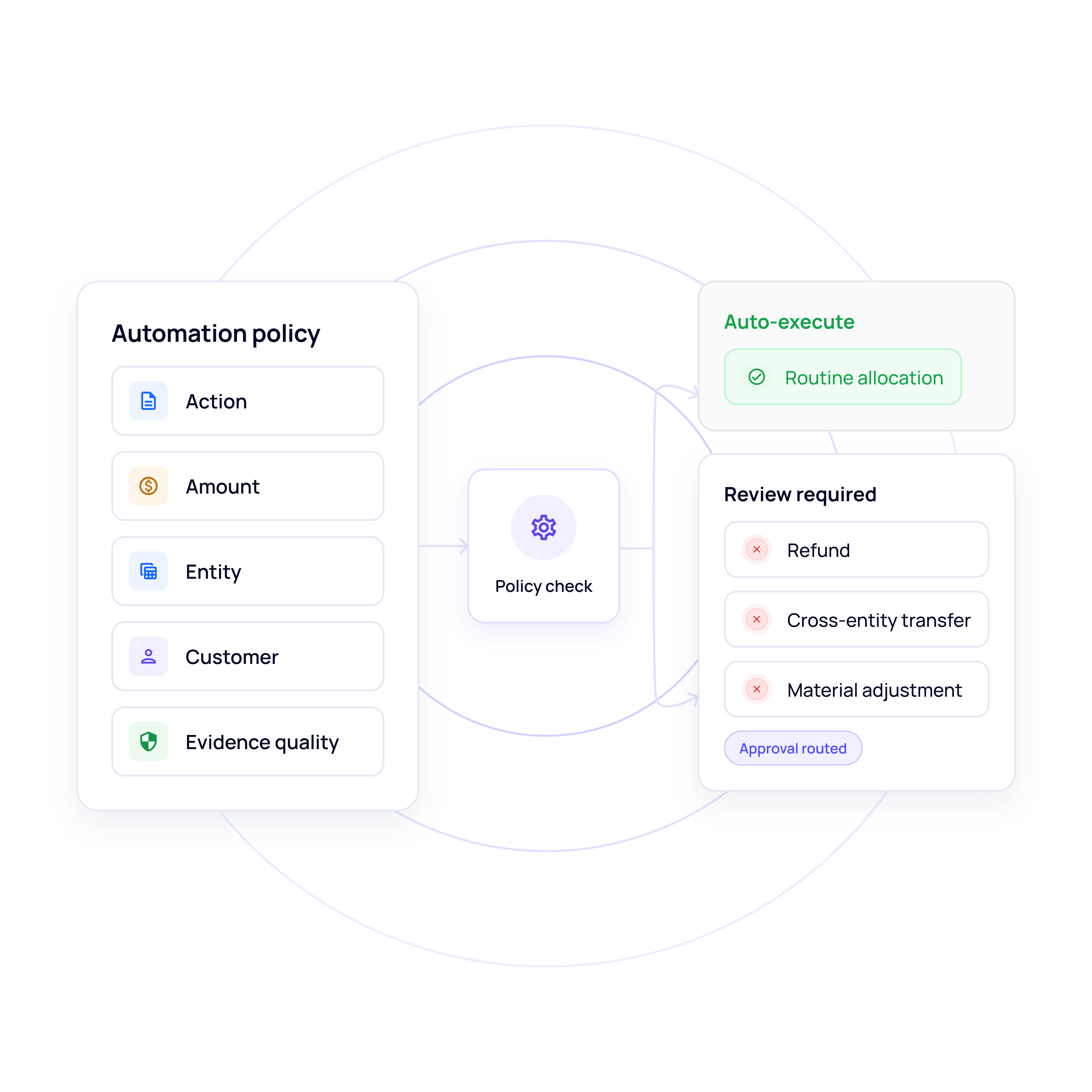
Set automation by amount, entity, customer, action, and evidence quality. Routine eligible work can proceed automatically, while sensitive adjustments, refunds, and cross-entity transfers stay behind review.
Posting recovery
A timeout does not mean the original write failed. Volopay checks for the existing transaction before retrying, then routes unresolved mapping, period, or permission issues to an owner.
Learning from approved work
Confirmed analyst corrections can inform suggested aliases, extraction improvements, and matching rules. Each proposed change shows its triggering examples and historical test impact before material rules reach production.
Reconciliation reporting
Track receipt-to-clearing time, unapplied cash ageing, automation coverage, exception mix, and posting quality. Reports can include filters, as-of dates, and links to source documents for operational review.
Automated cash application for complicated customer payments
An Australian parent company may settle invoices across subsidiaries or customer accounts. Use approved account relationships, remittance and open balances to identify the intended allocation without crossing entity or currency boundaries.
One receipt may cover several invoices, instalments, credits or accounts. Evaluate payment intent, current open balances, references and historical allocations together before applying the supported amount.
Provider payouts may combine customer receipts with processing fees and settlement adjustments. Keep the customer allocation separate from the provider settlement so finance does not mistake a net payout for a customer short-pay.
Centralised finance teams may handle cash application across several entities, customer portfolios and accounting structures. Keep permissions, allocation policies and exception ownership attached to each receipt while using a consistent operating process.
Australian businesses may collect in AUD while also receiving customer payments in other currencies. Separate exchange differences, bank fees and payment amounts using approved accounting rules before completing the allocation.
See how Volopay changes the cash application process
Manual operating model | The Volopay model |
|---|---|
Analysts often piece together payment information before deciding how to handle a receipt | Relevant payment records and customer context can be brought together before the next action is selected |
Unresolved work can sit in separate queues while teams chase information across functions | The workflow keeps the unresolved item attached to the original receipt as information and decisions change |
Rules may be applied broadly even when different financial actions carry different levels of risk | Automation can be configured differently by action, amount, entity, customer, and evidence quality |
Teams may need to create separate reconciliation work after a failed accounting transaction | Recovery stays within the same workflow, with the original transaction checked before another write is attempted |
They loved Volopay, you will too
FAQs
Volopay brings payment, remittance, invoice, and customer evidence together, then uses configured rules and permissions to recommend or execute eligible allocations. The workflow verifies the resulting accounting state before completion.
Yes. Volopay supports one-to-many and many-to-one allocations, consolidated remittances, instalments and eligible credit offsets. Before execution, it compares candidate allocations with current open balances to avoid applying cash against invoices finance has already cleared.
Volopay creates a linked request for the missing information and contacts the appropriate customer within the configured policy. New details update the original receipt, and the workflow reassesses the allocation using the additional evidence.
Volopay applies supported cash while keeping the residual open for investigation. For overpayments, finance can keep the excess on account or move it through an eligible credit process. Refund approval and payment remain separate decisions.
The system presents the uncertainty or requests additional remittance rather than forcing an exact-looking allocation. Matching recommendations can use configured confidence thresholds and approval limits.
Finance can require review based on the action, amount, entity, customer or evidence quality. Sensitive adjustments, refunds, cross-entity transfers and other higher-risk accounting decisions stay within the appropriate approval boundaries.
Bring Volopay to your business
Get started now