Make cash application easier to manage
One residual should not hold an entire receipt hostage. Progress the supported amount while the exception follows its own path.














Match with evidence, not assumptions
Payment and customer context
Receipts, remittance, invoices, and customer context are assembled before allocation, with the original source documents preserved.
Payer and account identification
Bank details, names, remittance, CRM and ERP relationships, historical allocations, and approved aliases identify the payer without merging unrelated accounts.
Rules-based matching
Configure reference normalization, allocation priority, tolerances, account relationships, confidence thresholds, and approval limits. Each suggestion shows its supporting receipt, remittance line, and invoice.
Complex payment allocation
Support one-to-one, one-to-many, many-to-one, installment, consolidated-remittance, and eligible credit-offset payments. Check candidate allocations against current open balances before execution.
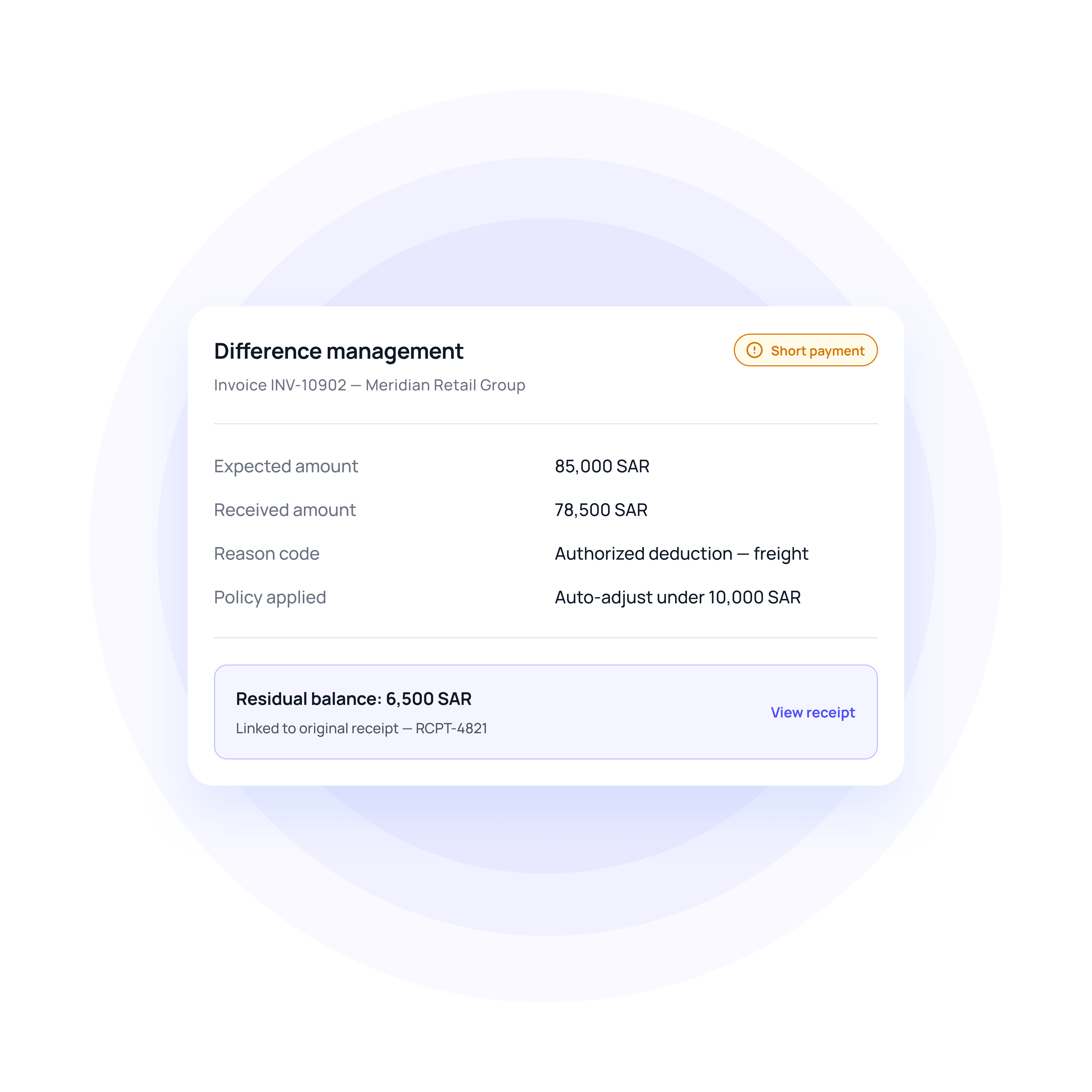
Difference management
Separate short payments, overpayments, commercial deductions, withholding-related differences, fees, and eligible currency differences. Apply the supported amount while keeping each residual tied to the original receipt until finance confirms its treatment.
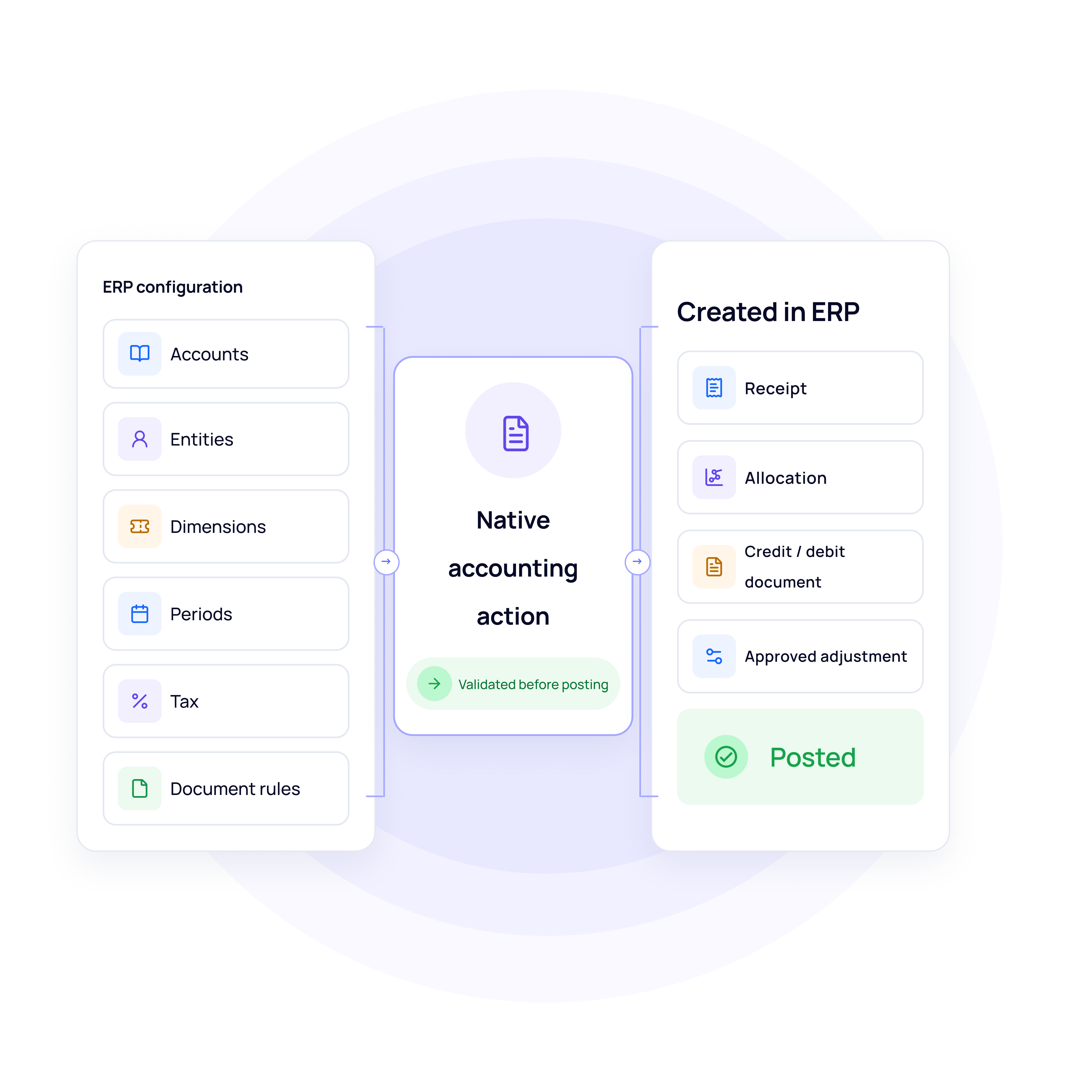
ERP-native execution
Volopay can work within the customer’s chart of accounts, entities, dimensions, periods, tax configuration, and document rules to create permitted accounting entries and adjustments.
Read-back verification
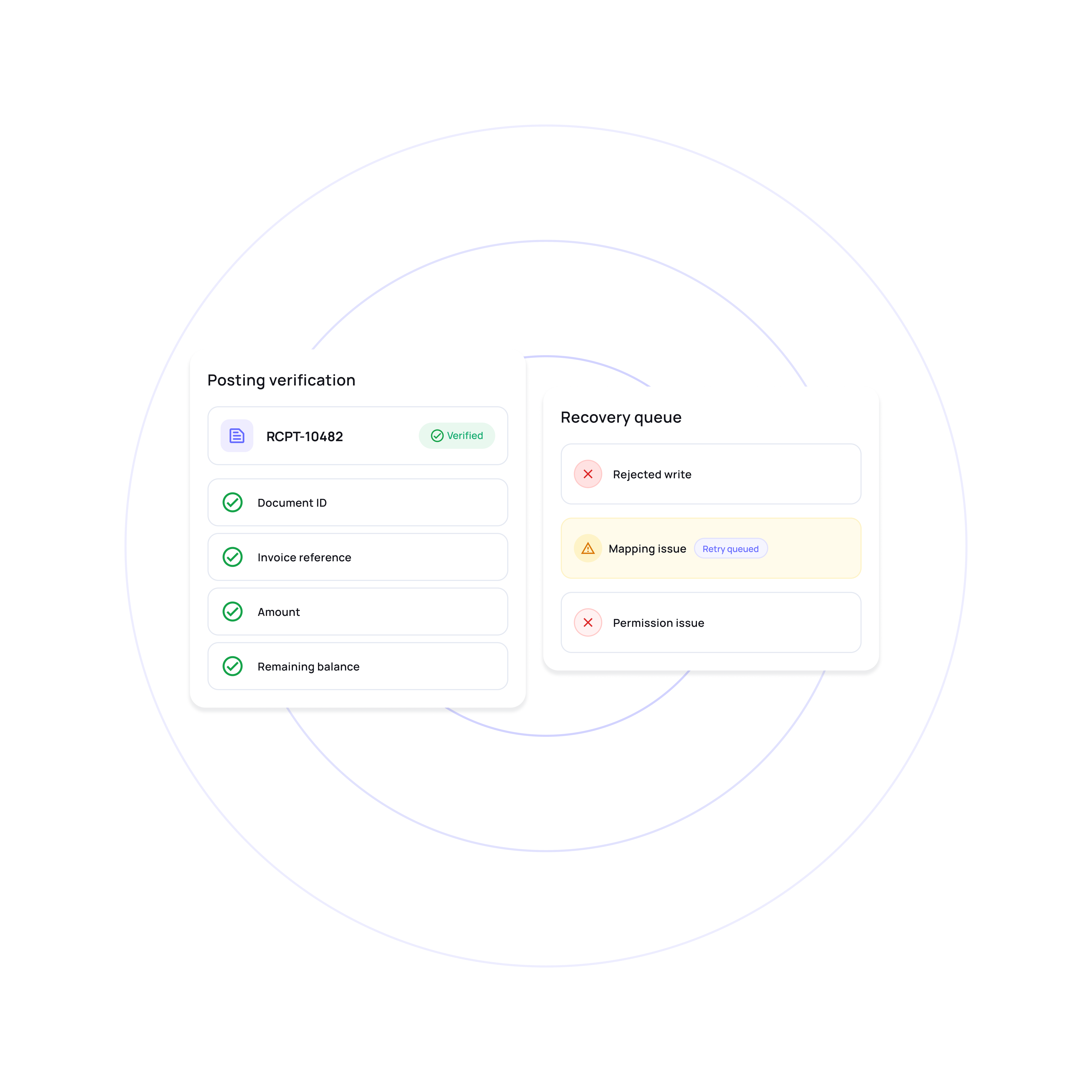
After each accounting action, Volopay checks document IDs, customer and invoice references, amounts, and remaining balances. Rejected writes, timeouts, and mapping or permission issues are recorded for resolution.
Clear cash faster. Keep every exception under control
Keep application outcomes accountable
Application audit trail and transaction tracking
Each application can retain its source evidence, allocation rationale, selected policy, reviewer, accounting action, and final ERP read-back. Corrections and failed attempts remain visible.
Reviewed matching improvements
Analyst-approved corrections can surface opportunities to improve payer aliases, extraction, or matching logic. Material rule changes stay subject to approval.
Performance visibility
Track how long receipts take to clear, why cash remains unapplied, which exceptions recur, and where posting issues appear.
Reconciliation reporting
Reporting agents can produce summaries with as-of dates, filters, and document links to support finance review without rebuilding the history manually.
Cash application for complex payment flows
Saudi B2B payments may arrive with remittance through separate bank records, spreadsheets, portals, or customer messages. Keep those sources connected to the same receipt while finance identifies the intended allocation.
A parent company or regional treasury team may pay invoices for several subsidiaries. Use approved account relationships, bank data, remittance, and aliases to identify the intended customer while preserving entity and currency boundaries.
Saudi businesses may collect in SAR while also receiving payments in other currencies. Keep customer payments, bank fees, and eligible currency differences distinct before completing the allocation.
From payment matching to verified application
Traditional cash application workflow | The Volopay cash application approach |
|---|---|
Payment and remittance data may arrive through separate sources and need to be reconciled manually | Volopay can bring receipt data, remittance, and customer context into the same application record while preserving the original source evidence |
Payer identification may rely heavily on names, references, or prior analyst knowledge | Volopay can use bank details, remittance, approved aliases, historical allocations, and account relationships to support payer identification |
Complex payments may require separate investigation before they can be allocated | One-to-many, many-to-one, installment, consolidated-remittance, and eligible credit-offset scenarios can be assessed against current open balances |
Short payments, deductions, fees, and overpayments may remain unresolved after the initial match | Supported amounts can move forward while residual differences stay linked to the receipt and follow the appropriate treatment |
A successful system response may be treated as enough proof that posting completed correctly | Volopay can read back the resulting accounting state, verify the expected allocation and balance, and keep failed or uncertain writes visible for recovery |
They loved Volopay, you will too
FAQs
Volopay can bring receipts, remittance, invoice data, and customer context together, then apply configured matching and allocation rules. Cases with insufficient evidence can remain open for investigation or review instead of being forced through automatically.
Yes. Volopay supports one-to-one, one-to-many, many-to-one, instalment, consolidated-remittance, and eligible credit-offset scenarios. Candidate allocations are checked against current open balances before execution.
Volopay creates a linked request when allocation evidence is incomplete. Agents ask for the specific invoice reference or payment advice, update the same receipt when new information arrives, and reassess the allocation using the additional evidence.
Volopay applies the supported amount while keeping the residual open for review. Finance can distinguish deductions, discounts, withholding-related differences, fees, and errors using available evidence. Overpayments can remain on account or follow an eligible credit process, while refund approval and payment stay separate.
When more than one allocation remains plausible, Volopay can surface the uncertainty or request additional remittance. Cases that do not meet the configured evidence or confidence threshold can move to finance review.
Finance can require review based on action, amount, entity, customer, or evidence quality. Sensitive adjustments, refunds, cross-entity transfers, and other restricted accounting actions remain behind the appropriate approval controls.
Bring Volopay to your business
Get started now