Tipalti vs. Stripe: Which platform to choose?
Manual AP processes are a major source of payment errors. If you're evaluating Tipalti vs. Stripe, the two platforms address different parts of the payment stack: Tipalti is built for accounts payable and supplier payments, while Stripe is built for payment acceptance and financial infrastructure. Pick the wrong one, and you may end up filling gaps with custom workflows or workarounds.
This guide helps you choose the right fit for your operation.











REVIEWED BY

Akanksh Muniyappa
Head of Product
WRITTEN BY

Mahasweta Bose
Content Writer
Quick summary: Tipalti vs. Stripe
Tipalti and Stripe are both best-in-class platforms. But they are built for entirely different jobs. If your core need is paying vendors, automating AP workflows, and managing global supplier compliance at scale, Tipalti is the stronger fit.
If you need to accept payments, manage subscriptions, or build payment infrastructure into your product, Stripe wins. Businesses that need both pay-in and payout capability may need to use them together.
| Key factors | Tipalti | Stripe |
|---|---|---|
Primary purpose | Outbound AP automation & mass vendor payouts | Inbound payment acceptance & billing infrastructure |
Best for | Mid-market to enterprise finance teams | Startups, SaaS, and e-commerce businesses |
AP automation | End-to-end, purpose-built | Not available |
Invoice processing | OCR, PO matching, touchless workflows | Basic billing invoices only |
Global payouts | 196 countries, 120 currencies | 46 countries, fees apply |
Payment acceptance | Not available | Cards, wallets, local methods |
Vendor management | Self-service portal, tax compliance, OFAC | Requires custom development |
Corporate cards | Limited | Stripe Issuing |
AR subscriptions & billing | Not available | Best-in-class |
ERP integrations | Deep, bidirectional (NetSuite, SAP, Oracle) | Revenue-side focus |
Pricing | From $99/month | From $0.30/transaction |
Setup time | 4–6 weeks | Minutes |
Security | PCI, SOC, KPMG tax engine, OFAC screening | PCI DSS L1, SOC 2, ISO 27001 |
Ideal company size | 50–5,000+ employees | 1–5,000+ employees |
Tipalti
Tipalti was built to solve a clear pain point: the high cost and effort of paying global suppliers at scale. It has since evolved into a full-suite global AP automation and mass payments platform, trusted by over 5,000 mid-market and enterprise companies.
It processed $70 billion in payments in 2024. Best for finance teams managing high-volume vendor, contractor, or affiliate payments across borders.
| Pros | Cons |
|---|---|
End-to-end AP automation (OCR, PO matching, approval workflows) | Steep learning curve for new users |
Covers 200+ countries across 120 currencies | Implementation can take 4–6 weeks |
Built-in tax compliance (W-9/W-8, 1099, OFAC screening) | Reported ERP sync issues (notably NetSuite) |
66% reduction in payment errors via 26,000+ validation rules | Starts at $99/month, which is not ideal for small businesses |
Stripe
Stripe started as simple code that turned weeks of payment integration into minutes. It has grown into a developer-first global payments infrastructure platform, processing over $1.4 trillion in 2024.
Best for startups, SaaS companies, e-commerce platforms, and any business that primarily needs to accept payments and not manage AP.
| Pros | Cons |
|---|---|
Best-in-class API and developer documentation | Not built for AP automation or mass outbound payments |
Supports 135+ currencies; operates in 50+ countries | Account freezes/fund holds with limited recourse reported |
No monthly fee; transparent pay-as-you-go pricing | Fees compound quickly at scale |
Covers pay-ins, subscriptions, billing, fraud detection (Radar), and in-person payments | Customer support gaps for non-enterprise users |
In-depth comparison: Tipalti vs. Stripe
Which tool is right for you?
Tipalti
Tipalti is best for finance teams handling high-volume cross-border payments to vendors, contractors, and affiliates.
Stripe
Stripe is best for startups, SaaS companies, e-commerce businesses, and organizations focused on accepting payments rather than managing AP.
Get your team working with Volopay
Key factors to consider in choosing the right product for you
AP automation & workflow
If your finance team has to handle high volumes of vendor payments each month across multiple approval levels, a robust AP automation system isn't an option anymore. It's essential for accuracy, speed, and audit readiness. Make sure you choose an expense management system that allows for all the different AP requirements your business has.
Invoice processing & management
Businesses processing hundreds of invoices monthly across multiple entities need a platform that can capture, match, route, and reconcile invoices automatically without custom development. If your business falls into this category of payment needs, then you should make sure that the platform you choose has payment scheduling capabilities, recurring payments, and the ability to make bulk payments.
Payment processing & infrastructure
Consider whether your primary need is to send or receive money, or both. Businesses accepting customer payments need a different infrastructure than those paying out to vendors. Choosing the wrong tool for your dominant flow creates expensive gaps that can lead to inefficient budget utilization.
Global payouts & multi-currency support
Companies with international vendor or contractor networks need a platform with broad currency support, local payment methods, and built-in validation to reduce failed transactions. Having a system that lowers your overall charges, be it FX markups or any other fees, should be your priority if there is a consistent need to make payments to other businesses.
Vendor & supplier management
Businesses managing large, ongoing vendor networks need self-service portals, automated tax form collection, and payment status visibility to reduce administrative overhead. Make sure that the expense management platform you are choosing is capable of creating automations to reduce manual work dealing with hundreds and thousands of vendors.
Reporting & analytics
Financial decision-making depends on timely, accurate spend data. Whether you're a CFO tracking AP liability or a growth team monitoring revenue, your platform's reporting depth needs to match your team's oversight requirements and ERP workflows.
Pricing & plans
Choosing a software to manage your expenses or receive payments will depend on your revenue model to some degree. Eg: If a platform offers its services at a monthly flat subscription fee, then a business with high-volume operations would benefit from it as compared to a pay-as-you-go model. On the other hand, early-stage businesses with variable transaction counts are better served by pay-as-you-go structures.
Accounting & ERP integrations
Having finance tools that are disconnected end up creating reconciliation headaches and audit risk. Businesses running established ERP systems need a payment platform that syncs bidirectionally in real time to eliminate manual data entry and maintain financial accuracy.
Company budget & size
The complexity of the platform you choose and its cost should match your operational scale. A tool that is built for enterprise AP workflows will overwhelm a small team; equally, a lightweight payments tool will buckle under the demands of a mid-market finance operation.
Customer support & onboarding
Implementation quality directly impacts time-to-value and team adoption. Businesses with limited technical resources or tight timelines need a platform that can offer hands-on onboarding support rather than just documentation.
Security & compliance
Financial platforms handle sensitive data, so it is no surprise that they must meet stringent regulatory standards for the safety of the customers using the platform. You should check that the platform you choose has certifications like PCI DSS, SOC 2, and built-in tax compliance tooling to satisfy both internal controls and external audits.
Alternatives to Tipalti and Stripe
Tipalti and Stripe are strong platforms, but neither is a universal fit. Tipalti can be too complex and costly for growing teams, while Stripe lacks the AP and vendor management depth many finance teams need. If you're looking for a more unified, accessible solution, the following alternatives are worth considering:
Volopay
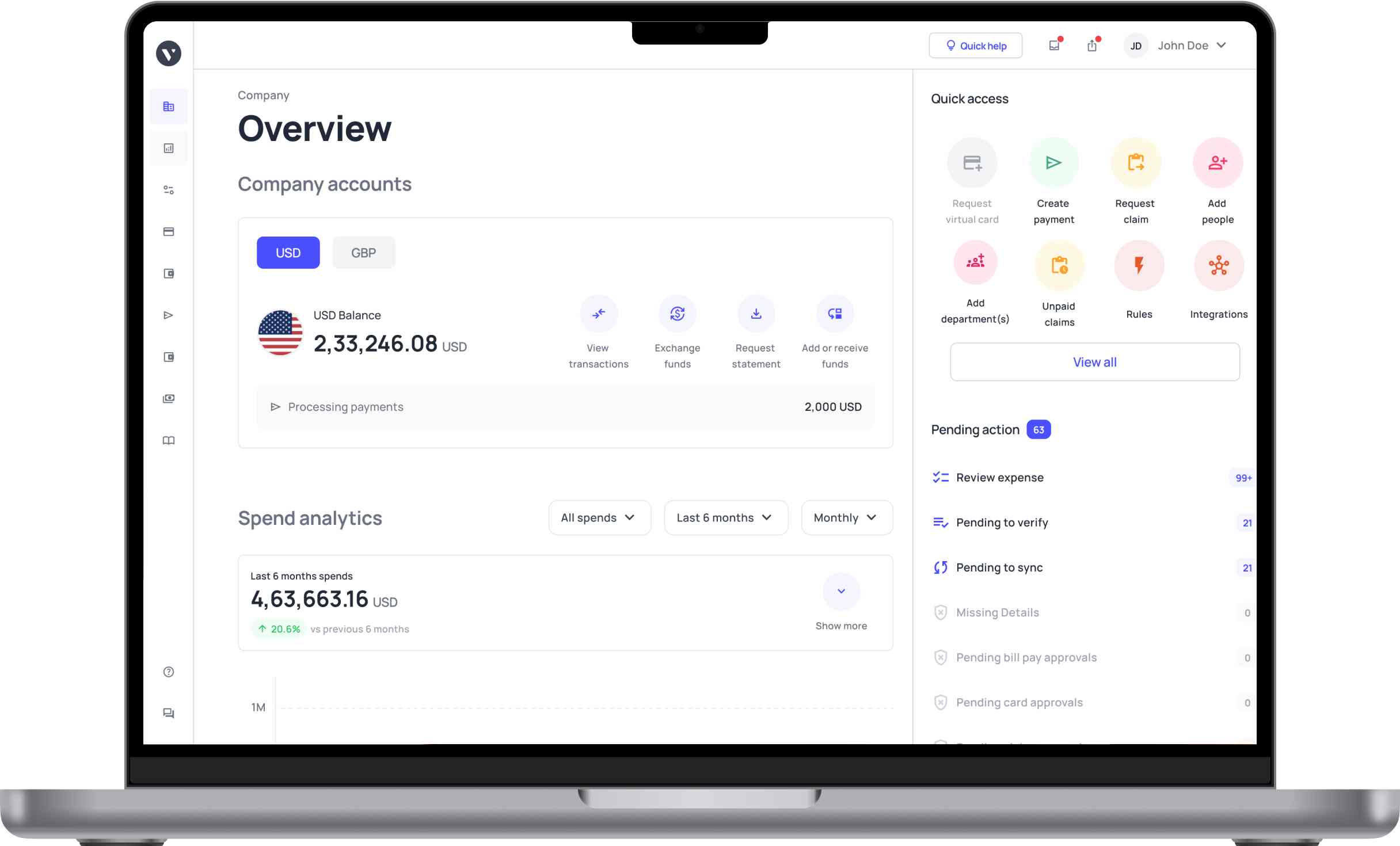
An all-in-one spend management platform combining AP automation, corporate cards, bill payments, expense reimbursements, and multi-currency payments in a single dashboard. Its dedicated procurement module ensures that you can manage and pay your vendors throughout the procurement lifecycle without any technical hiccups. It also allows businesses with multiple entities in different countries, set up separate accounts to handle their finances independently while still keeping everything on one platform.
All of these functionalities are also available on Volopay’s Android & iOS mobile app, making it easier for teams to manage their budgets and company spending wherever they are. The platform is best suited for scaling mid-market businesses that want breadth without enterprise complexity. The platform is region- agnostic as it can handle and carry out payments globally with support for 65+ currencies in over 180 countries.
BILL (formerly Bill.com)
Strong for SMBs needing both AP and AR management in one place, with solid approval workflows. BILL has evolved from a niche AP tool into an AI-powered financial operations platform, unifying AP, AR, expense management, and credit access in one solution. Key features include electronic invoice receipt, automated data extraction, customisable approval workflows, multi-method payment processing (ACH, wire, checks), and corporate card integration via BILL Spend & Expense.
Its AI engine has been trained over a large set of payment data, enabling intelligent invoice capture and fraud detection. This makes it ideal for businesses that need reliable and accurate automation for vendor payment processing. It is also great for SMBs and accounting firms managing both payables and receivables that want a proven, all-in-one AP/AR platform with deep QuickBooks and Xero integration.
Ramp
AI-led AP automation with a modern UX, ideal for teams prioritizing speed and a touchless invoice experience. With accurate OCR and intelligent line-item capture, Ramp delivers touchless invoice processing that is faster than legacy AP software. Its core platform is free, with revenue generated from interchange.
The platform is most suited for venture-backed startups and mid-market finance teams that prioritise speed, AI-driven cost savings, a modern UX, AP capabilities, corporate cards, and expense management unified without a heavy implementation lift.
They loved Volopay, you will too
Financial stack for business
No more switching between multiple bank accounts and tools to run your smart business. We have combined great software with every service you are using a bank for, to produce a state-of-the-art financial platform, Volopay.
Less time spent on manual reconciliations
Faster month-end book closing turnaround
Accurate receipt matching with automation
FAQs
Tipalti is built for outbound AP automation and global vendor payments. Stripe is built for accepting payments. They solve different financial problems and rarely compete for the same use case.
Tipalti is better for global payouts. It covers 196 countries across 120 currencies and gives deep tax compliance across regions, versus Stripe's 46 payout-supported countries. This makes Tipalti the better choice for high-volume mass payouts.
No, Stripe has no native AP module, invoice processing, or vendor management workflows. Businesses that need structured AP automation would require significant custom development to replicate Tipalti's functionality using Stripe.
Tipalti offers OCR scanning, PO matching, and touchless invoice workflows built for AP finance teams. Stripe handles basic invoicing for billing customers but it is not designed for complex B2B AP invoice management.
Tipalti is the clear choice for vendor payments due to its self-service supplier onboarding, automated tax compliance, and OFAC screening. Stripe's vendor payout capabilities via Stripe Connect require considerable custom engineering work.
Tipalti starts at $99/month, suited for mid-market and enterprise teams. Stripe charges $0.30 per transaction with no monthly fee in the US, making it more accessible for startups and lower-volume businesses.
Stripe is better for startups as it does not have any monthly fees. It offers instant setup, and a pay-as-you-go pricing model making it accessible immediately. Tipalti's cost and 4–6 week onboarding timeline are better suited for established finance teams that need more focus on AP functionalities.
Tipalti offers better ERP integrations. It has deeper, bidirectional ERP integrations across NetSuite, SAP, Oracle, Xero, and QuickBooks, purpose-built for AP workflows. Stripe's integrations are solid but oriented toward revenue recognition and receivables, not payables.
Volopay is a strong alternative, combining AP automation, corporate cards, expense management, and global payments in one unified platform without Tipalti's complexity or Stripe's AP limitations. BILL is a good alternative for those looking for both AP and AR features in a unified system. Ramp is a great alternative for teams looking for a simple and intuitive way to manage their budgets and reduce costs through AI workflows.