Simplifying AR automation for finance controllers
Volopay lets you move expense control upstream. Set spending limits, route approvals, and track expenses as transactions happen, reducing policy violations and reconciliation work finance handles later.














Greater control across every stage of receivables
Clearer visibility into AR exposure
Get a consolidated view of aging balances, unapplied cash, and open disputes across entities. See which amounts remain collectible, what's holding them up, and who owns the next action.
Faster reconciliation, fewer exceptions
Match incoming receipts against invoices and reconcile your AR subledger with the general ledger control account. Identify differences entry by entry, with likely causes, so your team knows exactly what needs investigating.
Fewer manual AR interventions
Let AI Finance Agents handle routine collections, payment matching, and exception follow-ups within your approved policies. Your team steps in when a decision requires judgment, authorization, or additional evidence.
Continuous AR close readiness
Stay ahead of month-end with ongoing cut-off checks, adjustment approvals, and exception tracking. Review the close checklist, collect sign-offs, and lock each receivables period with a frozen aging report and supporting records.
Keep billing aligned with approved contract terms
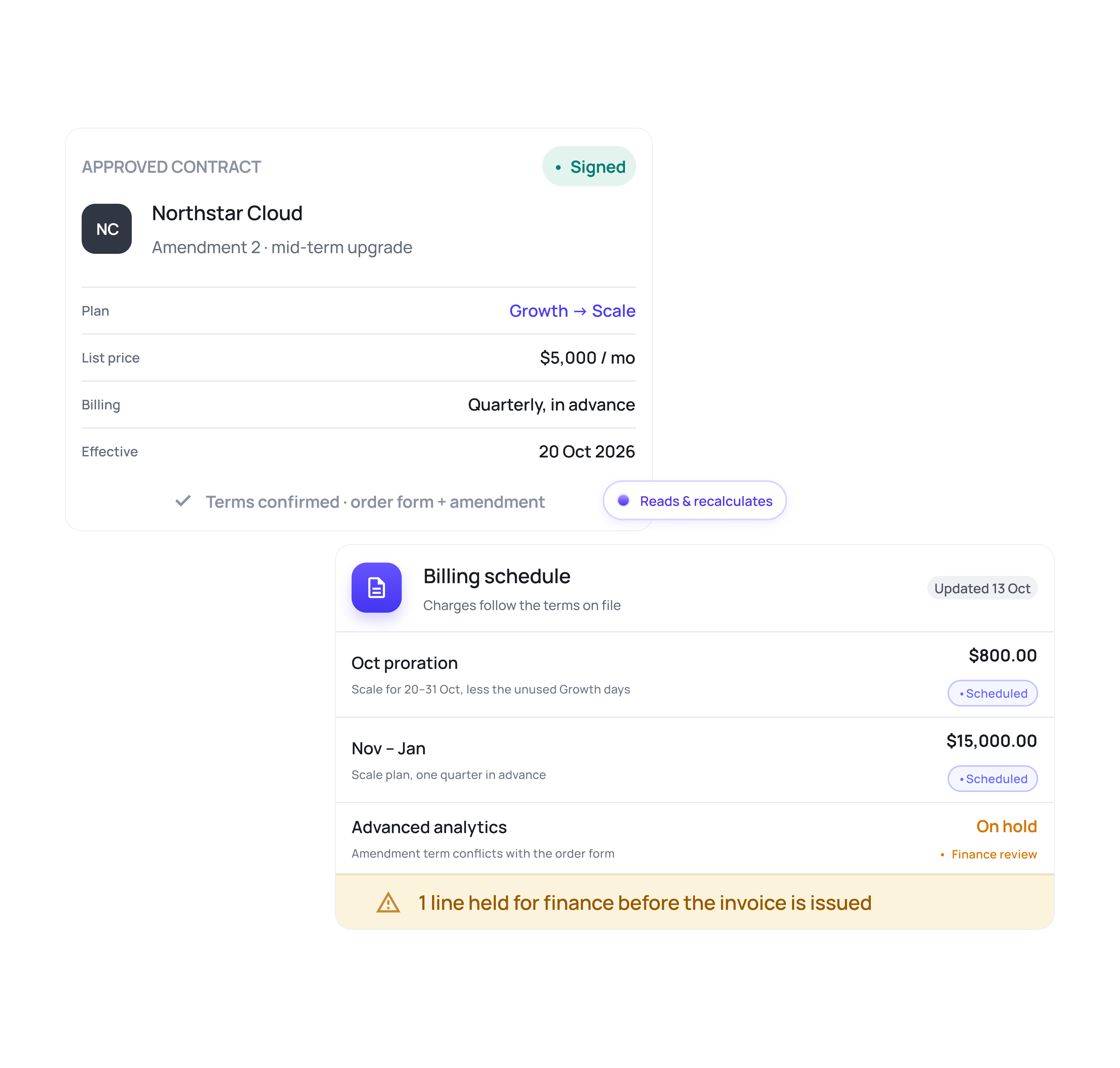
Volopay builds billing schedules around approved contracts, including pricing changes, milestones, and amendments. Say a customer upgrades their subscription mid-contract.
Volopay checks the revised terms, calculates the applicable charges, and updates future billing. Any conflicting or unclear terms go to finance for review before invoices are issued.
Keep every adjustment within approval limits
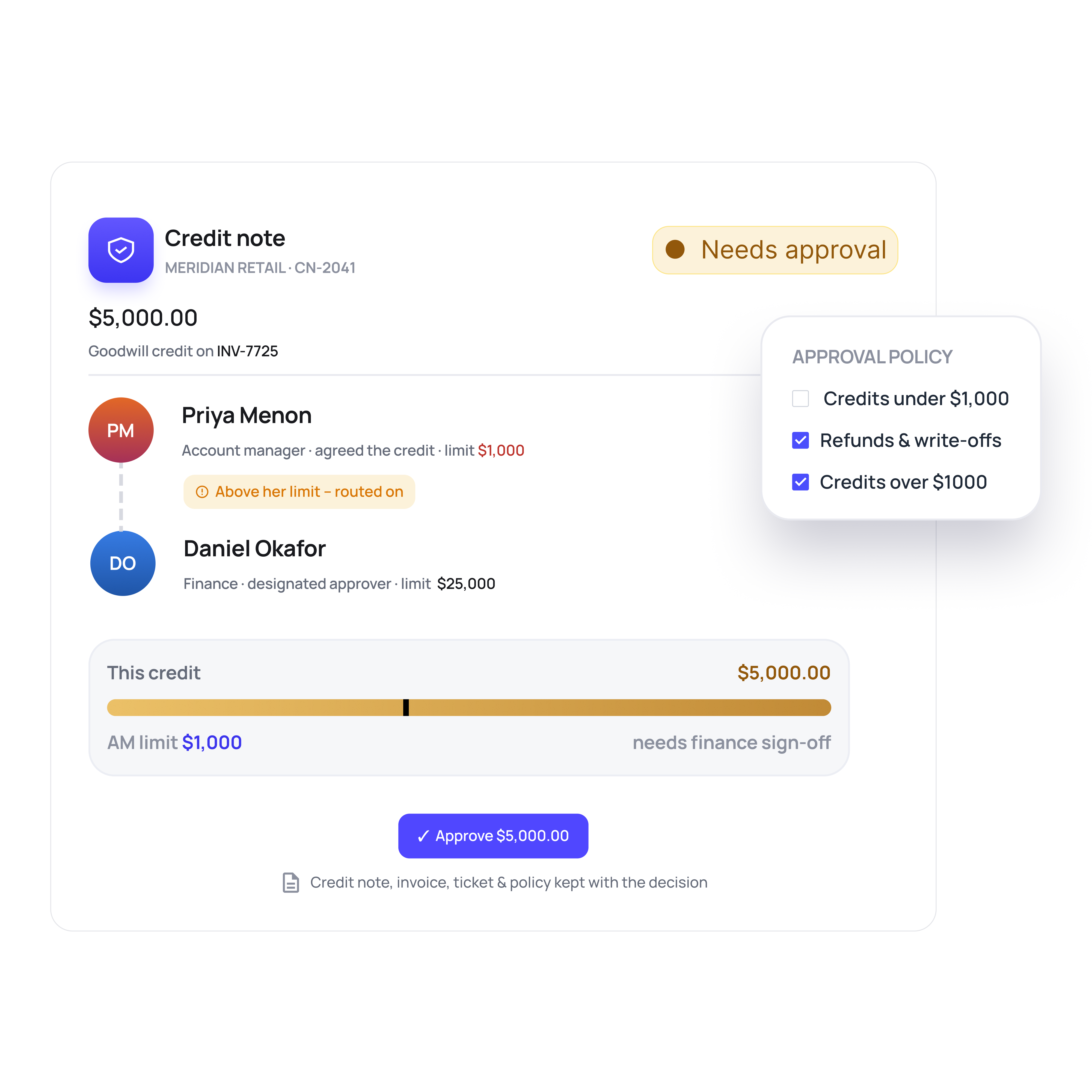
Credit notes, refunds, and write-offs follow your company's configured approval thresholds.
Suppose an account manager agrees to a $5,000 credit beyond their authority. Volopay routes the request to the designated approver before posting, retaining the supporting documents, decision history, and authorization details for subsequent review.
Bring more accuracy to bad-debt provisioning
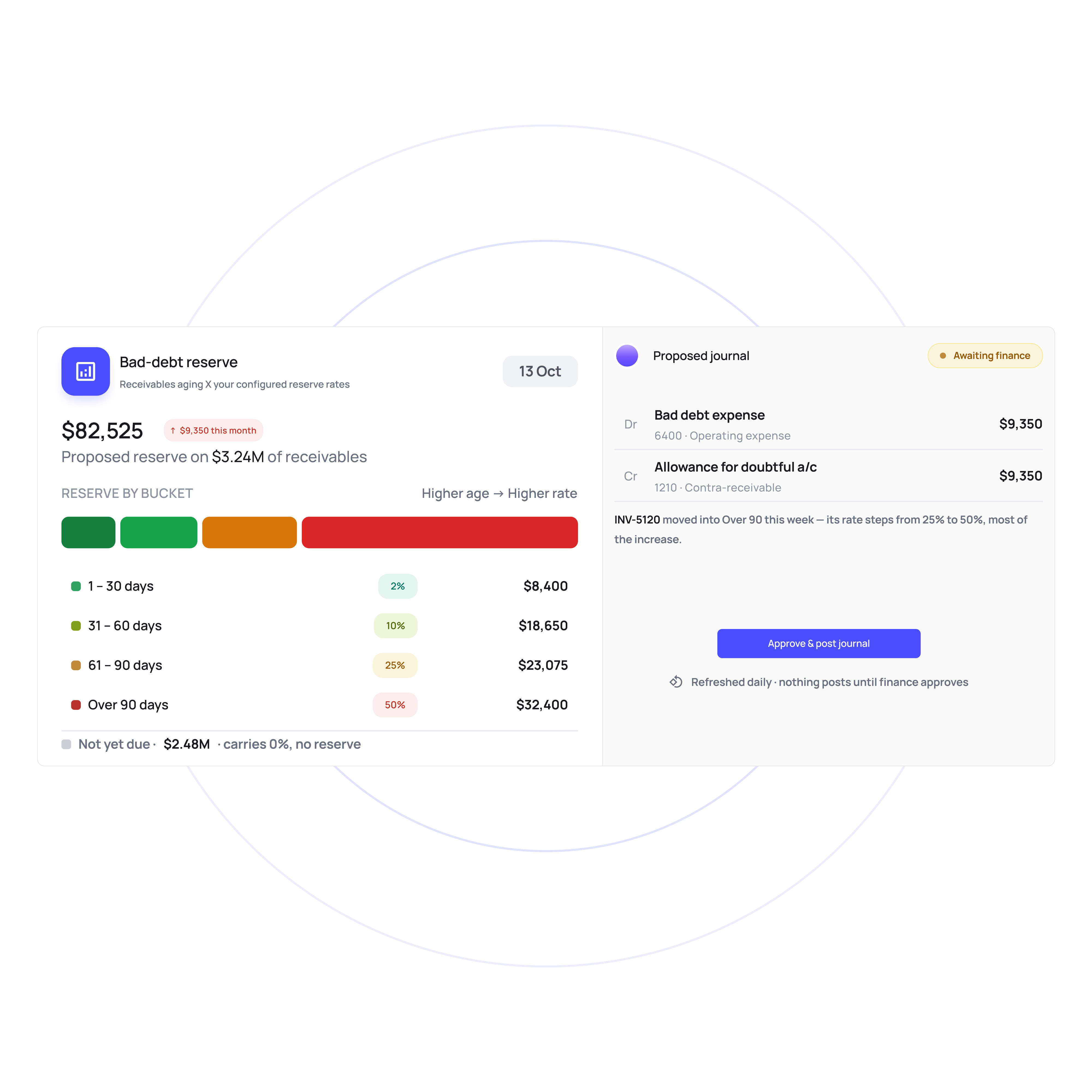
Volopay calculates proposed bad-debt reserves using receivables aging and your company's configured reserve rates. When an overdue invoice moves into a higher-risk aging bucket, the reserve calculation reflects the applicable rate.
Finance can review the proposed journal, assess recoverability, and approve the adjustment before it enters the accounts.
Turn complex receivables into seamless workflows
More AR and financial control capabilities for controllers
Revenue recognition and roll-forward reporting
Track deferred and unbilled revenue through schedules built from approved contract terms. Volopay prepares period-level revenue roll-forwards and ties the balances to their respective accounts.
Controllers can review revenue movements, identify discrepancies, and maintain supporting records without rebuilding calculations in spreadsheets. Accounting-policy decisions remain with finance.
ERP posting and sync monitoring
Track accounting entries as they sync from Volopay to your ERP, including failed postings, retries, and subsequent record changes. Each entry retains its accounting reference and coding.
Controllers can identify transactions that failed to post or were modified afterward, making it easier to investigate inconsistencies between systems.
Customer balance confirmation
Send account statements directly to customers to confirm outstanding receivables and identify balance discrepancies. Volopay captures customer responses within the corresponding account record, keeping confirmations connected to the underlying receivables.
This gives controllers documented customer feedback when investigating disputed balances or validating amounts reported in the AR subledger.
Controlled period reopening
Protect closed receivables periods from unauthorized changes with period-level posting restrictions. Once locked, transactions cannot be edited, posted, or backdated into that period.
If corrections become necessary, only an administrator can reopen it with a recorded reason, preserving accountability for changes made after financial sign-off.
AR automation for everyday challenges faced by controllers
A missing purchase order or incorrect contract rate can delay payment.
With billing automation, finance can validate invoice details against approved agreements, check customer requirements, and flag missing information before an invoice reaches the customer.
A single customer payment may cover multiple invoices or arrive without complete remittance details.
Cash application automation helps identify payers, allocate supported amounts, and investigate residual balances while keeping unresolved exceptions visible for review.
When customers short-pay invoices, the difference needs an explanation before finance can determine the appropriate treatment.
Disputes and deductions management connects claims with supporting evidence, routes decisions to authorized owners, and tracks resulting credits or recoveries.
Why finance controllers use Volopay to stay in control of AR
Traditional AR management | With Volopay |
|---|---|
Fragmented receivables visibility: Aging, disputes, unapplied cash, and customer commitments sit across spreadsheets, emails, and accounting systems. | Connected AR oversight: Review outstanding balances, payment status, disputed amounts, and exceptions across billing entities, with clear ownership and next actions. |
Manual collection follow-ups: Teams work through overdue lists and customer emails, with limited context on payment blockers or previous commitments. | Context-driven collections: AI Finance Agents use payment history, promises, disputes, and customer responses to progress permitted follow-ups and escalate exceptions. |
Time-consuming reconciliation: Finance investigates unmatched receipts and traces AR-to-GL differences across multiple records. | Traceable reconciliation: Match supported payments to invoices, identify discrepancies entry by entry, and review likely causes before resolving outstanding balances. |
Reactive month-end preparation: Unapplied cash, unapproved adjustments, and unresolved posting differences accumulate until the reporting deadline. | Continuous close readiness: Track outstanding close tasks throughout the period, with cut-off checks, approval workflows, sign-offs, and a frozen aging report at close. |
Uncertain collections forecasts: Expected receipts rely on invoice due dates, historical averages, and manually updated spreadsheets. | Evidence-based collections forecasting: Review a 13-week forecast refreshed daily using customer payment patterns, promises, disputes, and portal status, with invoice-level explanations. |
Limited control over adjustments: Credit notes and write-offs require manual approval tracking, making authorization history difficult to reconstruct. | Policy-based financial controls: Route adjustments through configured approval limits and retain supporting evidence, recorded decisions, and authorization history. |
They loved Volopay, you will too
Built to work with your finance systems
Connect Volopay with your existing ERP, banking, and communication systems to keep receivables workflows connected. Your financial records will stay in your ERP, while Volopay coordinates billing, collections, and cash application across systems.
Connect to:
● ERP and accounting: NetSuite, SAP, Oracle, Microsoft Dynamics, QuickBooks, Xero, Sage
● Email and messaging: Gmail, Outlook
● Customer AP portals: Coupa, SAP Ariba, Tungsten
● Banking: Bank feeds and virtual accounts




FAQs
Yes. Volopay uses AI Finance Agents to manage routine billing, collections, cash application, and dispute workflows. Agents follow configured policies, handle permitted actions, and escalate exceptions requiring human judgment, helping controllers reduce manual oversight without giving up financial control.
Volopay keeps receivables close-ready by applying cash, checking cut-offs, tracking pending adjustments, and reconciling AR balances throughout the month. Controllers can review outstanding exceptions, approve adjustments, collect sign-offs, and lock the receivables period with supporting reports.
Controllers can configure approval thresholds, assign responsibilities, and monitor exceptions across AR workflows. Volopay routes material decisions to authorized people, maintains supporting evidence, and records approvals, helping finance enforce established controls while routine work progresses.
Volopay provides visibility into outstanding receivables, payment commitments, disputes, and unapplied cash. Its 13-week collections forecast refreshes daily using customer payment history and current AR activity, helping controllers understand expected customer inflows and identify amounts at risk.
Volopay retains transaction references, supporting documents, approval histories, and recorded accounting actions. Controllers can review frozen period-end aging, receivables roll-forwards, and sign-off records, giving them a traceable history of AR activity and financial decisions.
No. Volopay operates alongside your existing ERP, connecting receivables workflows with accounting records. It reads relevant financial data, posts permitted transactions, and verifies accounting outcomes while your ERP remains the system of record for the general ledger and financial statements.
Bring Volopay to your business
Get started now