Tipalti vs. Airbase: Which platform to choose?
63% of AP teams spend over 10 hours a week just processing invoices. If yours is one of them, Tipalti vs. Airbase is likely already on your shortlist. Both promise to fix it. But they solve different problems, and picking the wrong one costs you months. We've reviewed both in terms of features, pricing, and fit, so you don't have to start from scratch.
Let’s begin!










REVIEWED BY

Akanksh Muniyappa
Head of Product
WRITTEN BY

KT Haritha
Content Writer
Quick summary: Tipalti vs. Airbase
Tipalti is built for managing supplier payments across different countries. It automates invoices, tax compliance, and multi-currency payments. Airbase brings bill payments, corporate cards, expenses, and purchasing into one system. It helps finance teams track and control company spending.
The right choice comes down to your priorities: choose Tipalti for global payment operations and Airbase for stronger spend control.
| Key factors | Tipalti | Airbase |
|---|---|---|
AP automation | End-to-end AP automation | Primarily spend management |
Invoice processing | Global invoice management | Invoice approvals |
Corporate cards | Available | Core feature |
Expense management | AP and expenses | Spend management |
Receipt automation | Automated capture | Receipt matching |
Global payments | Extensive global coverage | Domestic and international payments |
Multi-currency support | 120+ currencies, 50+ payment methods | 145+ currencies |
Supplier management | Self-service onboarding | Vendor management |
Pricing & plans | Starts at $99/mo; custom pricing available | Custom pricing only |
Accounting & ERP integrations | ERP-oriented | Accounting and ERP integrations |
Company budget controls | Budget controls | Spend controls |
Customer support | Dedicated onboarding | Enterprise support |
Security & compliance | Prioritize global compliance | Security and compliance controls |
Tipalti
Tipalti is an American financial technology company that provides accounts payable automation, global mass payments, procurement, expense management, and supplier onboarding solutions.
It’s a global AP automation and mass payments platform for mid-market and enterprise businesses. Founded in 2010, Tipalti was created to help companies easily manage mass payment programs while operating internationally. It is best for mid-market and enterprise organizations.
G2 rating: 4.5/5 based on 407 reviews
| Pros | Cons |
|---|---|
Customers value having knowledgeable contacts available throughout the setup process. | Users have cited lengthy refund processing times and challenges obtaining updates on refund requests. |
The PO module is intuitive and straightforward for employees to learn and adopt. | Users report implementation delays due to unresolved integration issues, particularly when handling complex NetSuite configurations and large customer datasets. |
Airbase
Airbase is an American cloud-based spend management software platform focused on accounts payable automation, corporate card management, procurement, and employee expense management.
Its primary positioning is as a unified spend management and procure-to-pay platform. Founded in 2017, Airbase was acquired by Paylocity in 2024. It is best for mid-market companies.
G2 rating: 4.4/5 based on 5,311 reviews
| Pros | Cons |
|---|---|
The platform's structure makes it simple for users to find and access key functions. | Customers have cited differences between implementation promises and actual platform capabilities. |
Frequent enhancements and improvements help keep the platform current and responsive to user needs. | Many backend configuration changes require submitting support tickets rather than being managed directly by administrators. |
In-depth comparison: Tipalti vs. Airbase
Here, you will see an in-depth Tipalti vs. Airbase comparison for 2026. We have evaluated both products across the key decision factors that will help you shortlist the right solution for your business.
Which tool is right for you?
Tipalti
Tipalti is best suited for mid-market firms and enterprise-level organizations.
Airbase
Airbase is best suited for established mid-market businesses.
Get your team working with Volopay
Key factors to consider in choosing the right product for you
AP automation & workflow
You need a system with less manual work and low error rates. Poor AP automation leads to late payments, missed early-payment discounts, and strained vendor relationships. It is best to have an AP platform where automated approval workflows align with the company policies.
Together with PO-matching your invoices to cross-check any discrepancies, it will help your business keep moving flawlessly. As your team grows, you need customizable multi-level approval workflows that can handle department-specific rules without IT involvement. Finally, a good AP system has duplicate detection to validate the expense accounts and prevent fraudulent activities.
Invoice processing & management
Collecting paper receipts and manually entering expenses is obsolete. Now we have Intelligent Document Processing that will comprehend the words on the spreadsheet. With an automated platform, you can have transparent invoice processing, which helps to keep a healthy relationship with vendors.
OCR technology helps catch discrepancies and reduces overpayments. To add more, self-service supplier portals enable vendors to submit and track invoices independently, rather than relying on the AP team. Choose a system that meets your invoice management needs so that you can cut down the time and effort spent processing them.
Corporate cards & spending controls
You need a card program that reduces manual tracking and keeps spending under control. Virtual cards are useful because they can be locked to a specific vendor or used only once. This feature helps to reduce fraud risks compared to traditional corporate cards shared across multiple employees. Another important factor is spending control. You can set spending limits for employees, departments, merchants, or projects before the purchase happens.
The speed of card issuance also matters. If your finance team can create a virtual card within minutes for a new vendor, subscription, or project, business operations move faster without waiting for physical cards to arrive. Additionally, it will be beneficial to have all card transactions visible in one dashboard. This gives finance teams a clear view of company spending, budgets, and receipts.
Expense management & receipt automation
You should look for an expense management system that reduces manual work for employees and finance teams. Mobile receipt capture features allow employees to take a photo of a receipt and submit it instantly. This will keep expense records up to date.
A great expense management platform should automatically flag expenses that violate company policies and notify managers in real time. Employees prefer to receive reimbursements quickly without lengthy approval cycles. Platforms with direct bank reimbursements can process claims faster. It is also worth noting that built-in mileage calculators and per diem rules eliminate the need to maintain manual spreadsheets and minimize calculation errors.
Global payments & multi-currency support
It is important to have an expense platform that supports multiple payment methods. The ability to pay vendors through local bank transfers, ACH, wire transfers, PayPal, or prepaid debit cards will help broaden your business horizons. Local payment networks such as SEPA in Europe or Faster Payments in the UK generally process transactions faster than international wire transfers. If your business pays contractors, freelancers, affiliates, or suppliers across multiple countries, having a strong global payment infrastructure becomes necessary.
Another important factor is foreign exchange fees. Some platforms apply currency conversion markups that can increase international payment charges. For businesses with high payment volumes, these fees can become a major expense over time. In addition, the platform should have built-in tax compliance features that meet your business needs, such as W-9, W-8BEN, and VAT registration documents. Automatically collecting and validating tax documents helps reduce errors and compliance issues.
Vendor & supplier management
Your business should have a centralized vendor management system that stores vendor banking details, tax information, and contact records in one place. It will reduce the risk of payment errors, duplicate records, and fraudulent transactions caused by incorrect vendor information.
Another important factor is supplier onboarding automation. Instead of manually collecting vendor information through emails and spreadsheets, vendors can complete their own onboarding process through a self-service portal. Automated screening against sanction lists and compliance databases helps identify potential risks before payments are made.
Moreover, payment status visibility can improve vendor relationships. When suppliers can log in to a portal and track payment status themselves, they do not need to repeatedly contact the accounts payable team for updates.
Pricing & plans
Pricing should not be evaluated based on the subscription fee alone. Businesses should also consider implementation costs, transaction fees, training requirements, and charges for additional users or modules. Another key factor is feature availability across pricing plans. Some platforms reserve advanced features such as multi-entity management, custom workflows, or advanced reporting for higher-tier subscriptions. You need to review the pricing structure carefully to ensure the required features are included in your plan.
Volume-based pricing is also worth considering. While transaction-based fees may seem affordable initially, they can increase rapidly as payment volumes grow. Testing the platform with actual business workflows allows teams to evaluate usability, automation capabilities, and overall fit before committing to a long-term contract. Finally, choosing a platform that can support your long-term requirements helps avoid unnecessary migration costs and operational disruptions later on.
Accounting & ERP integrations
An integration that fails to sync data correctly or misses transactions can create additional manual work for the finance team. Platforms with bi-directional sync can exchange information between systems, including GL codes, cost centers, chart of accounts entries, and transaction data.
Another aspect to consider is that native integrations are generally more reliable than third-party connectors. Since they are built and maintained by the platform provider, they tend to offer better stability. Assess the depth of the integration rather than focusing only on the integration logos displayed on a website. Some platforms support only basic data synchronization, while others provide deeper integration across workflows, records, approvals, and financial data.
Company budget & size
Choose a platform that matches your business size and operational requirements. A company processing a small number of vendor payments each month may not require the same level of infrastructure and complexity as a large organization managing thousands of transactions.
Larger organizations should evaluate permission controls and approval management capabilities. Features such as role-based access, spending limits, approval hierarchies, and audit trails help maintain financial control as teams and departments expand. Affordability should be assessed beyond the licensing fee. Businesses should also consider implementation costs, onboarding requirements, training efforts, and ongoing administration.
Customer support & onboarding
Calculate the implementation process before choosing a platform. Even a feature-rich solution may not deliver the expected value if onboarding takes several months or requires significant IT involvement. Businesses with multiple entities, international payments, or high invoice volumes often benefit from having a dedicated account manager who can provide guidance and resolve issues quickly when needed.
If your finance team works across different time zones or requires assistance during month-end close periods, limited support hours can create operational challenges. Documentation, video tutorials, knowledge bases, and in-app guidance help employees learn the platform faster and reduce dependency on support teams for routine questions.
Security & compliance
The platform should support security and compliance standards before handling financial data and payments. They should recognize certifications such as SOC 2 Type II, as this demonstrates that appropriate security controls and monitoring processes are in place to protect sensitive information. Features such as bank account validation, dual-approval workflows, and anomaly detection help identify suspicious payment activities before transactions are processed.
Businesses operating internationally should also evaluate data privacy and regulatory compliance capabilities. A final aspect to evaluate is the vendor's security practices. Regular penetration testing, vulnerability assessments, and transparent communication about security processes demonstrate a proactive approach to protecting customer data.
Alternatives to Tipalti and Airbase
The Airbase vs. Tipalti spend management comparison may not point every business to the same solution. Depending on your AP and spend management needs, another platform may be a better fit. Here are some alternatives to consider.
Volopay
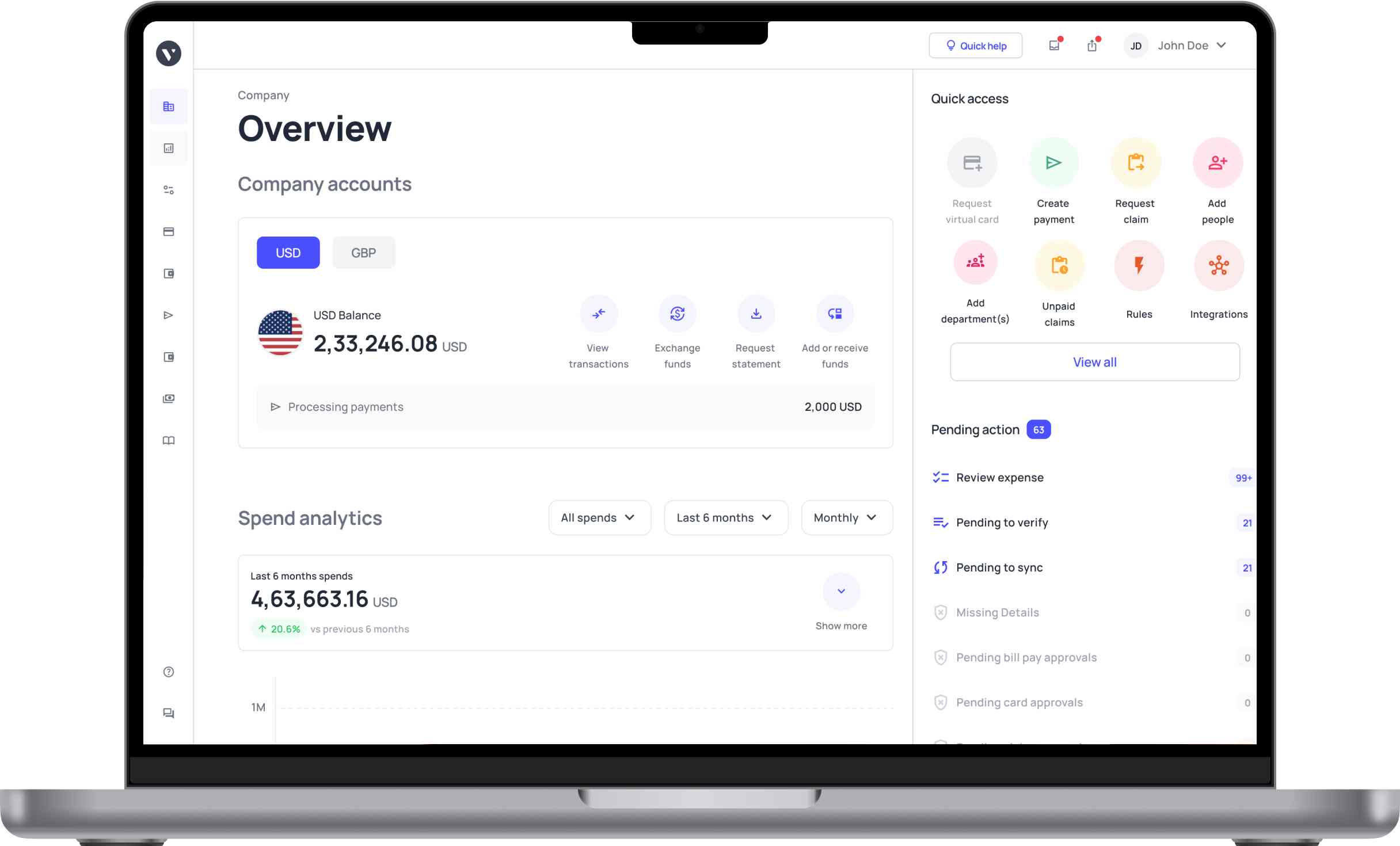
Volopay is a spend management platform that helps businesses manage corporate cards, accounts payable, reimbursements, and accounting workflows from a single dashboard. It provides physical and virtual cards, approval workflows, expense controls, invoice management, and accounting integrations to reduce manual finance operations. Volopay is used by businesses all over the world, and is best for SMBs and mid-market companies looking for an all-in-one finance platform.
It uses OCR technology called Magic Scan to capture invoice and receipt information automatically. Businesses can schedule payments based on approval date, a selected payment date, or the invoice due date. The platform supports custom approval workflows with up to five approval levels.
The platform also includes payroll functionality to automate salary calculations, tax deductions, and employee payments from the same system used for expenses and vendor payments. Volopay follows custom pricing based on business requirements. Businesses need to contact the sales team for a quote. It integrates with NetSuite, Xero, QuickBooks, MYOB, Tally, Zoho Books, and Deskera.
Stampli
Stampli is one of the few platforms built around how AP teams actually work. The core product is an invoice collaboration and approval workflow tool with strong communication features: approvers can ask questions, tag colleagues, and attach context to individual invoices without leaving the platform.
Its AI assistant, Billy the Bot, automates GL-code suggestions for mid-market finance teams with multi-step approval processes. It is best for mid-market to lower-enterprise companies with complex approval workflows, typically processing between 2,000 and 10,000 invoices monthly in industries like manufacturing, construction, healthcare, and hospitality.
Stampli helps teams that need invoice collaboration and high ERP compatibility (70+ ERPs). Pricing is quote-based with no published rates.
Brex
Brex is a spend management platform that combines corporate cards, expense management, reimbursements, accounts payable automation, and financial controls in a single system. The platform was initially built for startups and technology companies. It is popular among venture-backed startups and fast-growing businesses because card limits are based on company cash balances rather than personal credit history.
Brex provides physical and virtual corporate cards with spending limits based on the company's cash reserves. Businesses can set spending limits, approval policies, merchant restrictions, and budget controls to monitor company expenses and reduce unauthorized spending.
Finance teams can monitor card transactions, budgets, and company spending from a centralized dashboard. Brex integrates with accounting and business software such as NetSuite, QuickBooks, Slack, and other operational tools, helping streamline financial workflows and reporting. It is a good option for companies where corporate cards and spend management are central to financial operations.
They loved Volopay, you will too
Financial stack for business
No more switching between multiple bank accounts and tools to run your smart business. We have combined great software with every service you are using a bank for, to produce a state-of-the-art financial platform, Volopay.
Less time spent on manual reconciliations
Faster month-end book closing turnaround
Accurate receipt matching with automation
FAQs
The main difference between Tipalti and Airbase is that Tipalti is built for global accounts payable and mass payment. Airbase is a spend management platform. The former deals with large volumes of suppliers, contractors, and partners from all across the world, while the latter helps with corporate cards, expense management, and bill pay, all together in a single system.
In the Tipalti vs. Airbase accounts payable comparison, Tipalti is better for AP automation. It was built purely to solve the pain points of accounts payable. Airbase handles AP automation, but it is a part of expense management, not as a standalone AP-first tool like Tipalti.
Airbase does provide global payments, but not at the same scale as Tipalti. Tipalti supports payments to 196 countries in 120+ currencies across six payment methods (ACH, wire, PayPal, prepaid debit, local bank transfer, check).
Airbase’s core platform is built around corporate cards (virtual and physical). It provides real-time spend controls, receipt capture, and automatic reconciliation. Tipalti also offers the Tipalti Card, but it is a new addition to the platform, as Tipalti was primarily built for AP automation.
Tipalti is better for processing large volumes of invoices. It has OCR-based invoice capture, PO matching, multi-entity support, and a supplier self-service portal. Airbase also provides invoice processing capabilities, but they are not as advanced as Tipalti's.
Both Tipalti and Airbase use custom/quote-based pricing; neither publishes a standard price list.
Airbase was built with mid-market companies in mind. It is a unified platform for corporate cards, expense management, and bill pay. The onboarding process is quick, the interface is user-friendly, and it provides spend controls.
Tipalti has broader ERP integrations. It connects with NetSuite, QuickBooks, Xero, Sage Intacct, Microsoft Dynamics, and others.
Airbase can replace Tipalti for businesses with domestic or moderate international payment requirements, manageable invoice volumes, and a need for a unified spend management platform. However, if your business processes high volumes of global vendor or contractor payments and requires advanced tax compliance capabilities, Tipalti remains the stronger choice.
The best alternatives to Tipalti and Airbase are Stampli for AP automation and P2P workflows. BILL is a good option for cost-effective invoice and payment management. Volopay is a good alternative if you’re looking for corporate cards, expense management, spend control, and multi-currency business payments.