Stripe vs. Wise: Better for cross-border payments?
Cross-border payments can get expensive fast, especially once card fees, FX markups, and payout costs stack up. Stripe and Wise are not direct competitors: Stripe is best for accepting customer card payments, while Wise is best for sending money internationally and managing multi-currency balances.
This guide will help you choose the right tool for the way your business actually moves money.














REVIEWED BY

Akanksh Muniyappa
Head of Product
WRITTEN BY

Yashvi Tiwari
Content Writer
Quick summary: Stripe vs. Wise
Stripe is the right choice when you need to accept card payments from customers. It works best for SaaS, subscription, and marketplace businesses. Wise is the better option when your team needs to send money internationally, hold multiple currency balances, or receive payments from overseas clients without paying a high FX markup.
| Key factors | Stripe | Wise |
|---|---|---|
Best for | Startups, SaaS, e-commerce scaling globally | Freelancers, SMEs, global teams, remittances |
Currencies supported | 135+ for payments | Hold 40+, send to 160+ countries |
ERP integrations | Deep & extensive | Good |
Invoice automation | Strong (Invoicing + Billing) | Basic invoicing tool |
Corporate cards | Can be issued | Debit card available |
Monthly/setup fees | None | None |
Tax & compliance | Excellent (Stripe Tax) | Good regulatory compliance |
Support | 24/7 phone/chat for higher tiers | Email/chat; strong self-service |
User ratings | G2: 4.2/5, Capterra: 4.6/5 | G2: 3.9/5, Capterra: 3.8/5 |
Stripe
Stripe was founded in 2010 as a developer-first payment API. Over the next 15 years, it grew into one of the most powerful payment platforms in the world, processing over $1.9 trillion in payments in 2025, a 34% increase from 2024.
Stripe positions itself as a full-stack payment infrastructure and a developer platform for internet businesses. It is the top choice for SaaS companies, online stores, and marketplaces that need flexible, scalable payment tools without heavy engineering work.
Its product suite includes Stripe Billing, Radar, Tax, Connect, Issuing, Capital, and the 2026 Agentic Commerce Suite, which supports AI-driven purchasing workflows. Stripe is best for businesses that want to accept payments globally and build sophisticated financial products on top of a single platform.
| Pros | Cons |
|---|---|
Accepts payments in 135+ currencies | Higher fees for international and FX transactions |
All-in-one suite: billing, fraud, tax, cards | Setup can be complex for non-technical teams |
No monthly fees, pay per transaction | Some complaints of poor customer support |
Smart fraud detection reduces chargebacks automatically | Not built for payroll or supplier payments |
Great documentation and third-party integrations | Complex pricing for additional features |
Wise
Wise, formerly known as TransferWise, was founded in 2011 in the UK. The goal was simple: fix the hidden costs buried in international bank transfers.
Instead of making money on exchange rate markups, Wise uses the mid-market exchange rate as its reference rate and charges a separate transparent conversion fee. This transparent approach sets it apart from traditional banks and payment services.
Today, Wise serves over 700,000 businesses globally and processes more than $16 billion per month. It is a regulated e-money institution, not a bank, though it handles most international payment needs just as well as a bank does.
Wise is best for freelancers, remote teams, and businesses that regularly send money across borders and want low fees, honest exchange rates, and multi-currency accounts.
| Pros | Cons |
|---|---|
Real mid-market rate with no hidden fees | Cannot process customer card payments |
Hold 40+ currencies without forced conversion | No loans, overdraft, or credit available |
Sends money to 160+ countries within 24 hours | Not a full payment gateway like Stripe |
Pay up to 1,000 people in one upload | Features vary depending on your country |
No monthly fees, simple one-time setup cost | Complex support issues might be slow to resolve |
In-depth comparison: Stripe vs. Wise
Let's examine each platform across the 11 decision factors most relevant to finance and operations teams evaluating a Stripe vs. Wise comparison for international payment infrastructure. Each section is designed for teams evaluating specific requirements.

Which tool is right for you?
Stripe
Stripe is best for businesses that need a scalable payment platform to accept global payments and build advanced financial solutions.
Wise
Wise is ideal for freelancers and businesses that frequently send international payments and want low fees, transparent exchange rates, and multi-currency accounts.
Get your team working with Volopay
Key factors to consider in choosing the right product for you
International payments & cross-border transfers
Sending money across borders gets complicated fast. Delays, failed transfers, and limited country coverage can disrupt your vendor relationships and cash flow. If your business pays international suppliers or employees, this factor is critical.
Check how many countries each platform supports and how long transfers typically take. Choose a tool that covers your key payment corridors without requiring manual workarounds.
Fees & pricing plans
The base price rarely tells the full story. Hidden fees for transfers, currency conversion, or added users can make a cheap plan expensive fast. Understanding the true cost protects your budget and helps you compare tools fairly.
Ask for a complete breakdown of all fees before you decide. Factor in your monthly transaction volume to estimate what you will actually pay each billing cycle.
Remittance & FX rates
Poor exchange rates quietly eat into every international payment you make. Even a small rate difference adds up when you pay vendors or employees in other currencies regularly.
Before choosing a tool, compare the FX rates each platform offers against the mid-market rate. Look for platforms that are transparent about their markup and offer rate locks or forward contracts if your payments are high volume.
Multi-currency support
If your business operates in more than one country, holding and sending funds in multiple currencies saves time and reduces conversion costs. Without it, every payment triggers an unnecessary exchange.
Check whether the platform lets you hold balances in the currencies you use most. If you pay vendors in euros, pounds, or pesos regularly, multi-currency accounts should be a baseline requirement, not a bonus feature.
Payment processing & infrastructure
Slow or unreliable payment processing disrupts your operations and damages trust with vendors and employees. The strength of a platform's infrastructure determines how fast and consistently your payments go through.
Before committing, check uptime records and average processing times. Ask whether the platform uses local payment rails in your key markets, as local rails are typically faster and cheaper than international wire transfers.
Business account features
A strong business account does more than hold funds. It helps you manage cash flow, track spending, and stay organized without switching between tools. Think about what your team needs day to day.
Look for features like virtual accounts, payment scheduling, and transaction history. If your current banking setup creates friction, choose a platform that replaces those gaps rather than adding another layer to manage.
Corporate cards & spending controls
Without spending controls, employee expenses are hard to track and easy to misuse. Corporate cards linked to your AP platform give you real-time visibility and let you set limits before money leaves the account.
If your team has regular business expenses, this feature is worth prioritizing. Look for platforms that offer virtual and physical cards with customizable limits, category controls, and automatic reconciliation with your accounting software.
Accounting & ERP integrations
A gap between your payment platform and your accounting software means manual data entry, sync errors, and wasted time. The tighter the connection, the less your team has to intervene.
Before evaluating any tool, list the software your team already uses. Confirm whether the integration is native or third-party. Native connections are faster to set up, more reliable, and less likely to break during software updates.
Company budget & size
An enterprise-grade tool can overwhelm a small team and strain a tight budget. The right fit depends on your transaction volume, team size, and growth plans.
List the features you will realistically use in the next 12 months. Then compare that list against each platform's pricing tier. Avoid paying for a scale you do not need yet, but make sure the platform can grow with you when the time comes.
Customer support & onboarding
Even the best platform becomes a liability if onboarding is slow or support is hard to reach. Finance teams need reliable help during setup, integrations, and payment issues, especially in the first few months.
Before deciding, ask about onboarding timelines, training resources, and average response times for technical issues. Fast, accessible support can make the difference between a smooth rollout and a costly, drawn-out delay.
Security & compliance
A single data breach or compliance failure can result in financial penalties and lost customer trust. Your payment platform sits at the center of sensitive financial data, so security cannot be an afterthought.
Check whether the platform is SOC 2 certified, PCI-DSS compliant, and supports two-factor authentication. If you operate in regulated industries or multiple countries, confirm it also meets local data protection and financial compliance requirements.
Alternatives to Stripe and Wise
When comparing Wise vs. Stripe, both tools do their core job well. But neither combines payments, transfers, and expense management in one place. If your team needs all of that together, these alternatives are worth a look.
Volopay
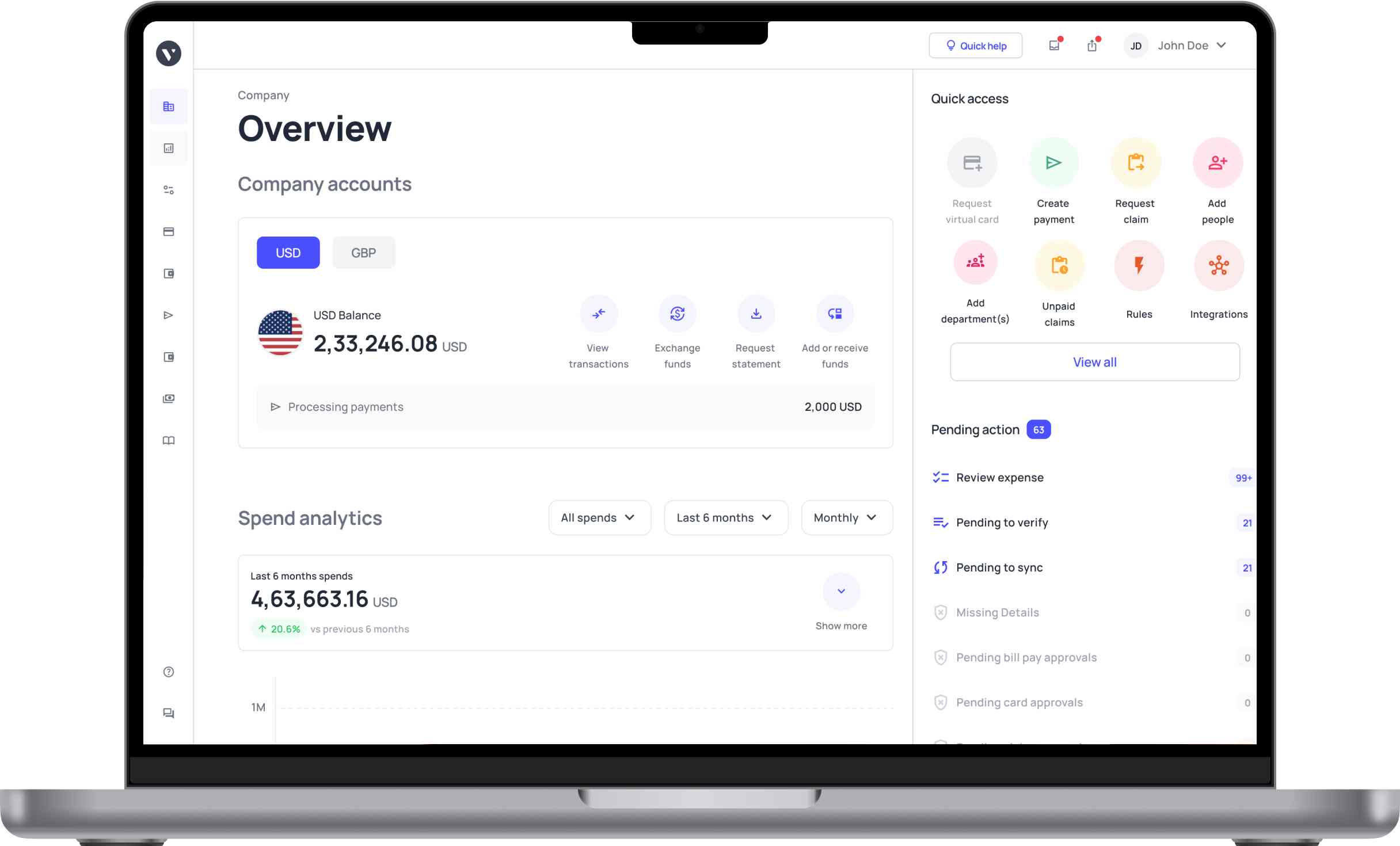
Volopay is the strongest all-in-one option for businesses that need to pay vendors, manage team spending, and move money across borders from a single dashboard. It was built for startups, SMEs, and growing companies that are tired of switching between a bank, an expense tool, a transfer platform, and a card system.
Where Stripe handles inbound payments, and Wise handles outbound transfers, Volopay covers both sides of your cash flow, plus the expense management layer that neither platform provides.
Key features include multi-currency accounts in USD, EUR, GBP, AUD, and SGD, transfers to 130+ countries, unlimited virtual cards, multi-level approval workflows, vendor management, and native integrations with Xero, QuickBooks, and NetSuite.
Volopay also gives finance teams real-time spending visibility, automated receipt collection, employee reimbursements, and department-level budget controls. You can issue cards, approve payments, and track every transaction without switching tools. A dedicated onboarding team and account manager support you throughout, something neither Stripe nor Wise provides.
Best for: Startups, SMEs, and mid-market businesses replacing multiple finance tools with one smart platform.
Payoneer
Payoneer is a strong alternative for businesses and freelancers that need to receive payments from international clients, marketplaces, and platforms without paying high fees. It is widely used by freelancers on Upwork and Fiverr, Amazon sellers, YouTube creators, and agencies that receive payouts from multiple global sources.
Businesses choose Payoneer because it makes it easy to collect payments in USD, EUR, GBP, and other major currencies through local receiving accounts, then withdraw to a local bank at low cost. It also supports mass payouts, making it practical for marketplaces and platforms that need to pay large numbers of contractors or sellers across different countries quickly and reliably.
Payoneer works well for creator economy businesses that receive income from multiple platforms and need one account to consolidate everything. Pricing is straightforward. Receiving Payoneer payments is usually free, while withdrawals and currency conversions include additional transfer charges.
Best for: Freelancers, marketplace sellers, creators, and businesses that need reliable global payment collection and low-cost multi-currency withdrawals.
Revolut Business
Revolut Business is a strong alternative if you want the multi-currency features of Wise with added expense management and team card controls. Companies use it to manage team expenses, pay international contractors, hold balances in multiple currencies, and issue cards to employees without needing separate tools for each task.
Instead of paying per transaction, you choose a monthly plan that includes a set allowance of fee-free transfers and currency exchanges. This makes it a better deal for businesses that move money frequently.
Growing teams find Revolut Business practical because it combines spending controls, approval workflows, and multi-currency accounts in one place, reducing the need for multiple finance platforms. If your business is based in the EEA, you also get particularly competitive rates on domestic card transactions. Revolut Business plans start at $0.00, with Premium at $9.99 and Metal at $16.99 monthly.
Best for: Small to mid-sized businesses that want multi-currency accounts, team expense management, and frequent international transfers under one affordable monthly plan.
They loved Volopay, you will too
Financial stack for business
No more switching between multiple bank accounts and tools to run your smart business. We have combined great software with every service you are using a bank for, to produce a state-of-the-art financial platform, Volopay.
Less time spent on manual reconciliations
Faster month-end book closing turnaround
Accurate receipt matching with automation
FAQs
Stripe helps businesses take payments from customers online using cards and checkout pages. Wise helps businesses send and receive money across countries at a low cost. They do different jobs.
Wise usually costs less for sending money abroad. It shows you exactly what you pay and uses fair exchange rates. Stripe can charge more when payments involve foreign cards or currency changes.
When comparing Stripe vs. Wise for remittances, Wise wins easily. Wise is better for sending money across borders. It uses local bank networks to keep costs low. Stripe is built to take payments from customers, not to send money to others.
Both use mid-market exchange rates. Wise charges a small, clear fee on top. Stripe may add extra fees for currency conversion and international transactions, which can add up quickly.
Wise is clearly the better choice for multi-currency accounts. You can hold, convert, and manage money in multiple currencies simultaneously. Stripe primarily processes payments and settles in your local currency, making Wise far more flexible for global businesses.
Wise Business works like a basic business account. You can hold money, send transfers, and use a debit card. Stripe is a payment tool, not a bank account. Neither replaces a real business bank.
Wise is the better choice for freelancers managing international clients and multiple currencies. Stripe suits startups selling products or subscriptions online. Overall, Wise edges ahead for freelancers, while Stripe is stronger for startups needing robust payment infrastructure.
Stripe is the better choice for accounting integrations, offering deeper connections for high-volume payment businesses. Wise integrates reliably with Xero and QuickBooks, suiting smaller teams. However, Stripe's broader ecosystem and developer flexibility give it a clear overall advantage.
Both are safe and follow strict rules. Stripe meets PCI DSS Level 1 and SOC 2 standards and has fraud detection tools. Wise is regulated in many countries and keeps customer funds protected.
Volopay, Payoneer, and Revolut are the strongest alternatives. Payoneer excels at cross-border payments for freelancers and marketplaces. Revolut Business offers multi-currency accounts and corporate cards with a sleek interface. Volopay adds expense management and approval workflows for growing businesses.