Stripe vs. Revolut: Which platform is better?
Your business can outgrow its payment setup before it realizes it. Stripe starts with a simple headline rate, but international cards, FX conversion, disputes, and add-ons stack fast. Revolut suits businesses that prioritize multi-currency handling and lower FX costs.
In the Stripe vs. Revolut debate, the right answer depends on how your money moves. Read on to find yours.















REVIEWED BY

Akanksh Muniyappa
Head of Product
WRITTEN BY

Mahasweta Bose
Content Writer
Quick summary: Stripe vs. Revolut
Stripe is the go-to for businesses that need robust, developer-driven payment infrastructure, like SaaS platforms, marketplaces, and high-volume e-commerce. Revolut is the stronger choice for internationally active SMEs that want lower FX costs, built-in business banking, and spend management without juggling multiple tools.
If your priority is accepting payments at scale, choose Stripe. If your priority is managing money across borders efficiently, choose Revolut.
| Key factors | Stripe | Revolut |
|---|---|---|
Primary purpose | Payment infrastructure & processing | Business banking & financial operations |
Best for | SaaS, e-commerce, marketplaces, developers | SMEs, international businesses, & finance teams |
Payment methods | 100+ | 25+ currencies accepted |
FX fees | 1-2% FX conversion + 1 to 1.5% international surcharge | Interbank rate (small weekend/over-limit markup) |
Multi-currency holding | No native account | Hold & exchange 30+ currencies |
Corporate cards | Via Stripe Issuing (API-dependent) | Physical & virtual cards with spend controls |
Expense management | Not included | Available as an add-on |
Accounting integrations | 100+ | Xero, Zoho, FreshBooks, Odoo |
Pricing model | Pay-per-transaction | Freemium + subscription from £10/month |
Developer tools | Best-in-class API & documentation | Limited |
Banking licence | No (funds held at partner banks) | Yes (UK & EU banking licences) |
Fraud prevention | Stripe Radar (AI-powered) | Built-in anti-fraud system |
Account stability | Reliable, no freeze complaints | Freeze complaints reported by users |
Ideal company size | Startup to enterprise | SME to mid-market |
Stripe
Stripe evolved from a simple developer-facing payments API into a full-stack financial infrastructure platform processing $1.9 trillion in total payment volume today. Its primary positioning is that of a developer-first, full-stack payment infrastructure for online and in-person commerce at a global scale.
For the most part, it is best suited for SaaS companies, marketplaces, and tech-forward businesses needing deep customization and a widely accepted payment/checkout interface for different payment methods and most major countries.
| Pros | Cons |
|---|---|
It has some of the best-in-class API and developer tools in the market | High fees can stack quickly for smaller businesses or businesses whose revenue/payment volume is constantly increasing |
100+ payment methods, 135+ currencies | Complex setup without a technical team |
Robust billing, subscriptions, and revenue automation | Slower, largely self-serve customer support |
Revolut Business
Revolut started as a low-cost foreign exchange app and has since transformed into a financial application that blends banking, payments, and investment. As of the latest data, it serves over 70 million customers across 140 countries.
It is primarily positioned as an all-in-one neobank and business account for internationally active SMEs. Best for businesses prioritizing multi-currency operations, expense management, and lower FX costs.
| Pros | Cons |
|---|---|
Multi-currency accounts with interbank(mid-market) FX rates for fair currency transactions | Many users have reported their accounts being frozen with limited notice given to them |
Built-in expense management and team spend controls | Weaker developer tools and fewer integrations |
Lower transaction fees for EEA(European Economic Area) businesses | Subscription plans are needed to unlock key features |
In-depth comparison: Stripe vs. Revolut
When evaluating Revolut vs. Stripe, the right answer for your business depends entirely on what it actually needs. Below, we assess both platforms across some of the major decision factors that matter most to buyers, from payment infrastructure to security, so that you can make an informed choice.

Which tool is right for you?
Stripe
Stripe is best for businesses that need a flexible, scalable payment platform for online sales and subscriptions.
Revolut
Revolut is ideal for businesses seeking low-cost international payments, multi-currency accounts, and integrated business banking.
Get your team working with Volopay
Key factors to consider in choosing the right product for you
Payment processing & infrastructure
The backbone of any payment platform. It determines what payment methods you can accept, how fast transactions settle, and whether the system scales with you.
As a business, you need to ask yourself whether you need a customisable checkout, sell subscriptions, or run a marketplace. If the answer is yes, then you need a platform with deep processing infrastructure, not just basic card acceptance. This is especially critical for e-commerce brands, SaaS companies, and any business processing high transaction volumes.
FX rates
Every percentage point of markup on currency conversion quietly erodes your margins. Each currency conversion carries a cost, and those costs scale with your transaction volume. This factor is especially relevant for businesses with international suppliers, overseas customers, or teams operating across multiple regions.
Evaluate this if your business regularly pays international suppliers, receives revenue in foreign currencies, or runs cross-border payroll. Calculate your monthly international spend and figure out what a 1–2% FX markup actually costs you annually. The number is often surprising.
Multi-currency & international payments
Beyond FX rates, consider whether you need to hold multiple currencies simultaneously, not just convert them on the fly. The ability to hold, send, and receive in multiple currencies without double-conversion costs is a major operational advantage for any business operating multi-nationally.
A must-evaluate factor for globally distributed teams and import/export businesses, as they benefit the most from native multi-currency account infrastructure, rather than converting every incoming payment into a single home currency.
Corporate cards & spending controls
If your team spends company money on travel, subscriptions, vendors, or supplies, you need visibility and control over that spend in real time. Evaluate whether the platform lets you set limits by employee, department, or category, issue virtual cards instantly, and automatically match receipts.
Company cards paired with granular spend limits reduce expense fraud, cut reimbursement cycles, and give finance teams real-time tracking, control, and visibility. This factor is most relevant for growing teams with distributed employees or frequent business travel.
Business account features
A strong business account consolidates banking, invoicing, and payments in one place. Consider whether you want your payment platform and your business banking to live in the same place. A unified account reduces reconciliation complexity, speeds up fund access, and cuts down on the number of tools your finance team manages.
This is a key factor for SMEs and startups looking to minimize the number of financial platforms they manage. Businesses with lean finance teams benefit most from consolidation; larger enterprises may prefer best-of-breed tools that integrate cleanly.
Fees & pricing plans
Never evaluate the monthly fees of a tool by itself. Always calculate the total cost of owning/using the software for a particular time period. Transaction fees, monthly subscriptions, and add-on costs compound fast, especially at scale. A platform with no monthly fee but high per-transaction costs may be cheaper at low volumes and expensive at scale.
Conversely, a subscription-based software with low transaction fees rewards high-volume businesses. Map your expected monthly transaction volume and run the numbers before committing to either structure. Businesses should model the total cost of ownership across expected volume, not just the headline rate.
Accounting & ERP integrations
A payment platform that doesn't talk to your accounting software creates manual reconciliation work every single month. Evaluate whether the platform integrates natively with the accounting tool you use and not just via a third-party tool like Zapier. Deeper sync means cleaner books, faster month-end close, and fewer human errors in your financial data.
This kind of seamless sync between your payment platform and your accounting or ERP software saves hours of manual reconciliation. It should be a non-negotiable for finance teams running structured month-end close processes.
Company budget & size
A platform that's right for a 10-person startup may be limiting or expensive for a 500-person enterprise. Budget and team size should anchor every shortlisting decision, of course, not at the expense of important financial functions. Platform pricing rarely scales linearly with your team.
Some charge per user, others per transaction volume, others via tiered subscriptions. While evaluating, set a realistic budget ceiling and filter platforms by whether they remain cost-effective at your current and projected headcount without compromising on the functionalities that you need.
Customer support & onboarding
Slow support during a payment failure or account freeze can directly cost revenue. Businesses without in-house technical teams should prioritize platforms with responsive, accessible human support. Support quality only becomes visible when something goes wrong, such as a failed payment, a frozen account, or an integration error.
Before committing to a platform, test its support channels. How long does it take to reach a human? Is there a dedicated account manager at your tier? Businesses should remember that a self-serve help centre is not a substitute for responsive human support.
Security & compliance
Your payment platform sits at the intersection of customer data, financial flows, and regulatory obligations. Fraud prevention, data encryption, and regulatory compliance protect both your business and your customers.
Evaluate whether the platform is PCI DSS compliant, what fraud prevention mechanisms are in place, and whether it holds relevant banking or e-money licences in your operating region. This is critical for businesses operating across multiple jurisdictions or handling sensitive financial data.
Alternatives to Stripe and Revolut
Stripe and Revolut are powerful platforms, but neither is a perfect fit for most business needs. Stripe can be too much for businesses that don't need deep payment infrastructure, while Revolut's account alleged freeze issues and limited integrations may give larger finance teams some trouble. If either platform falls short for your specific needs, here are some credible alternatives worth evaluating.
Volopay
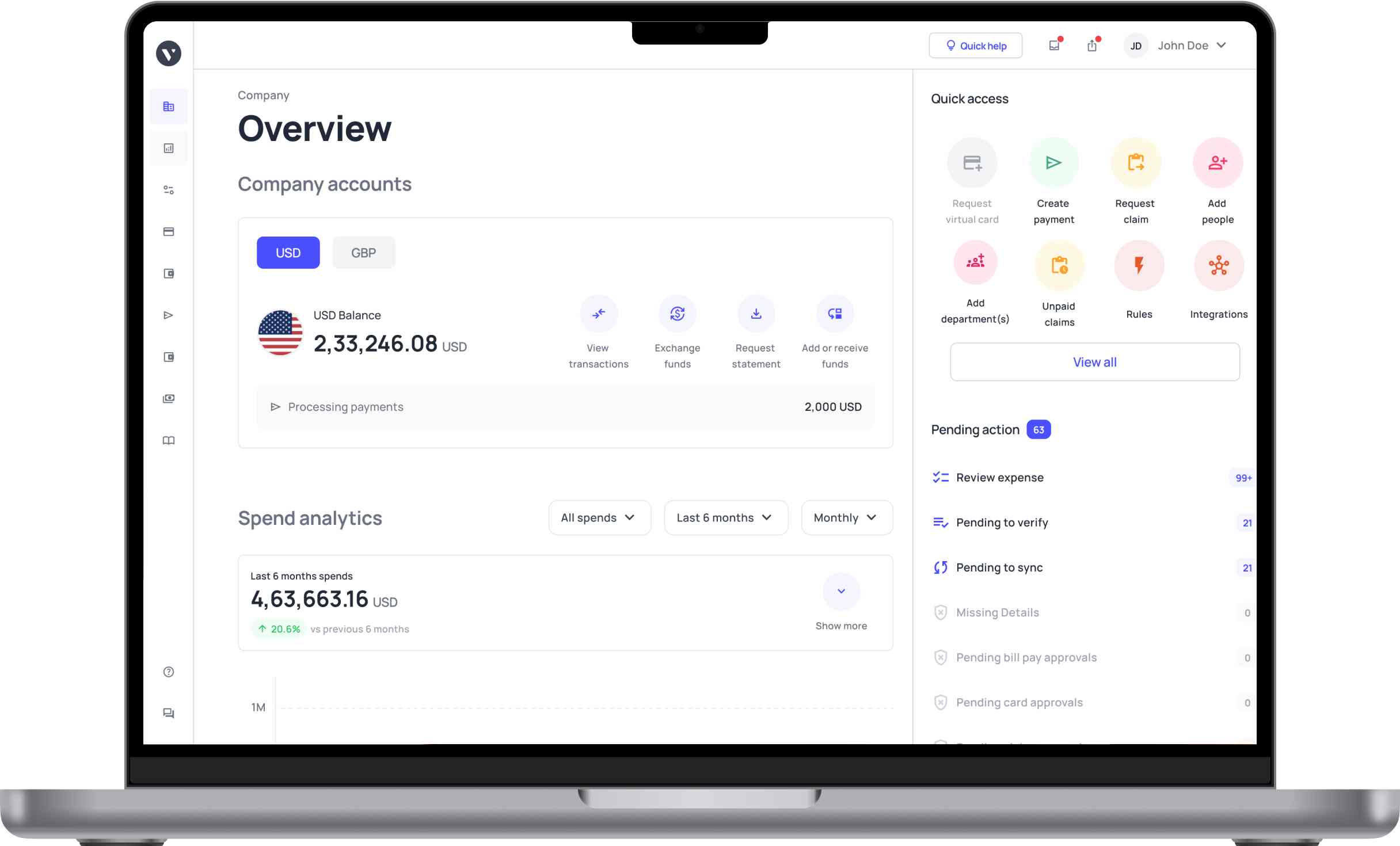
An all-in-one expense management platform that centralizes control over corporate spending by integrating corporate cards, bill payments, expense reporting, reimbursements, and accounting automation into one system. It offers seamless integrations with Xero, QuickBooks, NetSuite, Zoho Books, Deskera, and MYOB, and supports international transfers across 130+ countries via both SWIFT and non-SWIFT options.
Best for: SMEs and growing businesses in APAC seeking a unified spend management and business account platform.
Wise Business
It supports more than 40 currencies and offers local account details in major regions, including the UK, US, EU, and Australia, helping businesses reduce transfer fees and receive payments faster from overseas clients. Wise processes international payments at mid-market rates, far cheaper than traditional bank wires, and supports batch payments to up to 1,000 recipients simultaneously.
Best for: Businesses with high volumes of international supplier payments or contractor payroll who want transparent, low-cost FX without subscription complexity.
Adyen
It is a global payment platform that connects merchants with international cards, mobile payment options, and cash-based methods, managing payment workflows, real-time analytics, and compliance within a single unified system. It supports omnichannel checkout across online, mobile, and in-store channels, with built-in fraud detection, chargeback management, and extensive APIs and SDKs for technical teams.
Pricing is pay-per-transaction with no setup or monthly fee. Card payments run at €0.11 + interchange + ~0.6%. Adyen integrates with Adobe Commerce, Microsoft Dynamics 365, Oracle Retail, Salesforce Commerce Cloud, SAP Commerce, Shopify, Magento, and WooCommerce, among others, making it one of the strongest competitors to Stripe.
They loved Volopay, you will too
Financial stack for business
No more switching between multiple bank accounts and tools to run your smart business. We have combined great software with every service you are using a bank for, to produce a state-of-the-art financial platform, Volopay.
Less time spent on manual reconciliations
Faster month-end book closing turnaround
Accurate receipt matching with automation
FAQs
Stripe is a developer-first payment infrastructure platform; Revolut is an all-in-one neobank. Stripe processes payments at scale; Revolut manages business banking, FX, and spend operations.
For a Stripe vs. Revolut e-commerce business decision, Stripe wins. It offers superior checkout customisation, 100+ payment methods, subscription billing, and a broader global currency acceptance range.
Revolut charges significantly less. Stripe adds a 1% currency conversion fee plus a 1.5% international card surcharge, whereas Revolut converts at interbank rates with minimal markup during market hours.
Not fully. Revolut handles basic online payments, but lacks Stripe's API depth, subscription tooling, fraud prevention sophistication, and breadth of payment methods for complex e-commerce or SaaS businesses.
In most cases, Revolut is better for multi-currency payments, but that might change depending on the context. Stripe accepts more purchase currencies globally, while Revolut is better for holding and managing multi-currency balances internally without conversion costs eating into your margins.
On Stripe vs. Revolut cost: Stripe's fees stack quickly with add-ons for billing, payouts, and tax compliance. Revolut uses a freemium subscription model, lower transaction fees for EEA businesses, but key features require paid tiers.
For most small businesses, Revolut is the better option overall in terms of managing payments, but it would also depend on the exact requirments.
Revolut suits cost-conscious SMEs needing banking, cards, and FX in one place. Stripe suits small businesses building online-first products/e-commerce that need reliable, scalable payment processing from day one.
Stripe, by a wide margin. Stripe's developer kits have been optimised through years of popular use, with best-in-class API documentation, SDKs, and a mature CLI that Revolut simply cannot match.
No. Stripe's multi-channel infrastructure includes Checkout, Billing, Connect, and Terminal. These are materially deeper than Revolut's payment acceptance capabilities, which are better suited to operational banking than infrastructure-level payment processing.
Volopay and Wise stand out as some of the best AP workflow alternatives to Revolut, combining corporate cards, multi-currency wallets, automated expense management, bill payments, and deep accounting integrations into one platform purpose-built for finance teams.
Adyen is often considered more robust than Stripe when it comes to its payment infrastructure for its enterprise-grade, omnichannel platform that is built for high-volume, multichannel businesses and large international retailers.