Revolut vs. Wise: Which tool should you choose?
Banks charge an average of 14.99% to send small international transfers, according to World Bank remittance data, well above the global average of 6.36%. Revolut and Wise both offer lower-cost alternatives to traditional banks, but they emphasize different features and use cases.
To make more sense of the two platforms, let’s break down the Revolut vs Wise comparison further.















REVIEWED BY

Akanksh Muniyappa
Head of Product
WRITTEN BY

Anushka Sharma
Content Writer
Quick summary: Revolut vs. Wise
Revolut suits users who want an all-in-one financial app covering transfers, savings, crypto, and travel perks in one place. Wise is the better pick if your core need is sending or receiving money internationally at the real mid-market rate with full cost transparency. Both serve freelancers and businesses, but they are built around fundamentally different priorities.
| Key factors | Revolut | Wise |
|---|---|---|
Best for | All-in-one financial management | International transfers & receiving payments |
Exchange rate | Mid-market up to plan limits; weekend markup applies | Always mid-market, no markup |
Transfer fees | Plan-based; some free within limits | Transparent per-transfer fee from 0.4% |
Multi-currency account | Hold & convert 25 currencies | Hold 40+ currencies with local bank details |
Local bank details | Limited | 10+ currencies (USD, EUR, GBP, AUD) |
Travel card | Perks on paid plans | Spend in 170+ countries, low fees |
Business account | Card-first with spend controls | Payment-first with batch transfers |
Crypto & investments | Yes | No |
Customer support | Chat; priority on higher plans | Chat and email |
Personal pricing | Free to $16.99/month | Free to open; pay per transfer |
Business pricing | Free to $119+/month | One-time setup fee + per-transfer |
Revolut
Revolut launched in 2015 as a prepaid travel card and has since grown into a full-stack financial super-app covering banking, crypto, stock trading, savings, and global payments. It positions itself as an all-in-one financial hub rather than a specialist money transfer tool.
Best for: Individuals and businesses wanting a wide range of financial tools in a single platform.
| Pros | Cons |
|---|---|
Wide feature set: payments, savings, investments, insurance | Weekend FX markup and fair usage limits apply |
Competitive rates within monthly plan limits | Key features locked behind paid tiers |
Instant transfers between Revolut users | Customer support is slow and primarily chat-only |
Travel insurance and lounge access on paid plans | Not a licensed bank in all markets |
Business accounts with team spend controls | Transfer fees vary by plan and corridor |
Wise
Wise, formerly TransferWise, has operated on one core promise since 2011: send money internationally at the real mid-market rate with every fee disclosed upfront. It offers personal and business multi-currency accounts, local bank details in multiple currencies, and a debit card for international spending.
Best for: Freelancers, remote workers, and businesses that regularly send or receive international payments.
| Pros | Cons |
|---|---|
Always uses mid-market rate, no markup | Narrower feature set: no crypto, investments, or insurance |
Full fee transparency before every transfer | Per-transfer fees apply even on small amounts |
Local bank details in 10+ currencies | No phone support available |
Strong licensing and compliance track record | Business features require a paid subscription |
Batch payments and API access for businesses | One-time setup fee for business accounts |
In-depth comparison: Revolut vs. Wise
Here is how both platforms perform across the decision factors that actually shape day-to-day financial decisions for freelancers, SMBs, and global teams.

Which tool is right for you?
Revolut
Revolut works best for individuals and businesses looking for a comprehensive suite of financial tools on a single platform.
Wise
Wise works best for freelancers, remote workers, and businesses that frequently send or receive international payments.
Get your team working with Volopay
Key factors to consider in choosing the right product for you
International transfers & money transfer
Hidden fees eat into your transfer before the money even arrives. If the platform won't show you the exact delivery amount upfront, you're always reconciling shortfalls after the fact. Run a test transfer at your typical amount. If the platform shows you the recipient amount before you confirm, including all fees, it passes. If not, consider a different option.
Exchange rates & currency conversion
A 1.5% markup on a $10,000 monthly transfer costs you $1,800 a year. That number climbs faster when the platform quietly applies higher rates on weekends or above a volume threshold. Check the rate against a neutral currency exchange platform (such as Xe) at the time and day you usually transfer. Then read the fine print on your actual plan tier, not the headline rate on the pricing page.
Multi-currency account
Holding a currency and receiving it as a local payee are two different things. Your clients in Germany or the US can't always pay you locally just because your platform supports EUR or USD conversion. List every currency you need to receive money in. For each one, confirm the platform gives you a local account number or a multi-currency wallet, not just a conversion balance. If it doesn't, factor in the potential friction of alternative routing.
Travel card & spending abroad
A subscription with bundled travel perks only saves money if you actually travel enough to use them. Paying monthly for benefits you hit twice a year is just a fee dressed up as a feature. Estimate your monthly foreign spend. Calculate total annual cost under a subscription plan vs. a no-fee card with per-transaction conversion. Whichever number is lower for your actual usage is your answer.
Hidden costs & fees
Weekend FX rules, ATM caps, and overage charges activate at exactly the moments you're not checking. This can be mid-trip, end of the month, or when you need cash urgently. The cheapest headline plan is rarely the cheapest in practice. Stress-test three scenarios: a weekend transfer at your usual amount, an ATM withdrawal above the monthly cap, and a month where your volume exceeds your plan limit. If any of those numbers surprises you, it will cost you in real life.
Business accounts
Business platforms are built around two very different needs: controlling how your team spends, or sending payments reliably to suppliers and contractors. Choosing the wrong model means paying for features you don't use while lacking the ones you do. Identify your primary pain point first. If it's employee expense management, look at card-first platforms. If it's cross-border payables, look at payment-first infrastructure. Don't shortlist until you've made that call.
Company budget & size
Per-transfer pricing protects you when volume is low, but gets expensive fast as transfers scale. Flat-rate plans look like overkill at low volume but save significantly once you're making consistent, high-frequency payments. Pull your last three months of transfer data. Divide the flat plan cost by your average monthly transfer count to get your effective per-transfer rate. If it's lower than the per-transfer price, the flat plan might be the better option.
Accounting & ERP integrations
A platform that doesn't connect directly to your accounting software creates a manual reconciliation step every single month. That labour cost compounds over time and often outweighs whatever you saved on fees. List the tools your finance team uses today. Before shortlisting any platform, confirm it has a direct integration, not just CSV export, with those tools. Then ask whether it syncs in real time and handles multi-currency reconciliation automatically.
Customer support & onboarding
Account freezes and failed transfers don't happen at convenient times. A platform with slow or chat-only support creates expensive delays exactly when you need resolution fastest, before payroll, during a deal close, or mid-trip. Test support before you sign up. Send a pre-sales question and time the response. Then search reviews on reliable review websites from the last six months specifically for patterns around account freezes and slow resolution. What you find there is more reliable than anything on the pricing page.
Alternatives to Revolut and Wise
Revolut and Wise are solid platforms, but neither is a complete expense management or AP automation solution. Businesses that need deeper financial controls, team spend management, or automated accounts payable workflows will hit the limits of both fairly quickly. Here are the alternatives worth considering.
Volopay
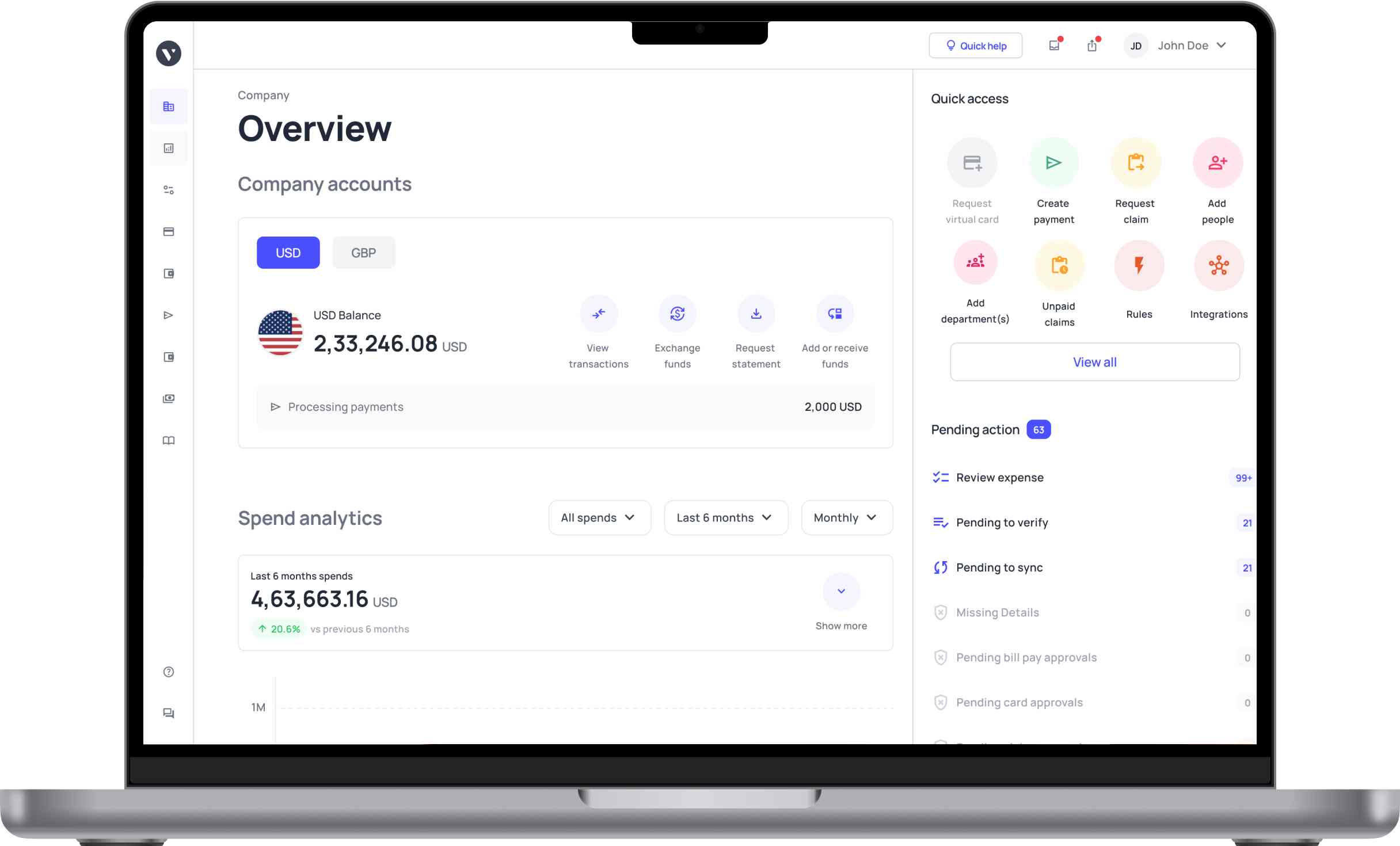
Volopay is the strongest alternative for businesses that have moved beyond basic transfers. It combines corporate cards (physical and virtual), multi-currency wallets, real-time expense tracking, approval workflows, and accounts payable automation in a single platform. Unlike Revolut or Wise, Volopay is built specifically for finance teams managing company-wide spending, vendor payments, and employee reimbursements.
It integrates natively with Xero, QuickBooks, MYOB, Deskera, and NetSuite, and gives finance leads granular control over budgets, merchant category restrictions, and spend limits by team or project. For companies that need a proper spend management layer, not just a bank account with a card attached, Volopay sits in a different category entirely.
Airwallex
Airwallex suits businesses that need global payment infrastructure at scale. It offers multi-currency accounts, competitive FX transfer rates, and a developer API supporting custom payment flows. It is particularly popular with e-commerce businesses and startups operating across multiple countries. Pricing is fee-based per transfer with no setup fee on the base account.
Payoneer
Payoneer is widely used by freelancers and marketplace sellers receiving payments through platforms like Amazon, Upwork, or Fiverr. It provides multi-currency receiving accounts and a prepaid Mastercard for spending. Fees are higher than Wise on many corridors, but its marketplace integrations and reach in underserved markets make it practical for the global freelance economy.
Xe Money Transfer
Xe suits individuals and businesses making occasional large international transfers where rate competitiveness on a single transaction matters more than ongoing account features. It offers competitive exchange rates, a straightforward platform, and no maximum transfer limits on most corridors.
They loved Volopay, you will too
Financial stack for business
No more switching between multiple bank accounts and tools to run your smart business. We have combined great software with every service you are using a bank for, to produce a state-of-the-art financial platform, Volopay.
Less time spent on manual reconciliations
Faster month-end book closing turnaround
Accurate receipt matching with automation
FAQs
Revolut is a financial super-app covering transfers, savings, crypto, and travel perks. Wise is purpose-built for international payments at the mid-market rate with full fee transparency. Revolut does more overall; Wise does international transfers more consistently and predictably.
Wise is the stronger choice for international transfer use cases. It uses the mid-market rate consistently, reaches 160+ countries through local payment rails, and shows every fee before you send. Revolut's rates and fees vary more by plan and timing.
Wise always applies the mid-market rate with no markup. In the comparison of Revolut vs. Wise exchange rates, Wise wins. Revolut matches it within plan limits but applies a markup on weekends and after you hit your monthly fair usage cap.
When comparing Revolut vs. Wise for freelancers, Wise wins if you invoice international clients and need local bank details to receive payments cleanly. Revolut suits freelancers who want a broader financial toolkit, including investments and savings alongside their payment needs.
Revolut's paid plans offer more for frequent travelers: insurance, lounge access, and higher ATM limits. The Wise vs. Revolut travel card comparison favors Wise for low-fee international spending without committing to a monthly subscription.
Yes, both have dedicated business products. Revolut Business suits teams wanting card-first spend management with broad tool integrations. In the Wise vs. Revolut business accounts comparison, Wise Business is the stronger fit for businesses focused on international payments and batch contractor payouts.
Volopay leads as the best alternative for businesses needing expense management and AP automation alongside global payments. Other credible options include Airwallex for payment infrastructure at scale, Payoneer for marketplace freelancers, and Xe Money Transfer for occasional high-value transfers.
In the Wise vs. Revolut multi-currency account comparison, Wise provides local bank details in 10+ currencies, making it far more practical for receiving international client payments. Revolut is better for holding and converting multiple currencies quickly within the app.