Ramp vs. Emburse: Which platform to choose?
Finance teams today need more than receipt tracking. They want automation, real-time visibility, and tight spend controls. That is why the Ramp vs. Emburse debate keeps coming up.
Both platforms look the part, but only one fits your business. We break down every factor that matters so you walk away with a clear answer as to which to choose in 2026.













REVIEWED BY

Akanksh Muniyappa
Head of Product
WRITTEN BY

Yashvi Tiwari
Content Writer
Quick summary: Ramp vs. Emburse
Ramp is the best choice for small and mid-sized businesses that want fast automation, cashback rewards, and simple spend control in one platform. Emburse fits larger companies that need deep customization, travel tools, and complex approval workflows.
Choose Ramp for speed and simplicity. Choose Emburse for flexibility and scale.
| Key factors | Ramp | Emburse |
|---|---|---|
Best for | SMB growth | Enterprise workflows |
Corporate cards | Limited | |
Receipt automation | ||
Travel management | Limited | |
Real-time visibility | ||
Global support | Limited | Limited |
Accounting integrations | ||
Bill Pay & AP | ||
AI automation | ||
Pricing model | Free tier available | Custom quote |
Ramp
Ramp is an AI-powered corporate card and spend management platform. It helps businesses automate financial operations, control spending, and improve efficiency.
Ramp started as a corporate card solution for startups. Since then, it has grown into a full finance platform. It now includes expense management, reimbursements, accounts payable, procurement, travel controls, and real-time reporting, all in one place.
The platform works best for startups, small and mid-sized businesses, and fast-growing companies. These are teams that want to cut down on manual finance work using automation and AI insights. Ramp is more than an expense tool. It is a modern finance platform built for lean teams that need speed, control, and visibility.
| Pros | Cons |
|---|---|
Unlimited virtual and physical corporate cards with a strong infrastructure | Travel management is less developed than specialized travel platforms |
AI-powered automation for expense categorization and receipt matching | Global availability and international support are still limited in some regions |
Strong mobile experience for approvals, receipts, and reimbursements | Some advanced features are only available on higher-tier paid plans |
Real-time spend visibility across all departments and teams | Reporting customization can feel limited for complex enterprise workflows |
Unified platform for cards, AP automation, reimbursements, and reporting | AI tools can feel slow or inconsistent during high-volume workflows |
Competitive cashback rewards with no annual card fees | Some users report occasional delays in customer support during urgent issues |
Emburse
Emburse is an expense, travel, and spend management platform. It helps businesses automate reimbursements, expense reporting, invoice processing, and policy compliance.
Emburse grew through the acquisition of several finance and expense management solutions, including Captio, Certify, Chrome River, Abacus, Nexonia, and Tallie. This gave it a broad set of tools built for organizations with complex financial workflows. The platform works best for mid-market companies, enterprises, schools, and organizations with heavy travel or reimbursement needs.
Emburse focuses on policy-driven expense and travel management rather than corporate cards. Its key strengths include configurable approval workflows, compliance controls, reimbursement management, ERP integrations, and flexible enterprise reporting. It is built for large finance teams with detailed, process-heavy operations.
| Pros | Cons |
|---|---|
Strong travel and expense management | The user interface can feel outdated compared to newer competitors |
Flexible approval workflows that can be configured for complex organizations | Navigation can feel unintuitive for first-time users |
Enterprise-level customization across policies, reporting, and reimbursements | Smaller businesses may find the platform too complex for their needs |
AI-assisted receipt coding and enforcement | Occasional mobile app stability issues |
Multiple specialized products under one ecosystem | Automation capabilities vary significantly across different Emburse products |
Strong mobile receipt capture and expense submission experience | Transaction syncing delays reported |
In-depth comparison: Ramp vs. Emburse
Choosing between Ramp vs. Emburse is about more than just price or brand name. You need to look at how each platform performs in the areas that matter most to your business, like finance efficiency, employee adoption, compliance, and growth. Below is a detailed comparison of Ramp vs. Emburse across the most important categories to help you decide.
Which tool is right for you?
Ramp
Ramp is ideal for startups, small businesses, and growing companies as it combines corporate cards, expense management, and bill pay with automation that reduces manual work and scales easily.
Emburse
Emburse works best for mid-size and large organizations that would benefit from advanced approval workflows, detailed expense policies, and multi-entity reporting for more complex financial operations.
Get your team working with Volopay
Key factors to consider in choosing the right product for you
Corporate cards & spending controls
Corporate cards matter because they determine how well your team controls employee spending before it happens. Without proper controls, unauthorized purchases and poor spend visibility become recurring problems.
Finance teams need the ability to set transaction limits, restrict merchant categories, and enforce approval policies in real time. When choosing a platform, check how easily you can issue virtual and physical cards, customize spending rules, and monitor transactions live. Teams with distributed employees should prioritize centralized controls and automated policy enforcement.
Expense management & receipt automation
Manual expense reports slow your team down. Receipts go missing, records get messy, and finance spends hours fixing errors that should never happen. For teams with high employee spending, this adds up fast.
Look for a platform that captures receipts by photo, matches them to transactions, and syncs with your accounting tool automatically. Check how fast reimbursements are processed and whether the tool flags policy violations before they are approved.
Teams with large expense volumes need automated coding, real-time approval tracking, and clear audit trails to stay in control without extra manual work.
Travel & reimbursement
Travel costs are hard to track without a system in place. Receipts get lost, mileage goes unreported, and reimbursements take too long. This frustrates employees and creates gaps in your financial records.
Look for a platform that handles travel approvals, expense submissions, and mileage claims in one place. Check if it supports your reimbursement policy and works on mobile for employees on the go.
If your team travels often or across countries, make sure the tool handles international expenses too. Clear approval steps and fast reimbursement processing matter most.
Reporting & analytics
Without strong reporting, finance teams struggle to track where money is going, spot unusual spending, or make confident budget decisions. Poor visibility leads to cost overruns and compliance gaps that are hard to catch until damage is already done.
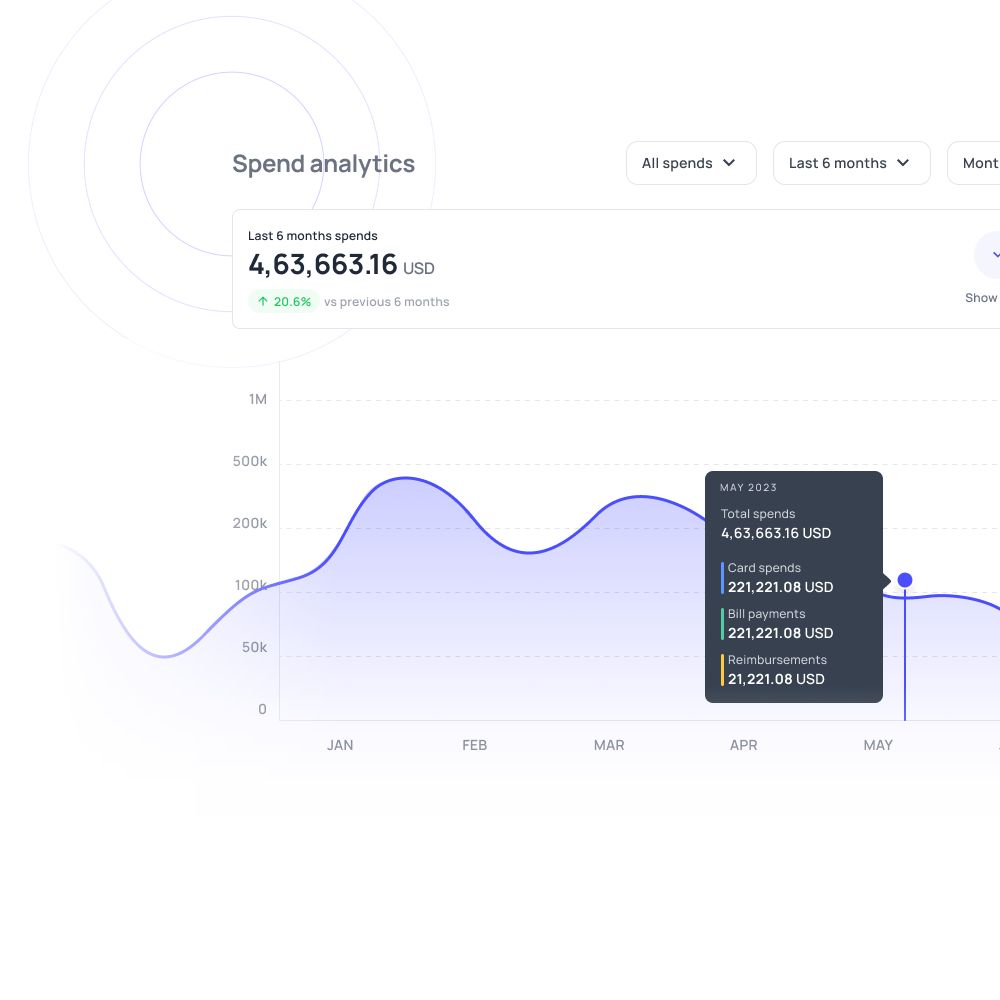
When evaluating platforms, look for real-time dashboards, customizable reports, and budget tracking across departments. Check whether the tool flags duplicate transactions or unusual activity automatically.
For teams with complex reporting needs, prioritize platforms that centralize financial data, support audit-ready reporting, and reduce reliance on manual spreadsheets. Strong analytics should inform decisions, not just display numbers.
Bill pay & accounts payable
Managing invoices and vendor payments takes time. Manual AP work leads to mistakes, late payments, and poor cash flow visibility. A strong AP system keeps finance teams organized and in control.
When choosing a platform, check how invoices are uploaded, approved, and paid. Look for support for ACH, bank transfers, and card payments. Review how approvals are routed and how transactions sync with your accounting system.
A good AP tool reduces manual work, speeds up payments, and gives finance teams better control over vendor relationships and cash flow every day.
AI & automation capabilities
Manual expense work slows teams down and causes errors. Good automation helps finance teams save time and work more accurately.
When picking a platform, look at what tasks it handles on its own. Check if it can match receipts, sort expenses, process invoices, and sync with your accounting tools. See if it sends spending alerts or flags unusual activity.
Growing businesses need strong automation. It cuts down on manual work and helps small finance teams do more without hiring extra staff. The right automation tools make daily finance tasks faster, simpler, and more accurate for everyone on the team.
Pricing & plans
Finance software costs can grow fast as your business scales. Some platforms charge extra for setup, support, or advanced features. A low starting price does not always mean low long-term costs.
When choosing a platform, review what each plan includes. Check for automation tools, integrations, and support options. See how pricing changes as users or transactions increase.
Pick a platform that fits your budget today and can grow with you. A clear pricing structure helps you avoid surprise costs and plan your finance software spending with confidence.
Accounting & ERP integrations
Bad integrations create errors and slow down your finance team. When software connects well with your accounting system, data syncs on its own. This saves time and keeps records clean.
When picking a platform, check if it works with QuickBooks, NetSuite, Xero, SAP, or Sage Intacct. Look at how fast data syncs and what export options are available.
Companies with multiple teams or locations need strong integration support. Good integrations help finance teams close the books faster and spend less time fixing mistakes made by manual data entry.
Company budget & size
Finance platforms are built for different business needs. Picking the wrong one can slow your team down and create more work as you grow.
Small businesses need simple tools, low costs, and fast setup. Larger companies need stronger controls, detailed approvals, and advanced reporting. When choosing a platform, check setup time, approval workflows, and reporting tools.
Look at user limits and support for multiple teams or locations. Pick a platform that fits where you are now and where you plan to grow. The right fit saves time and avoids extra finance work later.
Customer support & onboarding
Finance software affects daily work across your whole team. Poor onboarding leads to confusion, slow setup, and workflow problems. Good support helps employees learn faster and get more out of the platform.
When choosing a platform, check what onboarding help is included. Look for training resources, setup time, and support options like live chat or dedicated managers.
Small teams need fast setup and simple training. Larger companies may need more hands-on support during rollout. Strong onboarding and good support help your team get up and running without delays.
Security & compliance
Finance platforms store sensitive payment and business data. Weak security raises fraud risks and can cause compliance issues. Many businesses also need audit records to meet company or industry rules.
When choosing a platform, check for access controls, data encryption, and audit logs. Look for multi-factor authentication and role-based permissions. Businesses in regulated industries should review compliance reporting and approval workflows closely.
A secure platform protects your financial data and reduces risk. Strong security tools also help finance teams keep better control over spending and record every day.
Alternatives to Ramp and Emburse
Ramp and Emburse are good tools, but they do not work for every business. Some companies need better global payments. Others want simpler expense tools or easier approvals.
A few may need stronger travel features. There are other options worth looking at.
Volopay
Volopay is a great option for businesses that need global payments and simple finance tools in one place. It combines corporate cards, expense tracking, bill payments, reimbursements, and approvals in a single system.
Teams can issue virtual and physical cards with spending limits and budget controls. Businesses that pay vendors or contractors in other countries can use Volopay's multi-currency payment tools to send money fast.
Approval workflows are easy to set up and can be customized to fit any team size. Unlike Ramp and Emburse, Volopay gives businesses a single platform for both domestic and cross-border finance operations without needing extra tools.
Volopay also offers real-time spend tracking, automated receipt collection, and department-level budget controls that help finance teams stay on top of every transaction. Volopay connects with Xero, QuickBooks, and NetSuite to cut down on manual accounting work.
Best for: Startups, agencies, and growing teams that manage global payments and want one simple platform for all finance needs.
Brex
Brex is popular with startups and growing companies. It offers corporate cards, expense tracking, travel booking, and finance tools in one platform. Many businesses compare Brex with Ramp because both focus on modern spend management.
Brex works well for teams in different countries. It supports global spending, multiple business entities, and employee reimbursements. Finance teams can set spending rules, issue virtual cards, and track expenses in real time.
Brex also has built-in travel tools. Employees can book trips and manage travel costs in the same system. It connects with QuickBooks, Xero, and NetSuite to make bookkeeping easier.
Companies that manage high transaction volumes or operate across multiple countries often choose Brex because it handles complex spending structures without extra tools. Brex offers a free plan for startups and a premium plan starting at around $12 per user per month.
Best for: Startups and fast-growing companies that need global spend management, built-in travel tools, and strong automation in one platform.
Airbase
Airbase is a good option for companies that need strong approval workflows and better spending control. It combines expense management, bill payments, reimbursements, and corporate cards in one platform. Many mid-sized businesses use it to manage all spending from one place.
One reason companies choose Airbase is its approval process. Employees send a request before making a purchase. Managers review and approve it before money is spent. This helps control budgets and reduce unwanted spending.
Finance teams in legal, healthcare, and technology companies often choose Airbase because it gives them full visibility into spending before it happens. This is especially useful for businesses that need to track budgets across multiple departments or cost centers.
Airbase also automates accounting tasks like receipt matching and invoice management. It connects with NetSuite and Sage Intacct to keep records accurate. Airbase uses custom, quote-based pricing tailored to your organization's needs.
Best for: Mid-sized businesses that need strong pre-approval controls, detailed budget tracking, and automated accounting workflows.
SAP Concur
SAP Concur is one of the largest expense and travel management platforms in the world. Large businesses use it to handle complex finance operations, travel management, and detailed reporting.
Employees can book travel, upload receipts, and submit expense reports in one place. Finance teams can review and approve expenses while tracking spending across departments. It integrates with major ERP systems like SAP S/4HANA, Oracle, and Microsoft Dynamics, making it a natural fit for enterprises already using these ecosystems.
Concur is also strong on compliance. It helps large companies keep detailed records for taxes, audits, and internal rules. Companies operating across multiple countries benefit from its multi-currency support and region-specific tax compliance features.
Some users find Concur harder to use than newer platforms like Ramp. Setup can take longer, too. But large companies that need global support and strong controls still rely on it. Pricing is custom and quote-based.
Best for: Large enterprises with 500+ employees, high travel volumes, complex approval workflows, and global operations.
They loved Volopay, you will too
Financial stack for business
No more switching between multiple bank accounts and tools to run your smart business. We have combined great software with every service you are using a bank for, to produce a state-of-the-art financial platform, Volopay.
Less time spent on manual reconciliations
Faster month-end book closing turnaround
Accurate receipt matching with automation
FAQs
Ramp focuses on AI-powered corporate cards and spend automation. Emburse focuses more on expense reporting, reimbursements, and travel management for larger teams.
Ramp is the better choice for corporate cards. It offers real-time spending controls, virtual cards, and automated policy enforcement, making it easier for finance teams to manage and track company spending efficiently.
Emburse is better for complex enterprise expense reporting with detailed approval workflows. Ramp suits teams that prefer speed and automation. Overall, Ramp is the stronger choice for most modern finance teams prioritizing simplicity and efficiency.
Ramp offers transparent, free core pricing and earns revenue through interchange card fees, making it accessible for most businesses. Emburse uses custom, quote-based pricing depending on company size and feature needs, which suits larger enterprises better.
Emburse is the better choice for travel reimbursements, particularly for enterprises with detailed travel policies and complex approval chains. Ramp works well for simpler reimbursement needs but lacks Emburse's depth in managing structured travel workflows.
Ramp is the better choice for receipt automation. Its AI automatically matches receipts, flags missing submissions, and reduces manual work. Emburse offers solid automation, too, but focuses more on structured approval workflows than speed.
Ramp is clearly the better choice for small businesses. It is quick to set up, simple to use, and designed for fast-growing teams that need straightforward expense management without complex configurations or enterprise-level overhead.
Ramp is the better choice for straightforward QuickBooks and NetSuite syncing, offering fast and clean integration. Emburse edges ahead for complex ERP configurations and enterprise-level accounting needs requiring deeper customization and structured data mapping.
Yes. Emburse can replace Ramp for teams that need strong reimbursement workflows and enterprise-level approvals. It handles employee expenses and corporate cards well, though it lacks Ramp's built-in savings insights and automation depth.
Volopay, Brex, and SAP Concur are strong alternatives. Volopay combines corporate cards, expense management, and bill payments in one platform. Brex suits startups needing smart corporate cards, while SAP Concur is ideal for large enterprises managing travel and compliance.