Ramp vs Brex: Which platform is better?
Ramp and Brex are two leading platforms that businesses consider when choosing a corporate card and spend management solution. Both offer expense controls, automation, rewards, and financial visibility. Making the right choice can be tough.
Through this Brex vs. Ramp comparison, you will gain clearer insights into which solution better supports your finance operations.











REVIEWED BY

Akanksh Muniyappa
Head of Product
WRITTEN BY

Alifiya Rathod
Content Writer
Quick summary: Ramp vs Brex
When comparing Brex vs. Ramp, decisions often depend on your company’s growth stage, spending complexity, and global operations. Ramp suits businesses focused on cost control, automation, and straightforward expense management. Brex works well for fast-growing companies needing international capabilities, travel tools, and startup-focused benefits.
This features comparison helps you evaluate which platform better supports your financial workflows and priorities. Your final choice should depend on whether your business values stronger cost optimization and simplicity or broader global features and startup-focused financial flexibility.
| Key factors | Ramp | Brex |
|---|---|---|
Corporate cards & spending controls | Better spending controls | Flexible company cards |
Expense management & receipt automation | Easy expense tracking | Fast receipt uploads |
Bill pay & accounts payable automation | Simple bill payments | Easy vendor payments |
International & multi-currency support | Limited global support | Better international support |
Company budget & size | Best for small businesses | Best for growing startups |
Pricing & plans | Free basic platform | More premium plans |
Integrations & ecosystem | Many software integrations | Startup-friendly integrations |
Accounting & ERP integrations | Easy accounting sync | Good ERP connections |
Reporting & analytics | Clear spending reports | Real-time expense insights |
Customer support & onboarding | Simple setup support | Dedicated customer assistance |
Security & compliance | Strong fraud protection | Advanced security controls |
Ramp
Ramp is a modern corporate spend management platform designed to help control expenses, automate finance workflows, and improve company savings. Since launching in 2019, Ramp has expanded from corporate cards into accounts payable, travel, procurement, and AI-driven automation tools. When you do a Ramp vs. Brex business account comparison, you’ll see that Ramp works best for growing businesses seeking operational efficiency, tighter spending visibility, and simplified finance management.
| Pros | Cons |
|---|---|
Easy expense tracking | Limited global coverage |
Strong spending controls | Fewer travel features |
Fast automation tools | No built-in banking |
Brex
Brex is a modern spend management and corporate card platform built for startups, scaling businesses, and global teams. Since launching in 2017, it has evolved from startup-focused corporate cards into a broader financial operations platform with travel, banking, automation, and international payment capabilities.
Compared to Ramp, Brex suits companies that need scalability, global operations, and flexible controls. Unlike Ramp’s cost-control focus, Brex focuses more on global growth, startup benefits, and travel flexibility, making it better for fast-growing companies.
| Pros | Cons |
|---|---|
Strong international payment support | Higher pricing for features |
Flexible rewards and travel perks | Complex setup for beginners |
Good for fast-growing startups | Limited savings-focused tools |
Advanced multi-currency features | Fewer budget-saving insights |
In-depth comparison: Ramp vs Brex
We’ll now compare Ramp and Brex across the features that matter most to your business, including spending controls, automation, pricing, integrations, reporting, and global support. This section helps you understand where each platform performs better, making your Ramp vs. Brex review easier when choosing a platform.
Which tool is right for you?
Ramp
Ramp is best for growing businesses focused on cost control, automation, spending visibility, and streamlined expense management for greater operational efficiency.
Brex
Brex is ideal for fast-growing companies that need international capabilities, travel management, and startup-focused benefits to support global expansion.
Get your team working with Volopay
Key factors to consider in choosing the right product for you
Corporate cards & spending controls
You should look at how well the platform helps control employee spending while still allowing flexibility for daily business purchases. Features like customizable spending limits, merchant restrictions, approval workflows, and virtual cards can help reduce unnecessary expenses. Think about whether your business needs stronger finance oversight, department-based budgets, or card management that can scale as your company and spending grow.
Expense management & receipt automation
You need expense management tools that reduce manual work, improve reporting accuracy, and make reimbursements easier for employees and finance teams. Features like automatic receipt matching, expense categorization, and real-time tracking help save time and reduce errors. Consider how often your team submits expenses and whether automation can improve compliance, visibility, and month-end closing across different departments.
Bill pay & accounts payable automation
You should check whether the platform makes vendor payments, invoice management, and approval processes easier without slowing down your finance team. Automated accounts payable workflows can help reduce processing time, prevent missed payments, and improve cash flow visibility. Consider your company’s invoice volume, approval structure, and need for centralized financial control before choosing a solution.
International & multi-currency support
You should consider whether the platform supports global payments, foreign transactions, and multi-currency expense management for international teams or vendors. Strong international features can help reduce currency conversion issues, improve payment flexibility, and simplify financial operations across different regions. Think about your company’s growth plans, business travel needs, and cross-border payments before making a decision.
Company budget & size
You need a solution that fits your company’s financial needs, team size, and operational scale without adding unnecessary costs or limitations. Smaller businesses may prefer simple and affordable tools, while larger companies often need advanced controls, approvals, and reporting features. Consider your current budget, future growth, and financial management challenges when choosing a platform that can support your business long term.
Pricing & plans
You should compare pricing plans carefully to understand which features are included, limited, or only available in higher-tier plans. The right platform should provide strong value without putting extra financial pressure on your business. Consider your expected usage, team size, automation requirements, and integration needs to see whether the pricing matches your company’s spending priorities.
Accounting & ERP integrations
You need software that works smoothly with your accounting or ERP system to make reconciliation, reporting, and financial management easier. Reliable integrations help reduce duplicate work, minimize errors, and speed up month-end closing.
Think about your current finance setup, reporting needs, and whether your team would benefit from automatic syncing between expense data and financial systems. Strong integrations can also make financial records more accurate and easier to manage over time.
Reporting & analytics
You should look for platforms that provide clear spending insights, customizable reports, and real-time financial visibility to support better decision-making. Detailed analytics can help identify cost-saving opportunities, track budgets, and improve financial planning.
Consider how often your business reviews financial performance and whether advanced reporting tools would support stronger operational and strategic planning. Strong reporting can also help you quickly spot spending patterns and respond to changes faster.
Customer support & onboarding
You need reliable customer support and a smooth onboarding process, so your team can start using the platform quickly without disrupting daily financial work. Fast and helpful support makes it easier to fix issues, while guided setup helps employees and finance teams get started with less confusion.
Consider your company’s internal resources, technical skills, and how much support you may need during implementation. Good onboarding can also improve adoption and reduce mistakes in the early stages of use.
Security & compliance
You should focus on platforms that offer strong security, fraud protection, and proper compliance certifications to keep company data and finances safe. Features like role-based access, transaction tracking, and secure login methods help reduce risks and build trust in the system.
Consider your industry rules, internal policies, and legal compliance needs before choosing a solution. Strong security practices also help protect sensitive financial data and prevent unauthorized access over time.
Alternatives to Ramp and Brex
Ramp and Brex may not suit every business, especially if your company needs different pricing, workflows, or global finance capabilities. Depending on your business needs, you may get better value from platforms that offer stronger international support, better accounts payable automation, or simpler everyday expense management.
Volopay
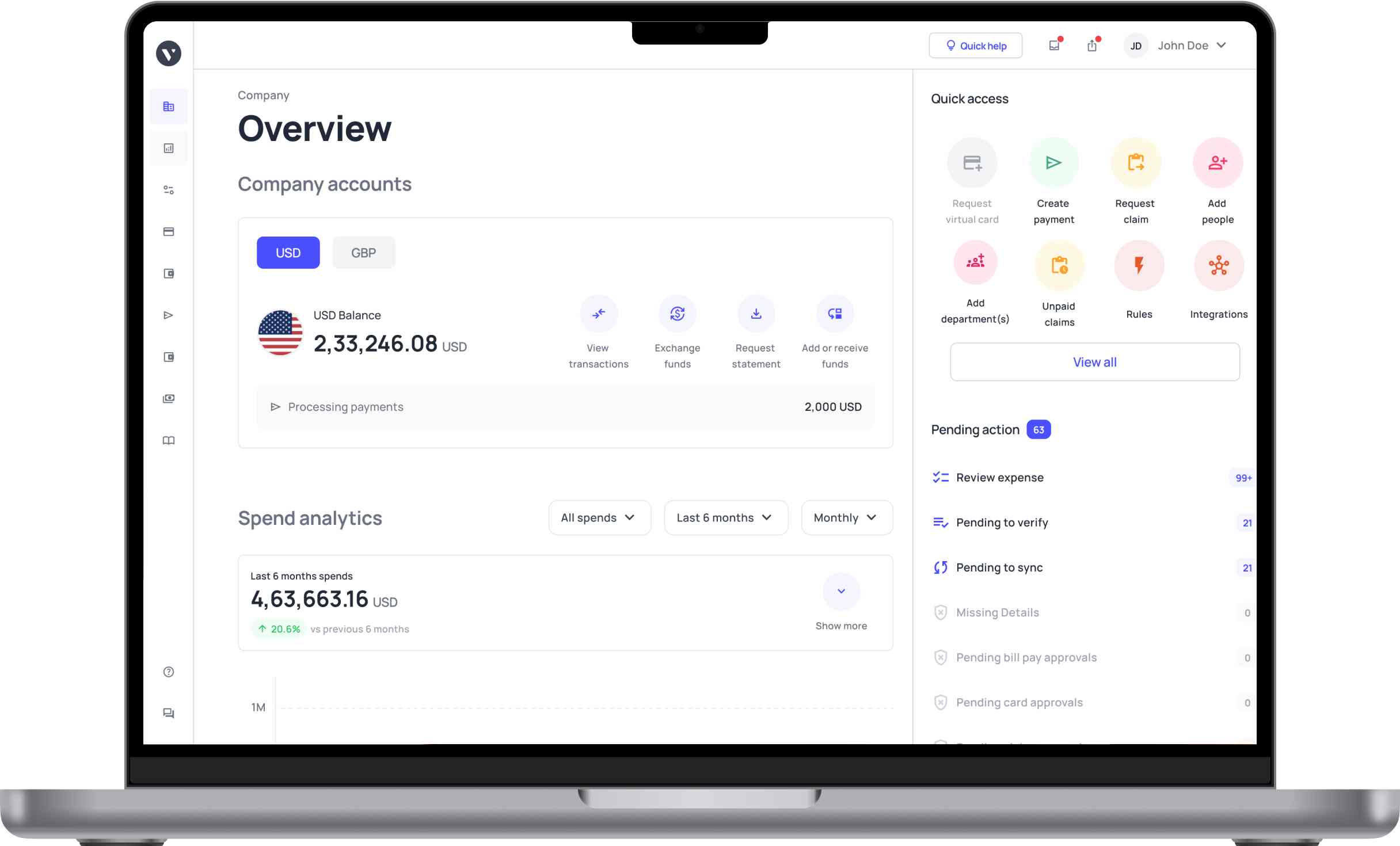
Volopay is an all-in-one spend management platform combining corporate cards, expense management, bill payments, reimbursements, approvals, and accounting integrations within one system. It works especially well for businesses managing distributed teams and international payments without wanting overly complex finance software.
You may prefer Volopay if your company values centralized financial visibility, multi-currency support, and operational simplicity while still maintaining strong spending controls and automation features.
Airbase
Airbase is a strong option for businesses wanting deeper accounts payable automation and finance workflow management. Its platform combines expense management, procurement, approvals, and accounting automation in a more structured environment.
You may find Airbase useful if your finance operations involve detailed approval chains, vendor management, and higher transaction volumes. It often suits mid-sized businesses looking for stronger operational control and more mature finance processes.
Spendesk
Spendesk works well for companies prioritizing employee spending visibility, team collaboration, and simplified purchasing workflows. Its platform focuses heavily on helping finance teams manage approvals, receipts, reimbursements, and company cards from one place.
You may prefer Spendesk if your business wants an easy-to-use system that encourages employee accountability while reducing manual finance tasks and improving day-to-day operational efficiency across departments.
They loved Volopay, you will too
Financial stack for business
No more switching between multiple bank accounts and tools to run your smart business. We have combined great software with every service you are using a bank for, to produce a state-of-the-art financial platform, Volopay.
Less time spent on manual reconciliations
Faster month-end book closing turnaround
Accurate receipt matching with automation
FAQs
Ramp mainly focuses on reducing company spending through automation, budgeting controls, and cost-saving insights. Brex offers broader financial tools, including travel management, international payments, and startup-focused rewards.
Ramp is often better for small businesses wanting affordable automation, simple expense management, and stronger spending visibility. Brex works well for startups expecting rapid growth, international operations, and larger employee teams. Your decision should depend on your growth stage, operational complexity, and whether global financial flexibility matters for your business.
Ramp generally offers transparent pricing, but some advanced tools or third-party integrations may create additional operational costs over time. Brex can become more expensive through premium plans, advanced financial features, or travel-related services. You should carefully review feature access, scaling costs, and integration requirements before choosing either platform.
Both Ramp and Brex support certain international operations, but Brex provides broader multi-currency support and stronger global payment flexibility. Ramp remains more focused on US-based financial operations with limited international capabilities. If your company handles cross-border payments regularly, Brex may offer a smoother and more scalable experience overall.
Yes, some businesses may find Volopay better suited for global operations because it combines corporate cards, expense management, bill payments, and multi-currency support within one platform. Airbase and Spendesk are also strong alternatives depending on your operational priorities. Your ideal choice depends on international payment needs and finance workflow complexity
Volopay can be a stronger option for international spend management because it supports multi-currency transactions, global reimbursements, vendor payments, and centralized expense visibility within one system.
Coupa works excellently for firms dealing with international vendors, and Airbase also offers international spend management, ideal for mid-sized firms. Expensify is a viable alternative for companies looking to balance reimbursements and international spending.
Volopay offers flexible corporate card management through customizable spending controls, virtual cards, approval workflows, and multi-currency support for global teams. Its broader international capabilities also make it practical for companies managing cross-border spending regularly and efficiently.
For European and UK-based businesses, Revolut and Pleo also offer flexible card management with sleek interfaces and easy-to-navigate portals. For companies looking at traditional banking options, American Express and Capital One provide good international card options with reward programs.
Volopay stands out as a strong alternative because it combines spend management, corporate cards, reimbursements, bill payments, and accounting integrations within one platform.
Airbase works well for advanced accounts payable workflows, while Spendesk suits businesses prioritizing employee spending visibility. Your best choice depends on operational complexity, international needs, and finance automation priorities.