Payhawk vs. Pleo: Which expense tool is better?
Your finance team is not losing receipts. Your employees are just not submitting them. Payhawk and Pleo both promise to fix that, and both actually do, but in very different ways. This comparison will help you pick the one that fits how your business actually spends money, before you waste three months trialling the wrong platform.









REVIEWED BY

Akanksh Muniyappa
Head of Product
WRITTEN BY

Shahla Jabbeen
Content Writer
Quick summary: Payhawk vs. Pleo
Payhawk usually makes more sense for companies that want tighter spend governance, stronger multi-entity controls, and a finance stack that can scale alongside more complex operations. Pleo appeals more to teams prioritizing simplicity, employee adoption, and lightweight expense management without introducing too much process overhead.
Both are strong modern spend platforms. The better fit mostly depends on how structured your finance operations already are.
| Key factors | Payhawk | Pleo |
|---|---|---|
Primary positioning | Enterprise-ready spend management | Employee-first expense management |
Best for | Scaling and multi-entity businesses | SMBs and growing teams |
Corporate cards | Strong governance and approval controls | Flexible employee card usage |
Expense management | Structured and finance-led | Lightweight and intuitive |
Receipt automation | Advanced policy and workflow integration | Fast and simple capture experience |
Multi-currency support | Strong international operations support | Good European-focused support |
Accounts payable | More advanced invoice workflows | Lighter AP functionality |
Reporting & analytics | Deeper finance reporting capabilities | Simpler operational reporting |
ERP integrations | Better suited for complex finance stacks | Easier setup for smaller teams |
Employee adoption | More process-oriented | Faster onboarding and adoption |
Ideal company profile | Operationally mature finance teams | Teams prioritizing usability and speed |
Payhawk
Payhawk positions itself closer to an enterprise-grade spend management platform than a simple employee expense tool. The product combines corporate cards, expense management, invoice handling, reimbursements, procurement workflows, and accounting automation into a fairly centralized finance operations system. Over the last few years, the platform has moved steadily upmarket, especially among companies dealing with multi-entity structures and international operations.
One reason finance teams gravitate toward Payhawk is the level of control built into the workflows. Approval routing, spend visibility, ERP synchronization, and policy enforcement feel designed for organizations where finance governance matters quite a bit. It is not just about giving employees cards. The platform is trying to create a tighter operational layer around company spending overall.
That added structure can be useful once transaction volumes start increasing across departments and countries. Smaller teams, though, sometimes find Payhawk slightly heavier than they initially expected, particularly if their expense processes are still relatively simple.
| Pros | Cons |
|---|---|
Strong spend governance controls | Can feel process-heavy for smaller teams |
Mature multi-entity support | Onboarding may require more finance configuration |
Good international and multi-currency capabilities | Less lightweight than employee-first expense tools |
Pleo
Pleo approaches spend management from a noticeably different angle. The platform feels much more employee-centric in day-to-day usage. Smart cards, receipt capture, reimbursements, and expense categorization are designed to happen quickly with as little friction as possible. That simplicity is a major reason Pleo became popular with startups and SMBs across Europe.
Where Payhawk often emphasizes control, Pleo tends to emphasize usability. Employees generally adapt to it very quickly because the workflows feel intuitive rather than heavily administrative. Finance teams still get oversight, but the product avoids making every purchase feel like part of a formal procurement process.
That lighter experience works extremely well for growing companies that want to improve expense visibility without building rigid finance structures too early. The tradeoff is that larger organizations with more layered approval environments or complex entity structures may eventually want deeper governance capabilities than Pleo currently prioritizes.
| Pros | Cons |
|---|---|
Very easy employee adoption | Less advanced procurement and AP workflows |
Fast receipt capture and expense reporting | May feel limiting for larger finance operations |
Sends money to 160+ countries within 24 hours | Governance controls are lighter than enterprise-oriented platforms |
In-depth comparison: Payhawk vs. Pleo
Payhawk and Pleo solve many of the same finance problems, which is exactly why companies end up struggling between them. Both modernize expense management. Both replace manual reimbursement chaos. Both centralize company spending better than traditional card programs ever did.
The difference is really about how much structure a business wants wrapped around spending. Payhawk tends to assume finance teams want tighter oversight as the company scales. Pleo assumes employees should be able to spend with minimal friction unless finance truly needs to intervene. Those philosophies shape almost every workflow inside the products.
Which tool is right for you?
Payhawk
Payhawk is best for mid-sized and enterprise businesses that need centralized spend management, strong financial controls, and support for multi-entity operations.
Pleo
Pleo is best for startups and small to mid-sized businesses that prioritize simple, employee-friendly expense management and fast adoption.
Get your team working with Volopay
Key factors to consider in choosing the right product for you
Corporate cards & spending controls
Corporate cards stop being simple payment tools once spending becomes distributed across teams, subscriptions, travel, vendors, and recurring operational expenses. Some businesses need granular controls tied closely to approvals and budgets. Others mainly want employees to stop using personal cards and manual reimbursements.
Expense management & receipt automation
Expense tools only work if employees actually use them properly. A platform with powerful controls means very little if receipts still go missing constantly or expense reporting becomes frustrating enough that employees delay submissions. Ease of adoption matters more than many finance teams initially expect.
Multi-currency & international support
International spending complexity arrives earlier than most growing companies anticipate. Different currencies, tax rules, reimbursement policies, banking systems, and entity structures can quickly create operational friction if the finance stack was originally built only for domestic spending.
Accounts payable & invoice management
Invoice workflows become increasingly important once vendor payments scale across departments and regions. Smaller companies may only need lightweight invoice handling, but growing organizations often require stronger approval routing, procurement visibility, and centralized AP oversight to avoid operational inconsistencies.
Reporting & analytics
Reporting requirements usually evolve alongside financial maturity. Some teams only need clean visibility into spending trends and department budgets. Others require entity-level reporting, approval audit trails, procurement visibility, and consolidated financial oversight across multiple regions or business units.
Travel & reimbursement
Travel spending creates surprisingly inconsistent employee behavior. Some companies want highly flexible reimbursement workflows. Others prefer stricter controls tied directly to travel policies and pre-approvals. The right balance often depends on how decentralized employee spending already is.
Pricing & plans
Software pricing rarely tells the full story. Implementation overhead, finance administration time, reconciliation work, employee adoption, and operational maintenance often end up affecting long-term cost far more than the subscription itself.
Accounting & ERP integrations
An integration existing on a vendor page does not necessarily mean the accounting workflow will feel clean operationally. Finance teams should evaluate how transactions sync, how approvals map into accounting systems, and how much manual correction still happens after reconciliation.
Company budget & size
Headcount alone is not the best predictor of which spend platform will fit properly. Operational complexity matters far more. A smaller international company may need stronger governance and multi-currency controls than a much larger domestic business with relatively simple workflows.
Customer support & onboarding
The more deeply finance software touches accounting workflows and approvals, the more implementation quality starts affecting long-term adoption. Some products are intentionally lightweight. Others require more process design and finance-side planning before they operate smoothly.
Security & compliance
Security is not only about certifications. Approval enforcement, audit visibility, transaction oversight, reimbursement controls, and policy governance all affect financial risk management differently, depending on how the company operates internally.
Alternatives to Payhawk and Pleo
Payhawk and Pleo are both strong modern expense platforms, but they are not always the best fit once businesses start operating across multiple countries, handling larger AP workflows, or managing more complex finance operations than basic expense reporting alone.
Some companies eventually want a broader finance infrastructure around cards, approvals, reimbursements, procurement, and international payments rather than a standalone expense management.
Volopay
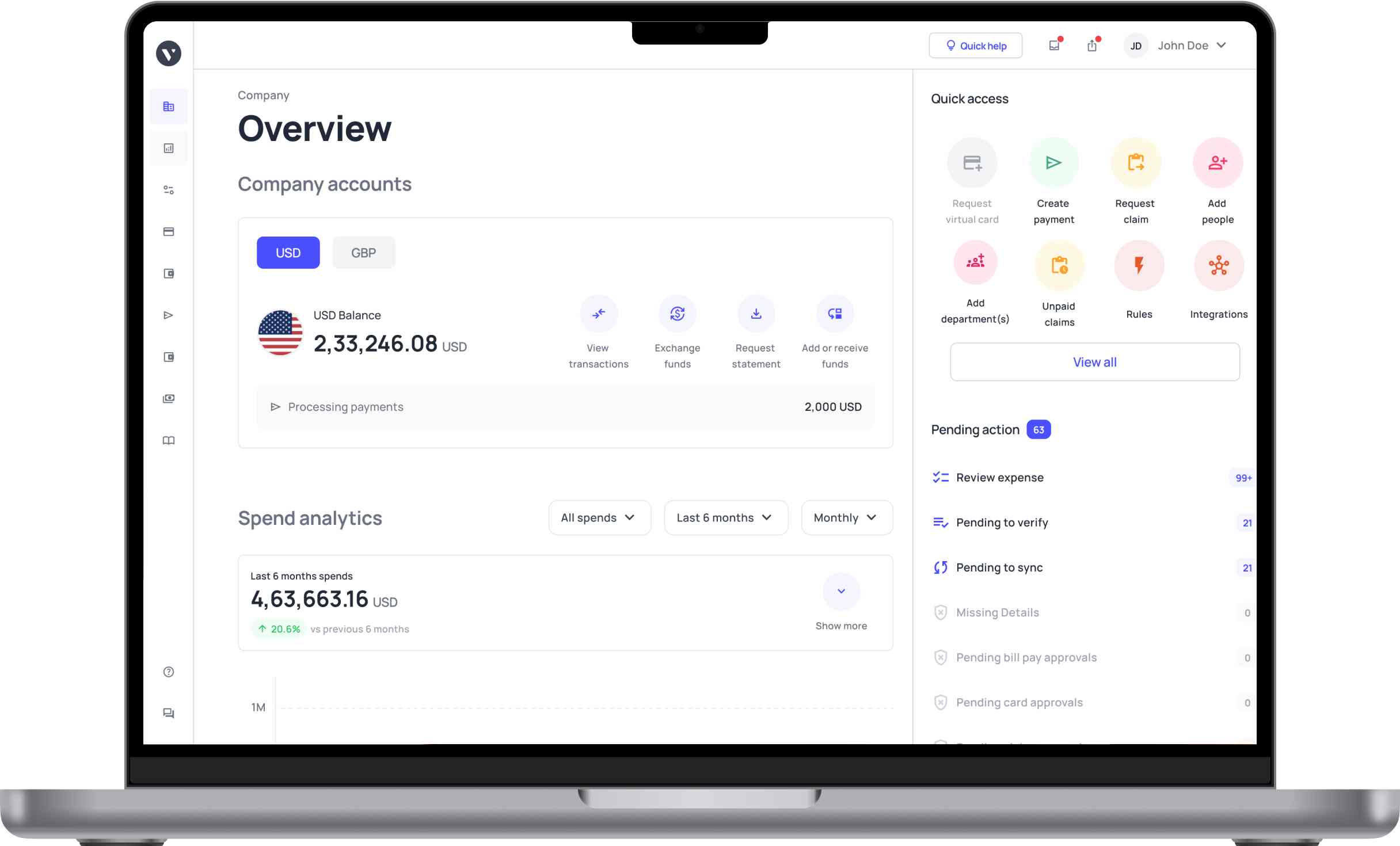
Volopay is one of the stronger alternatives for businesses that need more than expense management. While Payhawk and Pleo focus primarily on spend control and employee expenses, Volopay combines corporate cards, expense management, AP automation, procurement approvals, reimbursements, and international payments in a single platform.
This makes it particularly attractive for companies operating across multiple countries, managing distributed teams, or handling large volumes of vendor payments alongside employee spending. Businesses that find themselves using separate tools for cards, expenses, approvals, and cross-border payments often benefit from the additional consolidation Volopay provides.
Ramp
Ramp is a well-suited option for startups and high-growth companies that care more about automation and finance efficiency than complex governance structures. The platform focuses heavily on reducing manual accounting work through automated categorization, receipt matching, approval workflows, and reconciliation support.
Companies evaluating Payhawk or Pleo often choose Ramp when their primary objective is to help a lean finance team move faster rather than building highly structured procurement and approval processes.
Airbase
Airbase is typically a better fit for organizations that have outgrown basic expense management and want tighter control over company-wide spending. Its combination of corporate cards, accounts payable, procurement workflows, and spend approvals creates a more centralized finance operating model.
Businesses with multiple departments, formal purchasing processes, or growing compliance requirements often find Airbase better suited to their needs than lighter employee-focused expense platforms.
Spendesk
Spendesk remains a popular choice for companies that want a balance between finance oversight and employee autonomy. The platform is particularly well-suited to distributed teams that want employees to make purchases independently without constantly relying on reimbursements or manual approval requests.
For organizations that value simplicity, employee adoption, and decentralized spending more than deep finance governance, Spendesk can be a compelling alternative to both Payhawk and Pleo.
They loved Volopay, you will too
Financial stack for business
No more switching between multiple bank accounts and tools to run your smart business. We have combined great software with every service you are using a bank for, to produce a state-of-the-art financial platform, Volopay.
Less time spent on manual reconciliations
Faster month-end book closing turnaround
Accurate receipt matching with automation
FAQs
Payhawk focuses more heavily on structured spend governance, multi-entity finance operations, and enterprise-ready controls. Pleo takes a more employee-first approach centered around simplicity, fast adoption, and lightweight expense management workflows.
Pleo is usually the easier fit for small businesses because onboarding is simpler, employee adoption tends to happen faster, and the workflows feel less operationally heavy. Payhawk often becomes more attractive once finance operations grow more complex.
Payhawk generally offers stronger corporate card capabilities for growing and larger businesses. Its card program is closely tied to spend controls, approval workflows, budget ownership, and finance governance, making it particularly useful for organizations that need tighter oversight of company spending.
Pleo also offers excellent corporate cards, but the focus is different. The platform prioritizes employee convenience, fast card issuance, and simple day-to-day spending. For smaller teams, that simplicity can actually be an advantage, but companies with more complex finance operations often prefer the additional control available through Payhawk.
Pleo generally feels more accessible for smaller teams because the implementation and operational overhead are lighter. Payhawk can become more cost-effective for larger or more complex organizations once stronger governance and finance controls start reducing manual operational work.
Pleo is generally the better choice for straightforward expense reporting and employee adoption. The platform makes receipt capture, expense submission, and reimbursement workflows extremely simple, which helps reduce the amount of chasing and follow-up finance teams need to do.
Payhawk offers more structured expense reporting with stronger approval workflows, policy enforcement, and finance oversight. Businesses operating in regulated environments or managing larger teams often value this additional control, even if the process feels slightly more structured for employees.
Payhawk usually integrates better for businesses with more complex accounting requirements. Its integrations are designed to support multi-entity organizations, ERP environments, advanced approval structures, and more sophisticated finance operations. Companies using platforms like NetSuite often appreciate the additional depth.
Pleo also integrates with major accounting systems and is generally easier to set up and maintain. For startups and SMBs with simpler accounting workflows, that ease of implementation can be more valuable than having access to advanced ERP functionality.
For most growing European businesses, Payhawk has a slight edge because of its stronger international finance capabilities and scalability. That said, the right choice depends heavily on operational requirements. Pleo remains one of the most user-friendly expense management platforms available and is often a better fit for startups and SMBs that prioritize employee experience and simplicity.
Payhawk becomes more attractive as organizations expand across countries, add multiple entities, introduce stricter approval processes, or require deeper reporting and spend governance. Both platforms were built with European businesses in mind, but they tend to serve different stages of operational maturity.
Yes, both support multi-currency spending, though Payhawk generally offers stronger functionality for businesses operating across multiple countries, entities, and international finance workflows.
Payhawk usually provides stronger invoice management and AP workflows, especially for companies needing centralized approvals, procurement alignment, and more structured finance governance. Pleo’s invoice functionality is lighter and more expense-focused operationally.
Volopay is one of the strongest alternatives for businesses wanting broader global finance operations alongside spend management. The platform combines corporate cards, AP automation, procurement approvals, reimbursements, and international payments inside one system. Other strong alternatives include Ramp for automation-focused spend management, Airbase for structured finance governance, and Spendesk for employee-friendly expense workflows.