10 Payhawk alternatives for spend management
Nobody starts searching for Payhawk alternatives without a reason. Most often it's the FX charges. Payhawk only waives foreign exchange fees when the card is issued in the currency you're spending in, so anything outside that set picks up a 1.99% markup.
For other teams, it's paying per physical card, or watching a supplier payment sit blocked while support catches up. Whatever set it off, the cost lands in places your budget doesn't track. We've compared ten platforms below on pricing, currency coverage, approval workflows, and support, so you can build a shortlist in one sitting.









REVIEWED BY

Akanksh Muniyappa
Head of Product
WRITTEN BY

Mahasweta Bose
Content Writer
Quick summary of the best Payhawk alternatives
● Volopay: Best for APAC-based startups and mid-market businesses that want an all-in-one platform.
● Ramp: Great for US-based, fast-growing companies that want to spend less.
● Brex - Best suited for high-growth, venture-backed startups and large global corporations that need high credit limits.
● Pleo: Best for European startups and small businesses moving away from manual expense reporting for the first time.
● Spendesk: Good choice for European mid-market companies managing spend across multiple entities.
● Airbase: Good for mid-market companies that need a true end-to-end procure-to-pay platform.
● Expensify: Best for small to mid-sized teams and freelancers who need the fastest, most frictionless receipt capture and reimbursement experience.
● Tipalti: Best for companies with high-volume, cross-border supplier and vendor payments.
● SAP Concur: Great for large global enterprises deeply embedded in the SAP ecosystem that need comprehensive travel booking, invoice management, and multi-level compliance in one platform.
● Sage Expense Management: A great option for businesses that want modern expense automation without being forced to switch banks or corporate cards.
| Tool | Best for | Flexible credit limits | Business banking | In-app travel booking | Multi-currency support | Fast onboarding | Responsive support | Custom workflow automation |
|---|---|---|---|---|---|---|---|---|
Volopay | Global teams & growing businesses | Limited functionality | ||||||
Ramp | For cost savings | Limited functionality | Limited functionality | |||||
Brex | Startups & high-growth | Limited functionality | ||||||
Pleo | EU-based startups & small companies | Limited functionality | Limited functionality | |||||
Spendesk | EU-based mid-market businesses | Limited functionality | Limited functionality | |||||
Airbase by Paylocity | Mid-market procure-to-pay | |||||||
Expensify | For small to mid-sized businesses | |||||||
Tipalti | For finance-heavy firms | |||||||
SAP Concur | For enterprises | Limited functionality | ||||||
Sage Expense Management | For flexible, employee-centric expense management |
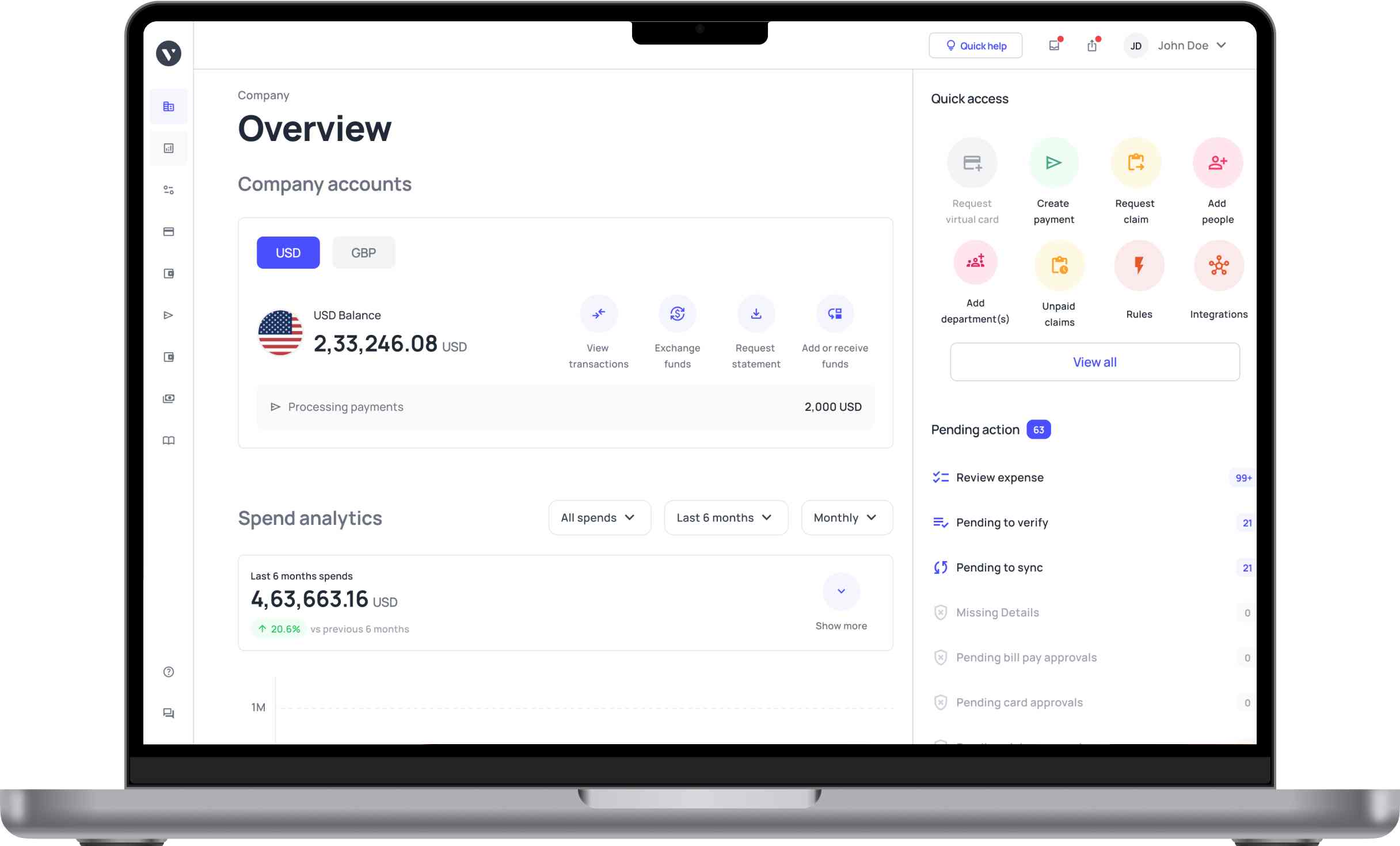
Get your team working with Volopay
Best for a fully automated finance suite
1. Volopay
Best for: Startups and mid-market businesses in APAC, India, and the US that need an all-in-one spend management platform without enterprise-level complexity or pricing.
Solutions: eCommerce, hospitality, enterprises managing global transactions, and mid-market companies looking to consolidate expenses, procurement, corporate cards, and bill payments into a single platform.
Integrations: Native integrations with NetSuite, Xero, QuickBooks, Tally, MYOB, and Deskera, plus HRMS tools and corporate travel management systems via custom integrations. Volopay also has the Universal CSV feature that allows you to connect a custom CSV format to export in order to perfectly match your accounting software so that there are no sync issues, reducing the burden for manual work with non-native accounting integrations.
Best for startups and high-growth companies
2. Brex
Best for: Growing companies from startups to enterprises needing a modern, global spend platform, particularly VC-backed startups that traditional banks turn away, offering high credit limits without a personal guarantee.
Solutions: Tech startups, eCommerce, SaaS, and global enterprises across 120+ countries.
Integrations: NetSuite, Xero, QuickBooks, Microsoft Dynamics 365, SAP, Oracle Fusion Cloud, Workday, Rippling, GEP, and SAP Taulia.
Pricing: Essentials: free; Premium: $12/user/month; Enterprise: custom pricing.
3. Ramp
Best for: Fast-growing startups and mid-market companies that want to consolidate corporate cards, expense management, bill payments, and procurement into a single platform focused on cost savings.
Solutions: Technology, nonprofits, education, environmental services, and multi-entity businesses across all industries.
Integrations: QuickBooks, Xero, NetSuite, Sage Intacct, Microsoft Business Central, Workday, Rippling, Slack, and other business tools.
Pricing: Free plan available. Ramp Plus at $15/user/month includes procurement tools, unlimited corporate cards, and AP automation. Enterprises must opt for a custom-priced plan for further requirements.
Best for small to mid-sized businesses
4. Expensify
Best for: Small and medium-sized businesses traditionally underserved by enterprise-focused competitors. This includes solopreneurs and freelancers to growing teams that need simple, transparent expense management without negotiating with a sales team.
Solutions: Professional services, nonprofits, retail, travel-heavy teams, and any business needing receipt-to-reimbursement automation at low cost.
Integrations: QuickBooks, Xero, NetSuite, Sage Intacct, Workday, ADP, Gusto, Uber, Lyft, and more.
Pricing: Collect plan from $5/user/month. Control plan from $9/user/month
Best for finance-heavy firms
5. Tipalti
Best for: Mid-market to enterprise companies with high-volume supplier payments, complex global AP operations, or mass payout needs, particularly those managing payments to creators, affiliates, publishers, or contractors at scale.
Solutions: Ad tech, digital media, eCommerce, SaaS, marketplaces, and financial services. Most industries running high-volume cross-border payments.
Integrations: NetSuite, Sage Intacct, QuickBooks, HRIS systems, performance marketing platforms, Slack, SSO providers, and 50+ ERPs via pre-built integrations and others using APIs.
Pricing: Starting from $99/month (AP Starter Plan)with custom pricing for higher-tier plans.
6. Airbase by Paylocity
Best for: Mid-market and early-enterprise finance teams that need a modern procure-to-pay platform built for organizational complexity, handling purchasing, AP, expenses, and cards in one system with enterprise-level workflow controls.
Solutions: Technology, SaaS, professional services, and finance-led organizations where small or non-existent procurement teams need real-time spend visibility across AP, expenses, and corporate cards.
Integrations: NetSuite, Sage Intacct, QuickBooks, Slack, Jira, Asana, Ironclad, DocuSign, and TravelPerk, with HRIS integration via Paylocity.
Pricing: Different plans available based on your company’s needs, such as Payroll, HR, Workforce management, etc.
Best for European SMBs
7. Pleo
Best for: Ideal for European startups and small businesses with a few hundred employees that are moving away from manual expense reporting for the first time. Trusted by companies for its clean interface and automated receipt scanning.
Solutions: Marketing and ad spend management, travel expenses, everyday team spending, IT spend, and SaaS subscription tracking for SMBs across Europe.
Integrations: QuickBooks, Xero, Gmail, Google Workspace, and 40+ accounting and HRIS tools, with two-way sync across major platforms.
Pricing: Starter (£9.50/month), Essential (£39/month), Advanced (£99/month), Beyond (£199/month), each plan includes 3 users, with per-user charges for additional seats.
8. Spendesk
Best for: European mid-market companies and growing SMBs that need centralised spend control with virtual and physical cards, approval workflows, and tight accounting compliance.
Solutions: Professional services, SaaS, consulting, manufacturing, and distribution businesses.
Integrations: QuickBooks, Xero, NetSuite, Sage 100, Workday, BambooHR, HiBob, Deel, Lucca, Payfit, Slack, Okta, Azure AD, SAP SuccessFactors, and 40+ HRIS and ERP tools via native connectors and public API.
Pricing: Two tiers are available: Foundations and CFO Connect Pro. Procurement and AP available as add-on modules.
Best for enterprises
9. SAP Concur
Best for: Large enterprises and global organizations with complex travel and spend management needs, particularly those already in the SAP ecosystem.
Solutions: Financial services, manufacturing, healthcare, professional services, and any large enterprise operating across multiple countries.
Integrations: Over 700 integration options across ERP, CRM, HR, and accounting systems, including SAP S/4HANA, NetSuite, QuickBooks, Xero, ADP, Microsoft Teams, Uber for Business, and 900+ partner apps via the App Center.
Pricing: Usage-based pricing that scales with your needs; contact SAP Concur sales for a tailored quote.
Best for flexible, employee-centric expense management
10. Sage Expense Management
Best for: SMBs and mid-market companies that want to automate expense management without switching their existing corporate cards.
Solutions: Professional services, construction, technology, and any SMB-dominated industry where finance teams need real-time card transaction visibility and faster month-end close without adding headcount.
Integrations: Two-way integrations with QuickBooks Online, QuickBooks Desktop, Xero, NetSuite, Sage Intacct, and Sage 300 CRE.
Pricing: Starts at $11.99/active user/month, with three tiers scaling up to enterprise-grade requirements — billed only for users with active expense or card activity.
What is the best Payhawk alternative in 2026?
When choosing a Payhawk alternative, businesses should consider factors such as expense management, corporate cards, multi-currency support, approval workflows, AP automation, procurement, pricing, and customer support.
The right platform will depend on the company’s size, budget, global operations, and how much flexibility, automation, and spend control the finance team requires.
How to choose the right Payhawk alternative for your business
Choosing the right tool depends on your business needs. Here are the key factors to consider:
Global payments
For any business reaching the scaling stage and needing to deal with vendors or employees beyond its national boundaries, it is important to consider whether your finance system lets you make payments/transactions in countries and currencies beyond your domestic one.
So when choosing a finance platform, consider if the platform supports multi-currency payments and cross-border transfers in your key markets, including APAC, the US, or beyond Europe? Can you make payments to remote employees or employees across different entities? These are important needs that your chosen platform should address so that your business can scale and global operations don’t come to a halt.
Cards at no extra charge
Charging for corporate cards isn't wrong, but make sure you choose a provider that doesn't charge for corporate cards in a way that is not feasible for your business. Avoid platforms that charge separately for physical cards. Instead, look for solutions that include them or are card-agnostic.
While most tools offer virtual cards at low rates or as an unlimited inclusion to your plan, physical card charges can add up. If your team travels or frequently uses physical POS terminals, this can be inconvenient.
Customer support
Do not compare support only by whether a vendor lists chat, email, or phone. For a finance platform, the useful test is whether support is available when payments, cards, or expense approvals are blocked and whether the plan you are considering includes that level of access.
For example, Ramp currently advertises 24/7 phone support for travel bookings on paid plans, while Volopay offers 24/7 chat, call, and WhatsApp support.
Pricing
While it is important to choose a service that costs less, you also want to make sure you don’t compromise functionality for a lower price tag. The sweet spot is low monthly fees without losing necessary features.
Look for transparent, usage-based, or flat-rate pricing with no hidden per-feature fees. The last thing your team wants is to discover hidden payments after already losing money. You also don’t want to pay for tools or features you don’t intend to use.
Ease of onboarding
An expense management system may tick all the boxes on the outside, but the onboarding flow shouldn’t take months to implement. Choose platforms with fast, self-serve setup and minimal implementation time so your team can go live within days, not months.
Also, make sure the onboarding process is easy to understand for long-term use, so your team actually uses the product instead of it becoming a wasted investment.
Integrations
Good connections reduce manual data entry and double work. Integrations to accounting software, or ERP and HR systems, can drastically cut down redundant effort and save time and productivity for your team. Make a checklist of all the tools you intend to keep and ensure your spend management tool integrates effortlessly with them.
Global support
Essential for teams operating across borders. Customer support in different countries is a much-needed feature for teams operating multiple entities, teams dealing with international vendors, teams selling in different markets, and companies with traveling employees. 24x7 support in multiple languages and available easily can make a massive difference to user convenience and prevent service disruptions. Choose a tool that offers international support coverage.
Customer support
Fast help matters when issues come up, regardless of location. Even timely domestic support is necessary to prevent service disruptions, delayed payments, or a halt in business operations. Opt for a tool that offers round-the-clock service as well as multi-channel service options.
FAQs
Among the alternatives covered here, Volopay is the strongest all-in-one option for businesses that want cards, expenses, AP, procurement, and global payments in one platform.
Ramp has a free tier for core spend and AP workflows, while Ramp Plus currently starts at $15/user/month plus a platform fee. Expensify’s Collect plan starts at $5/member/month. Pricing and included features can vary by region, plan, and usage, so compare the full configuration rather than only the entry price.
Ramp offers a free tier, and Brex’s Essentials plan is currently $0/user/month. Eligibility and feature limits can vary, so confirm the current terms before choosing based on price alone.
Volopay, Airbase, and Tipalti all support approval workflows, but the depth and availability of those controls can vary by plan. Compare the exact approval rules your finance team needs before choosing.
Volopay, Ramp, Brex, and Pleo offer virtual-card capabilities, but whether cards are unlimited or included at no extra cost can depend on plan, region, or card type. Verify the current plan terms before treating this as a like-for-like comparison.
Common reasons to evaluate Payhawk alternatives include FX costs, card-program fit, ERP and accounting requirements, AP or procurement depth, pricing structure, and support expectations. The right trigger depends on which part of the finance workflow is creating friction.