10 Mercury alternatives for spend management
The month you hire your 21st employee, Mercury's Plus plan stops adding users. That's usually when finance teams start looking around. Mercury is built for early-stage startups, and it does that job well. The strain shows up as you scale. Spend controls stay basic, non-USD transactions carry a 1% fee, bills are capped and metered past the limit, and dedicated support sits behind a paid tier. None of it breaks on day one. It just quietly adds hours to every month-end close.
The right replacement fixes that in one move: multi-currency accounts, approval rules that match your actual org chart, cards with real spending limits, and AP automation you don't have to bolt a second tool onto. Below are 10 Mercury alternatives across business banking and spend management, with what each one costs and the company size it fits. Skip to the comparison table if you just want the shortlist.












REVIEWED BY

Akanksh Muniyappa
Head of Product
WRITTEN BY

K T Haritha
Content Writer
Quick summary of the best mercury alternatives
● Volopay: Best for global growing teams that need cards, bill pay, and expense management in one platform.
● Brex: Best for venture-backed startups and high-growth tech companies needing flexible corporate credit with no personal guarantee.
● Ramp: Best for US fast-growth companies focused on automating expense workflows and cutting spend.
● Rho: Best for mid-sized businesses needing an all-in-one banking and expense management platform.
● Divvy (BILL Spend & Expense): Best for US SMBs already using BILL for accounts payable who want integrated corporate cards.
● Expensify: Best for freelancers and small teams needing a free, easy-to-start receipt and expense tool.
● Pleo: Best for European teams wanting smart company cards with real-time spend tracking.
● Zoho Expense: Best for SMBs and teams already using Zoho CRM, Books, or other Zoho products.
● Airbase: Best for mid-market finance teams needing end-to-end procurement and AP automation.
● Spendesk: Best for European businesses that need prepaid card controls, invoice management, and spend visibility across teams.
| Tool | Best for | Free plan | Corporate cards | Multi-currency | Reimbursements | Accounting integrations |
|---|---|---|---|---|---|---|
Volopay | Asian & global teams needing multi-currency cards + AP automation | |||||
Brex | High-growth startups & enterprises wanting premium corporate cards + banking | |||||
Ramp | Cost-conscious companies focused on saving money through AI-powered spend insights | |||||
Rho | Mid-sized businesses needing all-in-one banking, cards & AP automation | |||||
Divvy | SMBs want free expense management bundled with corporate cards | |||||
Expensify | Teams needing fast receipt scanning & straightforward expense reporting | |||||
Pleo | European teams want smart cards with real-time spend visibility | |||||
Zoho Expense | Budget-conscious businesses already in the Zoho ecosystem | |||||
Airbase | Mid-to-large companies needing full spend management with AP & procurement | |||||
Spendesk | European finance teams wanting 7-in-1 spend management with strong controls |
Get your team working with Volopay
Best overall
1. Ramp
Best for: Ramp is suitable for startups, small businesses, mid-market companies, and enterprises, with features that scale based on team size.
Solutions: Ramp provides solutions across industries such as technology, life sciences, healthcare, legal, education, and the public sector.
Integrations: Ramp integrates with NetSuite, Sage Intacct, QuickBooks, Xero, Acumatica, and Corporate Traveler, helping automate financial workflows efficiently.
Pricing: Ramp offers a tiered pricing structure, starting with a free AI-assisted plan, followed by the Plus plan at $15, and a customizable plan with AI-driven features tailored to business needs.
Best for startups
2. Brex
Best for: Brex is best for startups, mid-sized companies looking to scale with smart cards and controls, and enterprises managing multiple entities and currencies.
Solutions: Brex works well for industries like advertising, consulting, healthcare, and technology. It offers physical and virtual corporate cards, along with reimbursements and expense management.
Integrations: Brex integrates with QuickBooks Online, QuickBooks Desktop, Xero, NetSuite, and Sage Intacct.
Pricing: Brex offers an Essentials plan at $0 per user/month, a Premium plan at $12 per user/month, and an Enterprise plan with custom pricing.
3. Rho
Best for: Rho is best suited for incorporated U.S. businesses, including corporations, LLCs, and limited partnerships.
Solutions: Rho works well for accountants, banks, SaaS companies, technology firms, and consumer brands.
Integrations: Rho integrates with QuickBooks, Campfire, SAP Concur, Okta, Sage, Xero, Navan, and over 50 other tools.
Pricing: Rho offers its core features at no cost. However, detailed pricing is not publicly listed, and businesses typically need to request a demo for customized pricing based on their requirements.
Best for small businesses
4. Expensify
Best for: Expensify is best for small to mid-sized businesses and distributed teams.
Solutions: Expensify provides solutions for industries like accounting, churches, colleges and universities, construction, financial services, insurance, legal, logistics, nonprofits, personal trainers, and more.
Integrations: Expensify integrates with Intuit QuickBooks, Oracle NetSuite, Xero, Sage, Certinia, Microsoft Dynamics, and many other tools.
Pricing: Expensify offers two plans: Collect at $5 per user per month, and Control with custom pricing starting from $9 per user per month.
Best for enterprises
5. Spendesk
Best for: Mid-sized and scaling businesses with 50 to 200 employees in tech, marketing, and financial services.
Solutions: It provides solutions for industries like education, technology, agencies, hospitality, healthcare, and professional services.
Integrations: Spendesk integrates with LicenseOne, Xero, NetSuite, QuickBooks (US only), Slack, SAML SSO, the Spendesk API, and other tools.
Pricing: Spendesk offers customised pricing based on the specific needs and size of a business.
Best for international & global teams
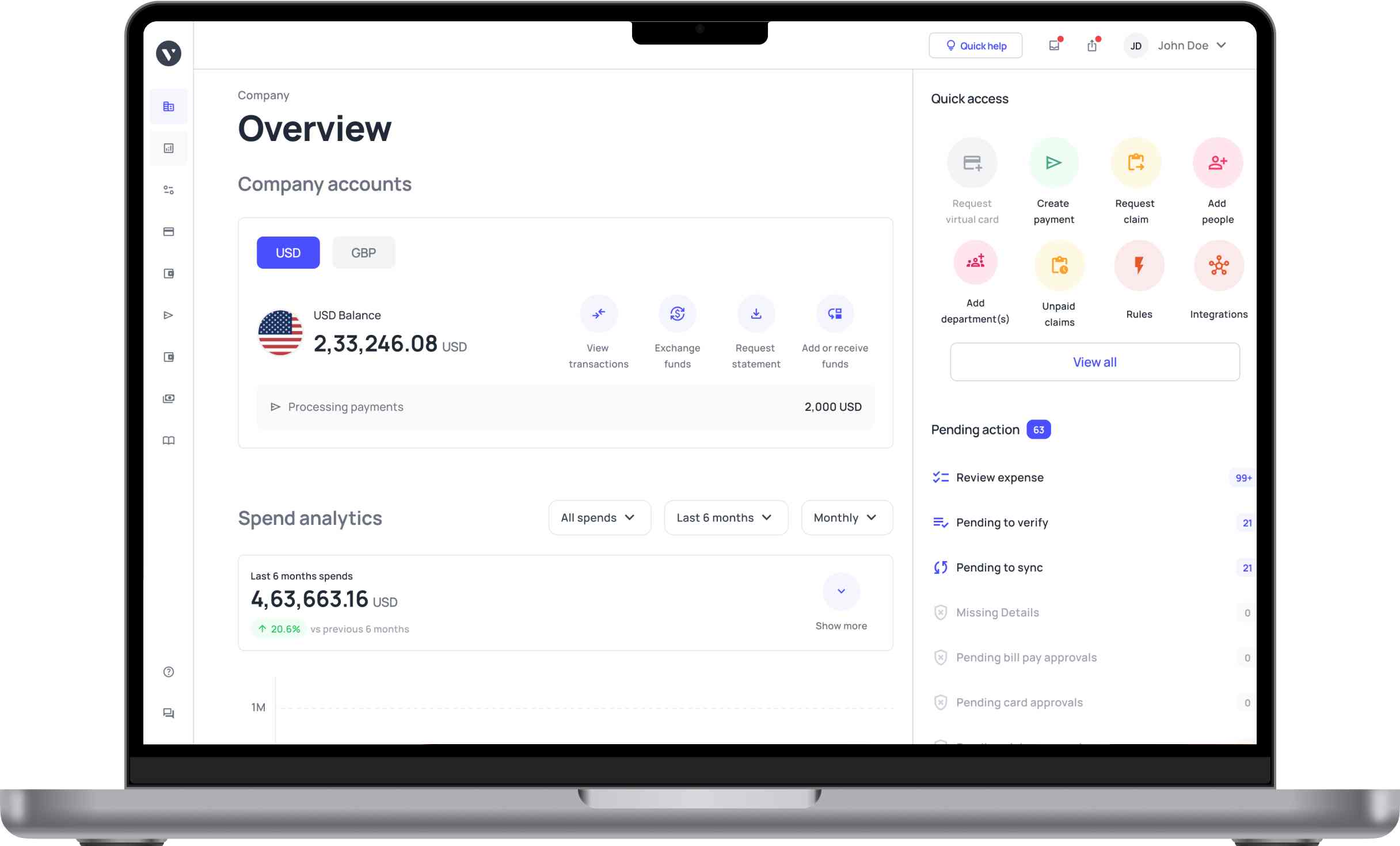
6. Volopay
Best for: Startups and SMBs looking for a clean interface and an all-in-one dashboard.
Solutions: Volopay provides solutions to SaaS, fintech, logistics, professional services, and any sector where teams frequently pay vendors, manage software subscriptions at scale, or handle travel expenses.
Integrations: Volopay integrates with NetSuite, Xero, QuickBooks, TallyPrime, MYOB, and Zoho Books, allowing users to sync data instantly and keep financial records updated.
Best for expense control & automation
7. Airbase
Best for: Airbase is best for small businesses, mid-sized businesses, and enterprises.
Solutions: Airbase provides solutions for industries like education, healthcare, non-profits, retail and wholesale, transportation and logistics, and government services.
Integrations: Airbase integrates with Sage Intacct, Xero, Slack, NetSuite, QuickBooks, Expensify, and Everest.
Pricing: There is no publicly available pricing information for Airbase.
Best for mid-to-large companies
8. Pleo
Best for: Pleo is ideal for startups, mid-size companies, and enterprises.
Solutions: Pleo supports industries like professional services, consulting, technology, SaaS, retail, hospitality, construction, and more.
Integrations: Pleo integrates with Xero, Oracle NetSuite, QuickBooks, SAP SuccessFactors, FreeAgent, XLedger, Twinfield, and many others.
Pricing: Pleo offers four pricing tiers. Starter starts at £9.50 per month for 3 users. Essential is £39 per month for 3 users, with £11 per additional user. Advanced is £99 per month for 3 users, plus £15 per extra user. Beyond is £199 per month for 3 users, with £18 per additional user per month.
Best for budget-friendly teams
9. Zoho Expense
Best for: Zoho Expense is suitable for both enterprises and small businesses.
Solutions: Zoho Expense provides solutions for industries like universities, IT, consulting, healthcare, non-profits, startups, and manufacturing.
Integrations: Zoho Expense integrates with Zoho Books, Zoho Practice, Zoho Invoice, Intuit QuickBooks, Xero, Sage, and many other platforms.
Pricing: Zoho Expense offers both monthly and yearly pricing plans, including Free, Standard, Premium, and Zoho Spend.
10. DIvvy
Best for: Divvy is ideal for small businesses, mid-sized companies, businesses using BILL for supplier payments, and multi-entity organizations.
Solutions: Divvy offers solutions for industries like construction, education, healthcare, hospitality, manufacturing, nonprofits, professional services, and software and technology.
Integrations: Divvy integrates with Xero, Sage, Microsoft, Intuit QuickBooks, Oracle NetSuite, Acumatica, and other tools.
Pricing: Divvy’s pricing starts at $49 per user per month for the Essentials plan, $65 for the Team plan, and $89 for the Corporate plan. Enterprise pricing is customized based on business needs.
What is the best Mercury alternative in 2026?
When choosing a Mercury alternative, businesses should consider factors such as business banking, corporate cards, expense management, AP automation, multi-currency support, integrations, pricing, and regional availability.
The right platform will depend on your company size, growth stage, geographic reach, financial workflows, and the level of automation and spending control your team needs.
How to choose the right Mercury alternative for your business
What works for each business size and stage
Choosing the right Mercury alternative depends on what suits your business size and stage. A 10-person startup operates very differently from a company with 100 or 1,000 employees. That’s why this becomes a key filter when picking an expense tool. As you scale, things like multiple departments, vendor management, and structured approvals should be taken into account.
Complicated workflow Pricing and total cost of ownership
Even platforms with no monthly fee or free core plan can end up being expensive once per-user pricing, transaction fees, FX conversion costs, and implementation charges are added. It’s important to build a comparison chart to estimate the real monthly cost based on company size, payment volume, and currencies used. In most cases, the total cost of ownership matters more than just the listed plan price.
Location and availability
When choosing a Mercury alternative, it’s important to make sure the platform is available in the regions where your business, vendors, and employees operate. For example, Pleo is often preferred by Europe-based businesses, while Rho is better suited for US-incorporated companies. Before comparing features, it’s worth prioritizing location and availability, since not all tools support every region.
How it fits into your existing tech stack
When choosing an expense tool, it’s important to see how well it connects with the tools you already use, especially your accounting software. A good integration makes it easier to sync data as your transactions grow, without adding extra manual work. When your accounting data flows directly into the expense tool, everything stays more accurate, and auditing becomes much simpler and less stressful.
FAQs
Brex and Rho are considered safer alternatives to Mercury. Brex offers up to $6 million in FDIC insurance and has no minimum balance requirement. Rho works with FDIC-insured partner banks and is generally seen as more reliable as businesses scale.
Ramp and Brex stand out as free Mercury alternatives. Ramp comes with unlimited corporate cards and AP automation, while Brex offers a free Essentials plan at $0 per user per month.
Yes, several Mercury alternatives support multi-currency accounts. Volopay supports 65+ currencies across 100+ countries, making it a strong option for global payments. Airbase also supports international payments and works well for businesses operating across different regions.
Yes, Expensify, Volopay, and Rho are some Mercury alternatives that include invoicing features. Expensify covers invoicing, bill pay, expense tracking, and corporate cards. Volopay adds invoicing with AP automation and multi-currency support, while Rho combines invoicing with bill payments and corporate cards for growing teams.
Ramp, Airbase, and Volopay are Mercury alternatives best for AP automation. They make it easier to manage invoices, approvals, and payments without adding extra manual work.
Rho stands out for its free tier. You don’t pay for same-day ACH, domestic wire transfers, platform fees, users, or even AP automation, which makes it a strong option for growing teams.