Simplify AR automation across entities
Standardize routine receivables workflows while keeping entity-specific policies, approval authority, and exceptions intact. Volopay helps finance teams coordinate execution across business units without replacing their existing ERP systems.














Reduce manual coordination across your AR operation
Connected revenue-to-cash execution
Keep billing, collections, disputes, and cash application aligned through shared receivables records.
Customer responses, payment commitments, and financial outcomes remain connected as work progresses between teams, reducing repeated investigation and manual handoffs.
Centralized oversight with entity-level detail
Review outstanding receivables, collections activity, and unresolved exceptions across billing entities.
Retain separate customer balances and accounting records for each entity, so operational oversight doesn't compromise financial reporting boundaries.
AI-led workflow standardization
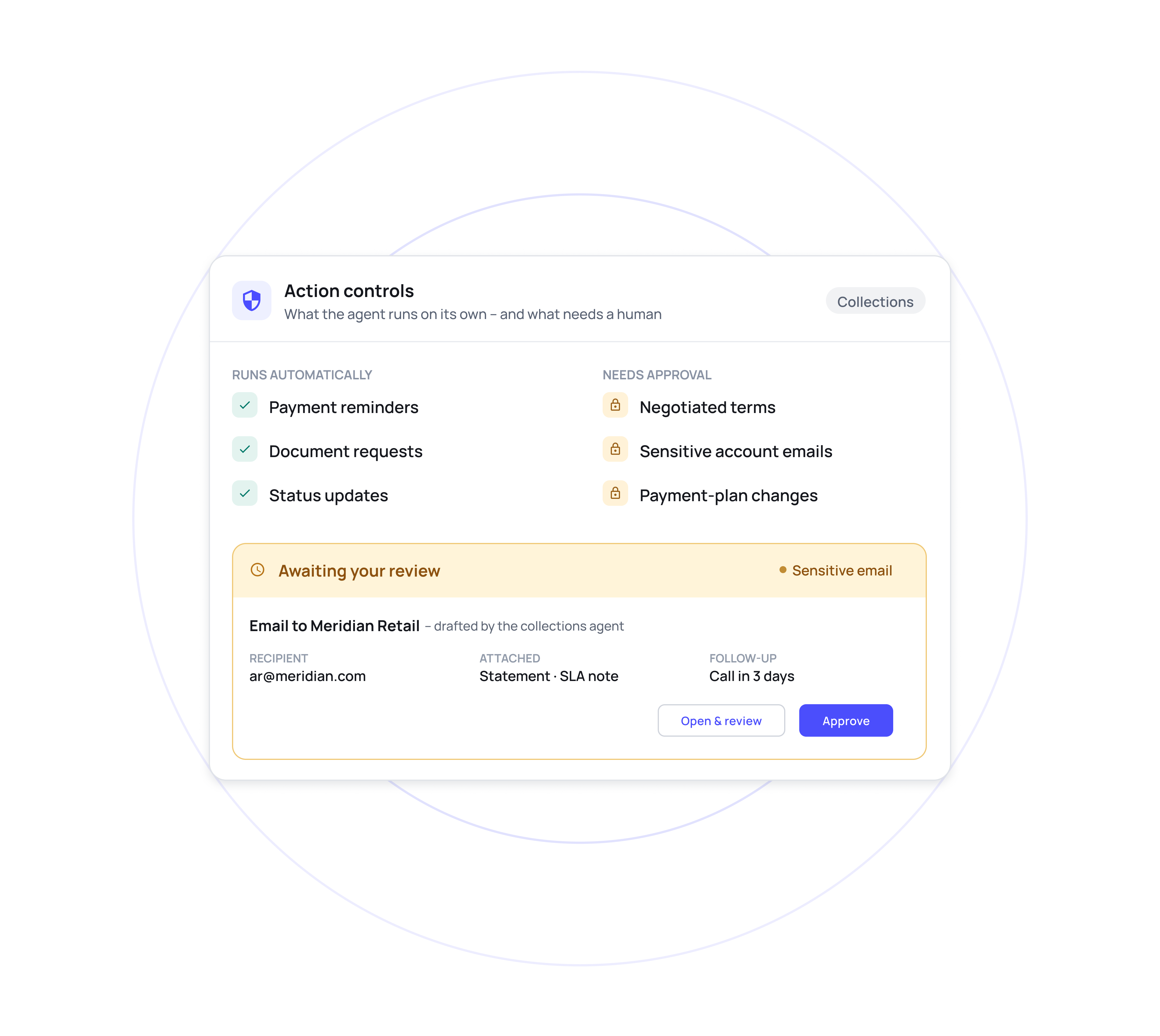
Configure AI Finance Agents around established operating rules and approval structures.
Agents execute permitted routine work across connected systems, while material exceptions and decisions outside their authority remain with designated finance owners.
Accountable exception routing
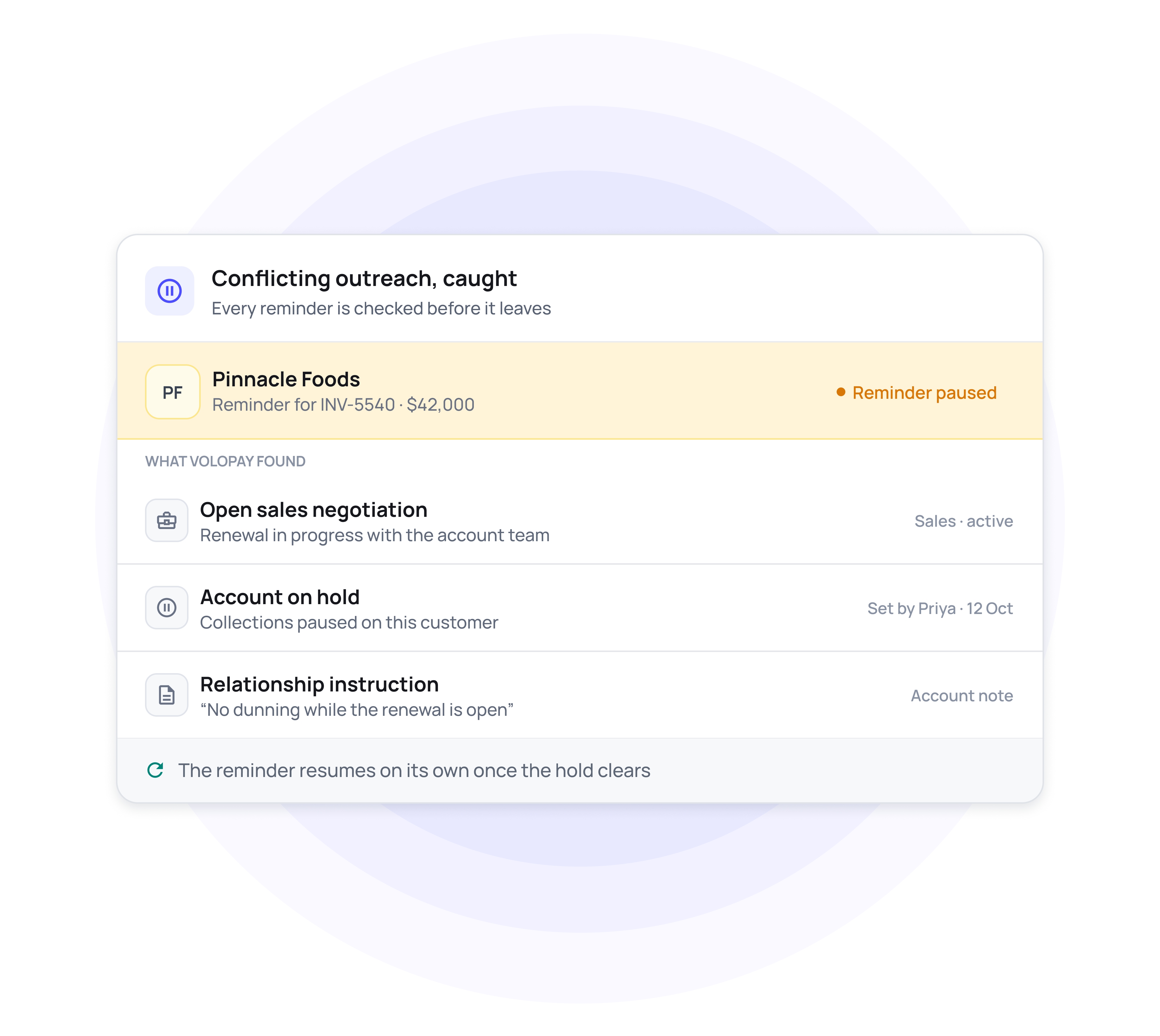
Give unresolved receivables a defined owner, reason, and next action.
Volopay routes missing documentation, payment differences, and internal approvals to the responsible team, helping prevent cases from remaining unattended between departments.
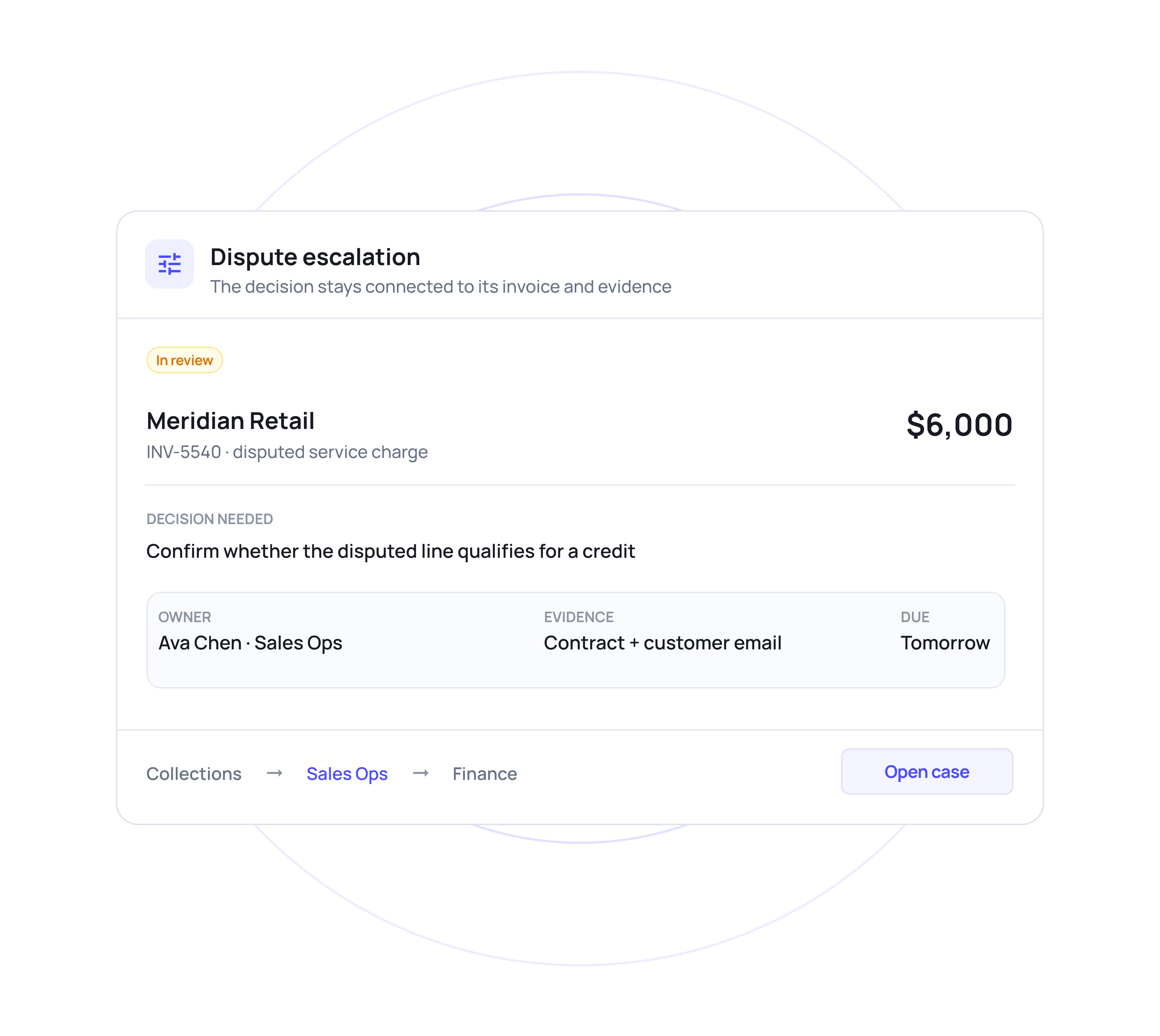
Make internal escalations specific and actionable
A disputed charge may require input from sales, operations, and finance before collection can resume. Volopay routes requests with the relevant invoice, amount, evidence, and decision needed.
Each case retains an accountable owner and follow-up deadline, helping your teams coordinate resolution without repeatedly reconstructing the same issue.
Keep partial payments moving through resolution
A customer may settle most of an invoice while withholding a disputed amount.
Volopay separates the supported payment from the unresolved deduction and creates a linked investigation case. Your team can apply eligible cash while the outstanding difference follows the appropriate approval and resolution process.
Verify accounting outcomes before closing exceptions
A resolved customer conversation doesn't necessarily mean the accounting work is complete.
Volopay checks resulting ERP documents and balances after permitted financial actions. If a credit posting fails or leaves an unexpected residual, the case remains open for correction rather than being treated as financially resolved.
Turn complex receivables into seamless workflows
Extend financial control across every billing entity
Contract-linked billing and invoice validation
Volopay builds billing schedules from approved contracts, including pricing changes, milestones, and amendments. It validates customer details, billing entities, and required documentation before invoice delivery.
Your teams can maintain consistent billing checks across entities while accommodating customer-specific terms and requirements.
Multi-currency receivables and settlement accounting
Manage invoices in their original currencies while reporting balances using your ERP's exchange rates. Volopay calculates and posts exchange gains or losses when foreign-currency invoices settle.
Your finance team retains invoice-level currency details, while period-end revaluation of outstanding balances remains in the ERP.
Entity-level reporting and receivables roll-forwards
Generate aging reports and receivables roll-forwards for individual billing entities. Track opening balances, invoices issued, cash applied, credits, write-offs, and closing balances.
This provides a consistent reporting structure across your business while preserving the separate financial records required for each legal entity.
Dedicated deployment and ongoing technical support
Every Volopay customer receives a deployment lead and forward-deployed engineer. They map existing AR processes, configure integrations, test workflows against historical cases, and support go-live.
Subsequent changes are tested before release, helping your team maintain configured workflows as operational requirements evolve.
Built for multi-entity receivables challenges
Different regions may follow different collection practices, making performance difficult to manage consistently.
With accounts receivable automation, you can configure customer-specific playbooks, communication rules, and escalation paths while retaining appropriate flexibility for local requirements.
A customer paying several subsidiaries may have separate invoices, currencies, and remittance references.
Cash application automation helps identify payers, allocate supported amounts to the correct invoices, and flag ambiguous transactions for review without mixing legal-entity balances.
Customers may require different purchase orders, supporting documents, or invoice formats across your business units.
Billing automation validates these requirements against approved commercial terms and identifies missing information before submission, helping your teams avoid preventable invoice rejections.
Why multi-entity finance leaders choose Volopay
Traditional multi-entity AR management | With Volopay |
|---|---|
Inconsistent AR processes: Different entities use separate collection procedures, approval rules, and exception-handling methods, making standardized execution difficult | Governed workflow execution: Apply consistent AR workflows across entities while retaining entity-specific approval limits, customer requirements, and financial controls |
Fragmented customer balances: A customer transacting with multiple subsidiaries has separate receivables records, making it difficult to assess their overall outstanding position | Connected customer visibility: Review the customer's combined receivables position while maintaining separate balances and accounting records for each billing entity |
Manual cross-functional coordination: Disputes, payment differences, and billing issues move between finance, sales, and operations without clear ownership or follow-through | Structured exception management: Route cases with supporting evidence, assigned owners, and defined next actions. Track unresolved dependencies through escalation and verified financial resolution |
Complex multi-currency reporting: Finance teams reconcile invoice currencies, entity-level balances, and exchange differences using separate reports and manual calculations | Consistent currency treatment: Retain original invoice currencies, report converted balances using ERP exchange rates, and calculate settlement gains or losses while keeping period-end revaluation in the ERP |
Disconnected entity-level reporting: Different close calendars, reporting formats, and accounting processes make it harder to maintain consistent oversight across business units | Standardised receivables reporting: Generate entity-level ageing reports, receivables roll-forwards, and close records while preserving separate period controls, sign-offs, and accounting boundaries |
They loved Volopay, you will too
Integrate with your finance systems
Connect Volopay with your ERP, banking, and communication platforms to coordinate receivables workflows across your existing finance infrastructure. Maintain your ERP as the system of record while improving visibility and execution across the revenue-to-cash cycle.
Connect to:
● ERP and accounting: NetSuite, SAP, Oracle, Microsoft Dynamics, QuickBooks, Xero, Sage
● Email and messaging: Gmail, Outlook
● Customer AP portals: Coupa, SAP Ariba, Tungsten
● Banking: Bank feeds and virtual accounts




FAQs
AR automation helps shared services teams manage billing, collections, cash application, and disputes across business units. Volopay coordinates routine workflows, routes exceptions to responsible owners, and keeps financial records connected while preserving entity-specific controls and approval authority.
Volopay supports consistent AR workflows with configurable collection playbooks, approval thresholds, and exception-handling rules. Teams can standardize routine execution while maintaining separate billing-entity records, local requirements, and authorization limits where needed.
Volopay provides a combined view of receivables across billing entities, including outstanding balances, disputes, and unapplied cash. Teams can examine a customer's overall position while retaining entity-level balances and accounting details for reporting and reconciliation.
Yes. Volopay's AI Finance Agents handle permitted tasks such as payment reminders, invoice document requests, receipt matching, and routine exception follow-ups. Actions requiring sensitive commercial judgment, material adjustments, or authority beyond configured limits remain subject to human review.
Volopay reduces repeated coordination between customer communications, billing records, bank transactions, and accounting systems. Its agents gather relevant information, progress permitted actions, and escalate unresolved issues with supporting evidence, helping teams spend less time reconstructing case histories.
Yes. Volopay's product specification includes integrations with NetSuite, SAP, Oracle, Microsoft Dynamics, QuickBooks, Xero, and other accounting platforms. It reads relevant receivables records and posts permitted transactions while your ERP remains the accounting system of record.
Bring Volopay to your business
Get started now