10 Spendesk alternatives for spend management & expense tracking
Spendesk does a solid job for companies looking for a straightforward spend management solution, particularly for teams that need corporate cards, basic expense workflows, and a clean interface to get started. But as businesses grow, requirements evolve.
In comparison, Spendesk might feel like it’s falling short due to limitations in AP automation and multi-currency support. You might find that your team now needs a more complete, all-in-one platform that handles everything from vendor payments to multi-entity accounting without requiring additional tools alongside it.
If that's where you are, it makes sense to explore what else is out there before committing to a direction. The spend management space has grown significantly, and there are platforms built specifically around the gaps that growing finance teams often run into with Spendesk.
Some focus on global payments, some on AP depth, and others on keeping things simple and affordable for smaller teams. We've done our research to understand what real users are saying, and we've put together this guide based on hands-on research across each platform.
This is a breakdown of which tool actually fits which kind of business, so you can make a smarter decision based on where your team actually is and where it's headed.
Here are the 10 best Spendesk alternatives worth considering in 2026.
Quick summary of the Spendesk alternatives
Before going deep into each platform, here's a quick look at the top picks and what each one does best.
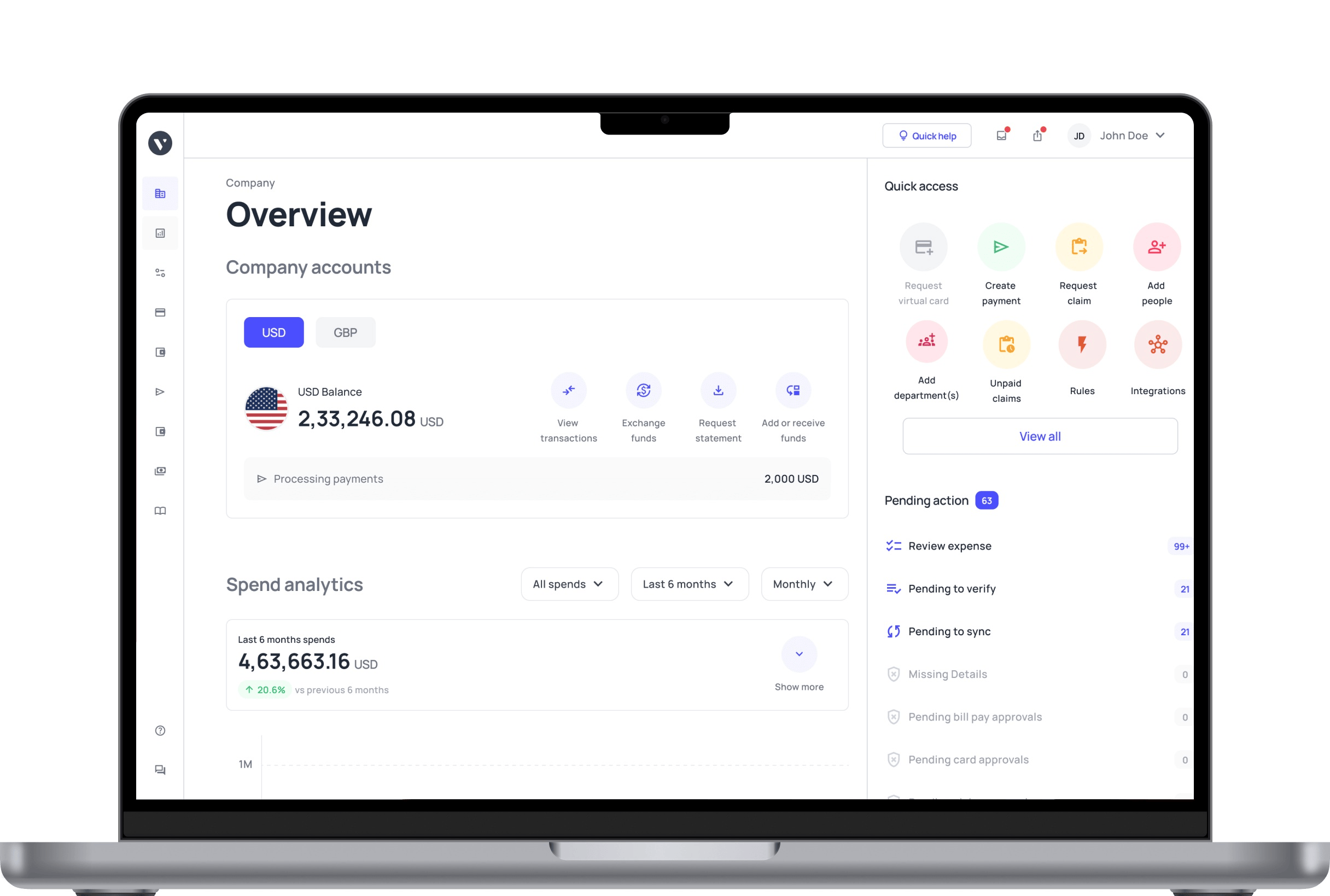
● Volopay - Best all-in-one spend management for global teams
● Brex - Best for startups and high-growth companies
● Ramp - Best for US-based teams focused on cost savings
● Payhawk - Best for mid-market companies in Europe and the US
● Airbase - Best for mid-size companies needing full AP control
● SAP Concur - Best for large enterprises with complex compliance
● Tipalti - Best for high-volume global AP and vendor payments
● Expensify - Best for teams with heavy travel expense needs
● Zoho Expense - Best budget-friendly option for smaller teams
● Pleo - Best for European SMBs managing employee spending
| Tool | Best for | Corporate cards control | Expense automation | AP automation depth | Global payments & FX | Multi-entity support | Real-time visibility |
|---|---|---|---|---|---|---|---|
Volopay | All-in-one spend management for global teams | ||||||
Brex | Startups needing cards + basic spend control | Partial | Partial | ||||
Ramp | US startups focused on cost reduction | Partial | Partial | Partial | |||
Payhawk | Mid-market companies with complex spend | Partial | Partial | ||||
Airbase | Mid-size companies needing full spend control | Partial | |||||
SAP Concur | Large enterprises with compliance needs | Partial | Partial | ||||
Tipalti | Enterprise AP automation and global payments | Partial | |||||
Expensify | Teams with heavy travel expense needs | Partial | Partial | Partial | Partial | ||
Zoho Expense | Budget-friendly expense tracking | Partial | Partial | Partial | Partial | ||
Pleo | European SMBs managing employee spending | Partial | Partial | Partial |
Best overall
1. Volopay
Best for: Finance teams at global companies managing multi-currency spend, corporate cards, and vendor payments from a single platform
Solutions: SaaS, retail, manufacturing, professional services, eCommerce, fintech
Pros:
● Combines corporate cards, expense management, AP automation, and global payments in one platform
● Real-time spend visibility across teams and departments
● Strong multi-entity and multi-currency support
● Automated receipt matching and approval workflows
● Hard and soft budget controls that work before spend happens, not after
Cons:
● May offer more functionality than very small or early-stage teams need
● Pricing plan requires upfront budgeting
Key features:
● Corporate cards, both physical and virtual
● Expense reimbursements with automated approval flows
● AP automation and vendor payments
● Budget controls and spend limits at the team and department level
● Real-time dashboards and spend analytics
Integrations: Xero, QuickBooks, NetSuite, MYOB, Deskera, and more
Pricing: Volopay works on custom pricing based on your team size and the modules you need. Sign up for a demo to get a quote tailored to your requirements.
Why it's a better alternative?
What separates Volopay from Spendesk is the depth of its offering. While Spendesk covers the basics well, users frequently mention that global payment support and AP automation start feeling limited as business needs grow.
With Volopay, these are central to how the platform is built, not features you have to unlock later or piece together with a separate tool. If your team operates across multiple countries or currencies, Volopay handles FX conversions, local vendor payments, and multi-entity accounting without forcing you to connect a patchwork of systems.
Finance teams that have made the switch often say the biggest relief is no longer jumping between three separate platforms just to close the month. Volopay also gives finance managers actual control over spending before it happens, not just visibility after the fact.
Budget controls, spend limits, and real-time alerts mean your team isn't chasing receipts or fixing overspend after month-end. That kind of proactive control is something finance teams consistently flag as a gap they're trying to fill when they start evaluating alternatives.
Best for startups and high-growth companies
2. Brex
Best for: Startups, venture-backed companies, and fast-scaling teams primarily in the US
Solutions: Technology, SaaS, eCommerce, fintech, consumer
Pros:
● No personal guarantee required for corporate cards
● AI-powered expense categorization saves significant manual work
● Fast onboarding with minimal setup time
● Strong rewards program that actually adds value
● Generous card limits for funded companies
Cons:
● Primarily US-focused, which limits usefulness for global teams
● Multi-entity support is restricted for lower-tier plans
● AP automation lacks the depth of enterprise-grade tools
Key features:
● Corporate cards with high limits and no personal guarantee
● Expense management and reimbursements
● Bill pay and vendor payments
● Travel management built into the platform
● AI-based expense categorization
Integrations: QuickBooks, Xero, NetSuite, Sage, Slack, Workday, Gusto
Pricing: Brex offers a free Essentials plan with solid core functionality, a Premium plan for growing teams, and custom Enterprise pricing for larger organizations. It's worth visiting Brex's website for current plan details.
Do note that Capital One acquired Brex in early 2026, so checking their site directly will give you the most accurate and up-to-date information on pricing and the product roadmap going forward.
Why it's a better alternative?
Brex works really well for startups because it removes one of the biggest friction points early-stage companies face with corporate cards: the personal guarantee.
Most card providers require founders or finance leads to put their personal credit on the line. Brex doesn't, which matters a lot when you're scaling fast and want to keep business and personal finances cleanly separated.
Startup finance teams frequently mention how quickly Brex gets them operational. The onboarding is fast, the card limits are generous for funded companies, and the rewards program gives you something back on every dollar spent.
For a team that needs to move quickly and doesn't have the bandwidth for a long implementation, that simplicity is a real advantage. Where Brex runs into its limits is international coverage. If you're a US-based startup with no near-term plans to expand globally, it's an excellent choice.
Once you start hiring in Europe or paying vendors in multiple currencies, you'll start bumping into those boundaries fairly quickly. That's worth factoring in if global growth is part of your 12-month plan.
3. Ramp
Best for: US-based startups and mid-size companies focused on reducing spend and automating expense reporting
Solutions: Technology, professional services, healthcare, nonprofits, retail
Pros:
● Strong cost savings and analytics features that flag wasteful spend
● Free plan with solid core functionality included
● Clean and intuitive interface that employees enjoy using
● Automated expense reports eliminate most manual work
Cons:
● Primarily available for US-based businesses
● Global payment capabilities are limited compared to international tools
● Not ideal for teams with complex AP workflows
Key features:
● Corporate cards with spend controls
● Automated expense reports and receipt matching
● Vendor management and subscription tracking
● Savings insights and analytics
● Customizable approval workflows
Integrations: QuickBooks, Xero, NetSuite, Sage, Workday, Slack, Plaid, Rippling
Pricing: Ramp offers a genuinely free core plan and a Plus plan for teams that need more advanced controls and workflows. Enterprise pricing is available on request. Head to Ramp's website for a full breakdown of what's included at each level.
Why it's a better alternative?
Ramp has carved out a strong reputation, specifically around helping companies spend less. That's not a common angle in this market, and it resonates with CFOs who are under pressure to show cost discipline.
The platform automatically flags duplicate subscriptions, underused vendors, and spending that falls outside policy, all without requiring a finance analyst to dig through the data manually.
Users frequently point out that Ramp's interface is one of the cleanest in the spend management category. Expense reports get filed automatically, approvals happen inside the tools your team already uses, and the monthly close process becomes significantly lighter.
For a team frustrated with manual steps and surface-level automation, Ramp is often a meaningful upgrade in day-to-day efficiency.
Best for mid-size companies
4. Payhawk
Best for: Mid-market companies in Europe and the US managing employee spend, vendor invoices, and multi-entity accounting
Solutions: Technology, retail, professional services, real estate, logistics
Pros:
● Strong corporate card controls and policy enforcement
● Good multi-entity support for growing companies
● Clean interface with a solid mobile app
● Integrates well with major ERPs, including NetSuite and SAP
Cons:
● AP automation is more limited compared to dedicated enterprise tools
● Global FX capabilities could be stronger for companies with heavy international payments
● Pricing can add up at scale
Key features:
● Corporate cards, both physical and virtual
● Expense management with automated approvals
● Multi-entity accounting and consolidation
● Vendor bill payments
● Budget tracking at department level
Integrations: NetSuite, SAP, Microsoft Dynamics, Xero, QuickBooks, Datev
Pricing: Payhawk uses custom pricing based on team size and feature requirements. It's positioned for mid-market companies, so costs reflect that segment. Reach out to Payhawk directly or visit their website to get a quote suited to your organization.
Why it's a better alternative?
Payhawk addresses the specific pain points of mid-size companies that have outgrown basic expense tools but don't yet need the full complexity of an enterprise ERP.
If you're running a team of 50 to 500 people, managing spend across multiple departments, and dealing with a mix of employee cards and vendor invoices, Payhawk gives you strong controls without overwhelming your finance team.
What sets Payhawk apart in this segment is the combination of policy enforcement and real-time visibility. Finance managers can set spend limits, require receipt uploads, and route approvals automatically, and all of this feeds into accounting systems without manual data entry.
Users specifically call out the NetSuite and SAP integrations as particularly solid for companies in this size range. The multi-entity support is also worth highlighting.
If you're running subsidiaries across different countries, Payhawk handles the consolidation in a way that many lighter tools simply aren't built for. That becomes a meaningful advantage as companies grow into more complex organizational structures and need finance processes that can keep pace.
5. Airbase
Best for: Mid-size companies that need full AP automation alongside corporate cards and expense management in one platform
Solutions: SaaS, technology, professional services, financial services, biotech
Pros:
● Deep AP automation, including purchase order matching and vendor management
● Strong spend controls and approval workflows that scale with the business
● Good multi-entity support with entity-level reporting
● Integrates cleanly with major accounting systems
Cons:
● Global payment capabilities are more limited than dedicated global payment tools
● Initial setup can feel complex compared to lighter alternatives
● Pricing is on the higher end for smaller teams that don't need the full feature set
Key features:
● AP automation with three-way purchase order matching
● Corporate cards with configurable controls
● Expense reimbursements
● Purchase orders and vendor management
● Real-time spend dashboards
Integrations: NetSuite, QuickBooks, Sage Intacct, Xero, Workday, Greenhouse
Pricing: Airbase is priced for mid-market and enterprise buyers and works on a custom quote model based on the modules selected and company size. It's not the most entry-level option on this list, but teams that need genuine AP depth will find the investment justified. Check their website for current pricing details.
Why it's a better alternative?
Airbase is one of the few platforms on this list that takes AP automation seriously as a core feature rather than a bolt-on.
If your team is still processing vendor invoices manually, chasing approvals over email, or dealing with mismatched purchase orders, Airbase addresses those problems at a level that most spend management tools, including Spendesk, don't quite reach.
Finance teams regularly highlight the three-way matching capability as something that would typically require a dedicated AP system. Having that built into the same platform as your corporate cards and expense reimbursements removes a significant amount of reconciliation work at month-end.
For growing companies handling a high volume of invoices each month, the time savings are substantial and easy to measure. The spend control layer is also worth calling out.
Unlike tools that give you visibility after money has been spent, Airbase lets you build approval gates into every spending pathway before a transaction goes through. That combination of proactive control and deep AP functionality is exactly what mid-size finance teams tend to need as their operations become more complex.
Best for enterprises
6. SAP concur
Best for: Large enterprises with complex travel, expense, and invoice management needs across multiple countries
Solutions: Manufacturing, financial services, healthcare, government, professional services
Pros:
● Industry-leading travel and expense capabilities
● Strong compliance and audit trail features
● Extensive integration ecosystem covering virtually every major enterprise system
● Multi-currency and multi-entity support built for enterprise scale
Cons:
● Steep learning curve and complex implementation timelines
● Interface feels dated compared to modern spend management tools
● Expensive, particularly for smaller teams
● Customer support experiences are mixed based on G2 reviews
Key features:
● Travel booking and itinerary management
● Expense reporting with policy enforcement
● Invoice management and AP workflows
● Audit and compliance tools
● Advanced analytics and reporting
Integrations: SAP ERP, Oracle, Workday, Microsoft Dynamics, and hundreds more through the Concur App Center
Pricing: SAP Concur is an enterprise-grade product and is priced accordingly. Implementation and licensing costs are significant and vary based on modules, company size, and contract terms. It's best suited for organizations with the budget and internal resources to match. Contact SAP or visit their website for enterprise pricing details.
Why it's a better alternative?
SAP Concur is the default choice for large enterprises because it handles the kind of complexity that most other tools simply weren't built for.
When you're managing thousands of employees across dozens of countries, with audit requirements, local compliance policies, and deep integration needs tied to a major ERP, very few platforms can match what Concur offers in terms of breadth and depth.
The tradeoff is real and worth being clear about. Concur is powerful but complex. It's not a platform your team will enjoy using day to day like any other go-to app. It is, however, a platform that gets the job done for organizations with heavy, non-negotiable requirements where thoroughness matters more than speed.
If you're running a 5,000-plus person company with multi-country operations, travel management, and SAP at the core of your finance stack, Concur makes sense. If you're significantly smaller than that, most other tools on this list will serve you better and cost you considerably less.
7. Tipalti
Best for: Enterprises and fast-growing companies with high-volume global AP and vendor payment needs
Solutions: Technology, media, advertising, marketplace businesses, eCommerce
Pros:
● Best-in-class global payments across 196 countries and 120 currencies
● Strong tax compliance, including W-9 and W-8 management for US companies
● Handles mass payouts at scale without manual processing
● Significantly reduces AP team workload through automation
Cons:
● Less focused on employee expense management or corporate card programs
● Corporate card capabilities are limited compared to dedicated card tools
● Pricing is on the higher end for smaller teams that don't need the full global payment infrastructure
Key features:
● Global supplier and vendor payments
● Invoice management and automated processing
● Tax and regulatory compliance
● Payment reconciliation across multiple methods
● AP workflow automation with configurable approvals
Integrations: NetSuite, QuickBooks, Xero, Sage Intacct, Oracle, Coupa
Pricing: Tipalti has starter options for smaller teams and enterprise pricing for larger organizations. Given the depth of infrastructure it provides around global payments and compliance, it sits at the higher end of the market. Visit Tipalti's website to explore current plan options based on your payment volumes and team size.
Why it's a better alternative?
Tipalti is built specifically for companies that process a large number of vendor and supplier payments across multiple countries. If your team is running into limitations around global payment rails or spending too much time managing tax documentation for international vendors, Tipalti is purpose-built to fix exactly those problems.
Finance teams at marketplace businesses and media companies particularly value Tipalti because of how it handles mass payouts.
Paying hundreds of affiliates or contractors across dozens of countries, each with different payment preferences and tax documentation requirements, is a workflow that most platforms can't support cleanly. Tipalti makes that process routine and repeatable.
The tax compliance layer is a differentiator that doesn't get enough attention in the market. For US companies working with international contractors, the W-8 and W-9 collection process alone can take considerable time per vendor when done manually.
Tipalti automates that collection and validates the forms before payment goes out, which removes a real administrative burden from your AP team.
Best for travel expense management
8. Expensify
Best for: Teams with frequent business travel, high receipt volumes, and expense reporting spread across many individual contributors
Solutions: Professional services, consulting, law firms, agencies, technology, real estate
Pros:
● SmartScan receipt scanning is fast and accurate enough that employees actually use it
● Strong travel booking integration through Expensify Travel
● Simple and familiar interface that requires minimal training
● Works well for individual contributors, not just finance teams
Cons:
● Corporate card controls are limited compared to full spend management platforms
● AP automation is basic and not suitable for complex invoice workflows
● Not ideal for teams needing multi-entity accounting or global payment rails
Key features:
● SmartScan receipt capture via mobile
● Automated expense report generation
● Travel booking and itinerary management
● Configurable approval workflows
● Per diem and mileage tracking
Integrations: QuickBooks, Xero, NetSuite, Sage, Workday, Gusto, BambooHR
Pricing: Expensify keeps its pricing accessible, with a free tier for individuals and straightforward paid plans for teams that need approvals, integrations, and more advanced controls. It's one of the more affordable options on this list. Visit their website for a full breakdown of what each plan includes.
Why it's a better alternative?
Expensify has been around long enough to become the default for many companies managing travel expenses. The SmartScan feature, where an employee photographs a receipt and it auto-populates all the expense details, is one of the most user-friendly implementations in the market.
Employees actually use it without being chased, which is more than you can say for most expense tools that require a certain level of finance literacy to navigate.
For companies where travel is the primary expense management challenge, Expensify is often a better fit than a more complex platform. It's lighter, faster to deploy, and doesn't require finance teams to configure lengthy approval hierarchies just to get started. Users frequently mention that the mobile experience is noticeably better than the legacy tools they used before.
Where Expensify runs into its limits is in the depth of spend control. If you need corporate cards with hard limits, multi-entity accounting, or invoice AP automation, it isn't the right fit. It's a specialist tool built for one specific job, and it does that job well.
Best for budget and user-friendly
9. Zoho Expense
Best for: Small and mid-size businesses looking for affordable, easy-to-use expense management without enterprise complexity
Solutions: Small businesses, startups, professional services, education, nonprofits
Pros:
● Very affordable pricing including a functional free tier
● Integrates natively with the broader Zoho ecosystem for seamless accounting
● Clean interface with a good mobile app that employees pick up quickly
● Solid policy enforcement features for the price point
Cons:
● Corporate card capabilities are basic
● AP automation is limited and not suitable for complex invoice workflows
● Global payment support is minimal
● Not designed for complex multi-entity setups
Key features:
● Expense reports and approval workflows
● Receipt scanning via mobile app
● Per diem and mileage management
● Budget tracking at department or project level
● Multi-currency expense support
Integrations: Zoho Books, QuickBooks, Xero, Sage, Salesforce, Slack, G Suite
Pricing: Zoho Expense is one of the most affordable options in this category. It offers a free plan for small teams and paid plans that scale up gradually, all at a price point that sits well below most competitors on this list. Check Zoho's website for the current tier breakdown and to find the plan that fits your team size.
Why it's a better alternative?
Zoho Expense is the go-to recommendation for teams that want solid expense management without an enterprise price tag attached. If your primary frustration is cost and you don't need deep AP automation or global payment infrastructure, Zoho Expense delivers most of what a growing team needs without overcomplicating the experience.
It also integrates naturally with Zoho Books if you're already using other tools in the Zoho ecosystem, which means your accounting reconciliation becomes nearly automatic.
For small businesses and growing teams where finance is handled by a small team or even a single person wearing multiple hats, that native connectivity saves real time every single week. The tradeoff is worth being clear about, though.
Zoho Expense is built for expense tracking, not for full spend management. If your needs grow to include corporate cards with real controls, vendor invoice processing, or cross-border payment rails, you'll eventually outgrow it. But as a starting point or for teams with straightforward requirements, it's one of the strongest value propositions in the market.
Best for European SMBs
10. Pleo
Best for: European small and mid-size businesses managing employee spending through company cards with simple expense workflows
Solutions: Technology, retail, hospitality, professional services, agencies
Pros:
● Purpose-built for European businesses with local currency and VAT support
● Clean interface that employees actually enjoy using day to day
● Strong receipt capture and automatic categorization
● Good integration with European accounting tools, including Datev and e-conomic
Cons:
● AP automation is limited and not suitable for complex invoice management
● Multi-entity support is not as strong as enterprise-grade platforms
● Less suitable for teams operating primarily outside of Europe
● Global payment capabilities are restricted to a narrower geography
Key features:
● Company cards, both physical and virtual
● Expense management with automated receipt capture
● Budget controls and spend limits per employee or team
● Automated accounting categorization
● Pocket app for employee out-of-pocket claims
Integrations: Xero, QuickBooks, Sage, Datev, e-conomic, Fortnox, Microsoft Dynamics
Pricing: Pleo offers a tiered structure with four plans, Starter, Essential, Advanced, and Beyond, designed to serve teams at different stages of growth. Pricing is published in GBP on their website since Pleo is primarily a European product. Visit Pleo's website to find the plan that fits your team size and feature requirements.
Why it's a better alternative?
Pleo has built a strong following among European SMBs specifically because it was designed with that market in mind from the ground up. The card program works smoothly across European countries, the VAT handling is solid for UK and EU businesses, and the accounting integrations cover the tools European companies actually use day to day.
Datev for Germany, e-conomic for the Nordic region (and Fortnox specifically for Sweden) are all supported natively, which removes a lot of the integration friction that comes with using a platform built primarily for another market.
Users in the UK and the Scandinavian region particularly praise Pleo for how easy it is to roll out across a team that isn't finance-trained. Employees don't need to be taught how to submit a receipt. The app is straightforward, the auto-categorization handles most of the admin, and the whole process takes under a minute from purchase to submission.
For SMBs where finance is a part-time responsibility shared across different roles, that kind of simplicity translates directly into higher adoption and cleaner data. Where Pleo doesn't stretch is in AP automation and global payments beyond the European sphere.
If your team is paying vendors in the US, handling multi-entity accounting across continents, or needs purchase order matching as part of your AP workflow, you'll need a more comprehensive platform to support those requirements. But for a European SMB managing day-to-day employee spend, Pleo is one of the most thoughtfully built tools in this space.
How to choose the right Spendesk alternative for your business
With ten solid options on the table, the question is which tool is the right Spendesk alternative for your specific situation. Here are the key factors to think through before you commit.
1. Company size and growth stage
A tool built for startups will hit its ceiling fast if you're scaling quickly. Enterprise platforms, on the other hand, will overwhelm a lean team with complexity they simply don't need yet.
Map your current headcount and transaction volume, then project 18 months out. If you're at 30 people now but expect to hit 150, don't pick a tool that maxes out at 50 users or lacks multi-team controls. Choose one stage ahead of where you are today, not two.
2. Budget and total cost of ownership
The sticker price rarely tells the full story. Implementation, training, and integration costs can quietly double what you thought you'd spend.
List every tool the new platform would replace, then do the net math. A platform at $2,000/month that replaces three tools costing $800 each is actually saving you money. Always ask vendors for an all-in cost breakdown, including onboarding fees and any API or integration charges.
3. Feature requirements
Vendors are excellent at making every feature sound essential. If you buy for features you won't use, you'll overpay and overwhelm your team.
Before your first demo call, write down your top five must-haves and three nice-to-haves. Stick to that list during evaluation. Let your actual workflows drive the decision, not the sales deck.
4. Global payments and multi-currency support
Basic FX conversion and true multi-currency support are not the same thing. Gaps in local payment rails or compliance coverage create real operational and legal risk.
List every country and currency your team currently uses or plans to use within the next year. Then verify, not assume, that the platform supports each one fully. Ask specifically about local payment rails, VAT handling, and multi-entity accounting across those regions before you sign anything.
5. AP automation depth
AP automation means different things to different vendors. Some stop at receipt matching. Others cover the full procure-to-pay cycle. Buying the wrong tier means you'll hit a wall exactly when volume picks up.
Count how many vendor invoices you process monthly. Under 50? Basic automation likely covers you. Over 200? You probably need purchase orders, three-way matching, and vendor onboarding workflows. Ask vendors to demonstrate your specific use case live, not walk you through a slide.
6. Integration with your accounting stack
A spend management tool that doesn't sync cleanly with your accounting software creates manual reconciliation work, which is exactly what you're trying to eliminate.
Confirm the integration exists, then go deeper. Ask whether it supports multi-entity mapping, how it handles duplicate transactions, and whether it syncs in real time or in end-of-day batches. Test the integration in a sandbox environment before committing, especially if you're running a complex chart of accounts.
7. Customer support quality
Features get you through the demo. Support gets you through the month-end close when something breaks at 11 PM.
Go to G2 and Trustpilot and filter reviews specifically for support experiences, not overall ratings. Look for patterns: slow response times, unresolved tickets, or poor escalation paths are red flags regardless of how polished the product looks. Prioritize platforms where support quality is consistently mentioned as a strength.
8. Ease of use for non-finance employees
Your expense tool is only as effective as the adoption rate across your organization. Poor UX leads to delayed submissions, low-quality data, and more reconciliation work for your finance team, not less.
Don't judge usability from a finance perspective alone. Run a two-week pilot with five to ten employees outside your finance team and track how often they submit expenses without prompting, and how many errors come through. A platform with a clean mobile app and a simple submission flow often outperforms a feature-rich tool that employees avoid.
FAQs
Zoho Expense and Pleo are strong picks. Zoho Expense offers affordable expense tracking with a generous free tier. Pleo is better suited for European small businesses that want an intuitive card and expense experience.
Most companies switch because they need deeper AP automation, stronger global payment support, or a more complete all-in-one platform that handles cards, expenses, and vendor payments together.
Focus on corporate card controls, expense automation, AP automation depth, global payment support, multi-entity capabilities, and how well the platform integrates with your current accounting software and ERP.
Volopay is the strongest option for global teams. It combines multi-currency support, global vendor payments, multi-entity accounting, and real-time visibility in one platform built specifically for international operations.
Yes, most Spendesk alternatives integrate with tools like QuickBooks, Xero, and NetSuite. Integration depth varies across vendors, so verify that the specific sync your team needs is supported before signing a contract.
Zoho Expense and Ramp both offer free or low-cost tiers covering essential expense management. Expensify is also more accessible for smaller teams when comparing at equivalent feature levels.