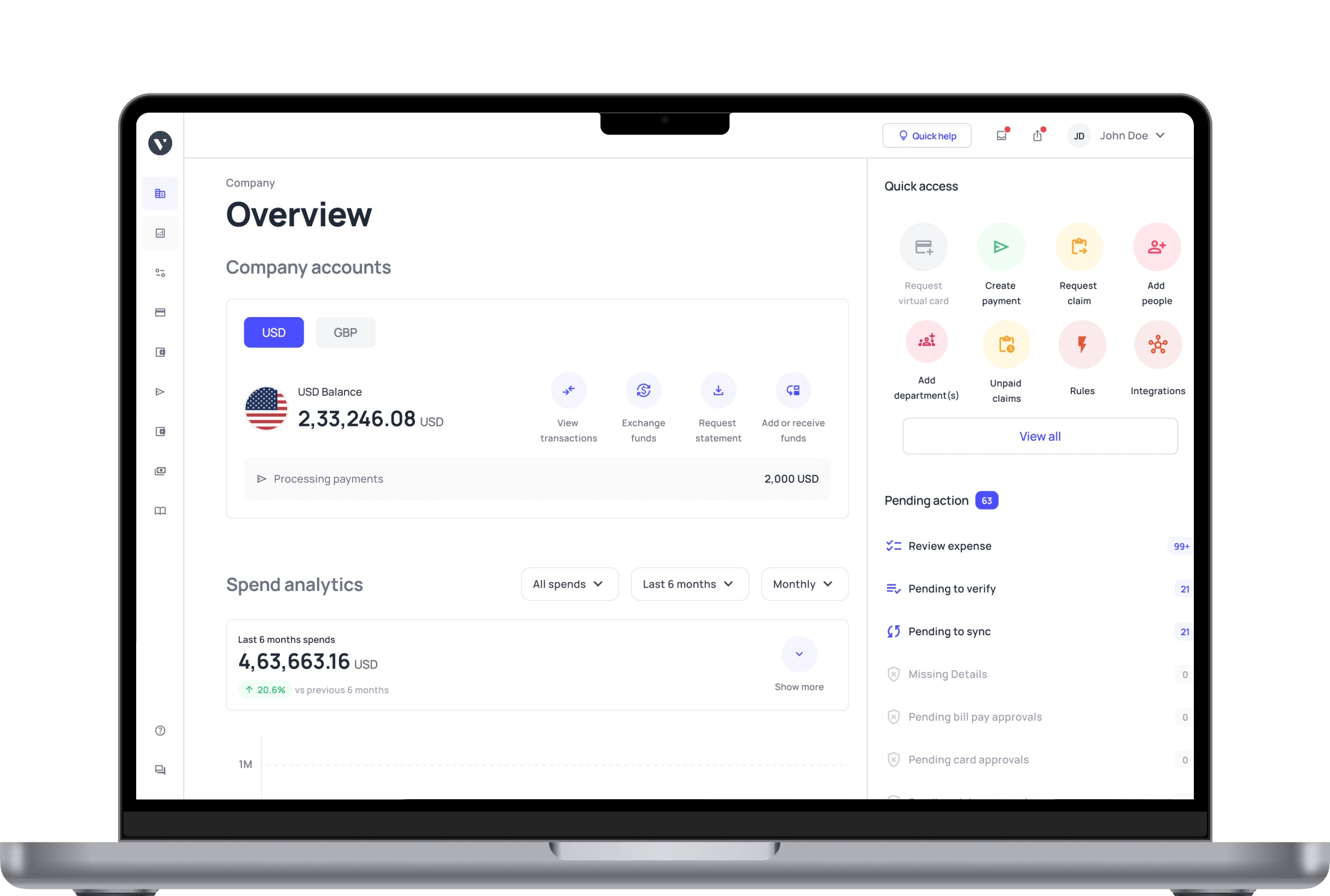
7 Ramp alternatives for spend management & finance automation
Ramp is a great system for many companies in the US that are looking for an easy-to-use corporate card and payment solution. But if you’re looking for a Ramp alternative, then you’re already familiar with some of the issues/shortcomings you might run into while using the platform.
Some of the issues (such as higher pricing & fees, limited capabilities & features for businesses outside the USA, and the need for a truly global business account) reported by many users have left many businesses looking for alternatives to Ramp.
Now, whether you have a small startup or an established MNC, there is a good chance that one of the many expense management software mentioned below will fit your exact needs. Within this list, you will find some of the best Ramp alternatives for all types of businesses with different priorities.
Quick summary of the Ramp alternatives
Out of all the alternatives to Ramp, each software has its unique standout feature or reputation in the market. Here is a list of the best Ramp alternatives and why you might want to choose them:
● Volopay: Best overall spend management software with excellent customer support
● Webexpenses: Great option for SMEs and larger enterprises looking to manage expenses
● Tipalti: Best for fast-growing mid-market companies that need to make mass global payments
● Expensify: Most popular mobile-first, receipt-scanning tool for individuals, freelancers, and small businesses
● SAP Concur: Best for extensive customization options, robust audit trails, and integration with major ERP systems
● PayEM: Best for finance teams that need tight control and real-time visibility over SaaS spend and vendor payment
● Spendesk: Best for startups and mid-market companies for its employee-friendly features and flexible card-based workflows
| Tool | Best for | Corporate cards & spend control | Automated expense tracking | Finance workflow automation | Accounting & AP integration | Savings and/or cash back | Analytics & insights |
|---|---|---|---|---|---|---|---|
Volopay | Global payments, spend management, & customer support | ||||||
Webexpenses | SMEs to large enterprises | ||||||
Tipalti | Fast-growing mid-market companies | ||||||
Expensify | Freelancers & small businesses | No comprehensive AP workflows | |||||
SAP Concur | Extensive customization & ERP integrations | ||||||
PayEM | Expense control & real-time visibility | ||||||
Spendesk | Startups & mid-market companies |
7 Ramp alternatives for spend management & finance automation
1. Volopay
Best for: Startup and mid-market businesses that need a robust all-in-one finance management platform with excellent customer support.
Solutions: While Volopay can be used by almost any type of company, the platform has been proven to be great for businesses in the D2C, F&B, healthcare, retail, logistics, education, construction, hospitality, and manufacturing industries.
Pros: Excellent customer support that helps businesses set up their finances on the platform quickly and get started on making payments and expense management more efficient.
Cons: May lack certain native integrations with ERP suites, but the capability to request custom integrations is available.
Key features:
● Global business account for payments in 180+ countries.
● Multi-currency support with 50+ currencies to make payments in.
● Procurement solution to manage vendors and AP efficiently
● Physical & virtual corporate cards for easy budget disbursements and granular level tracking and visibility of funds.
● Mobile app for both Android and iOS to keep track and manage finances on the go with the ability to approve payments, manage corporate cards, and submit reimbursements.
Integrations: Seamless integrations with accounting software like Xero, NetSuite, QuickBooks, MYOB, Zoho Books, and more.
Additional features:
● Reporting - As a centralized platform to help facilitate all payments and expenses for a business, Volopay becomes the central source of truth when it comes to monitoring the finances and analysing the spending on a daily basis. The software allows finance teams to generate reports with different filters, enabling custom reports and deep insights for different types of spending.
● Approval workflows - With Volopay, you can set up multi-level approval workflows to ensure that no bill payments are made without the approval of the necessary managers and stakeholders. You can set approval routing rules depending on the bill amount and create multiple approval policies for different teams, projects, and budgets.
● Vendor management - Volopay helps you manage all your vendors through a single dashboard. You can onboard suppliers through the vendor portal, set contracts, schedule payments, create approval policies for payments to vendors, and sync all expense data with your accounting software seamlessly.
● Accounting automation - The platform has native integrations with some of the best accounting software in the industry, like NetSuite, Xero, QuickBooks, MYOB, Zoho Books, and more. This allows for the automatic and seamless syncing of expense data to the right GL accounts every day without needing manual transfer capabilities.
● Multi-entity support - If your business has more than one entity situated within different countries, Volopay is a great tool to manage the finances for both entities separately, yet have a comprehensive way to see and analyse together.
Why is it a better Ramp alternative?
● Geographic availability - While Ramp and Volopay both support multiple currencies, Volopay offers a better experience through its truly global business account (US, APAC, & parts of Europe), letting you hold, convert, and make payments through multi-currency wallets.
On the other hand, Ramp is more suited for US-centric businesses dealing primarily in USD, and needs additional assistance from their sales reps to unlock more payment features in the APAC and Europe regions, instead of being a self-serve feature in the platform that can be accessed after the completion of the onboarding process. This can be a restriction for global companies dealing with multiple entities.
● Multi-currency support - Using Volopay, you can make payments in 50+ currencies across 180+ countries using the global business account, whereas most of the support for multi-currency payment within Ramp is restricted to corporate cards.
When it comes to bill payments and AP workflows, Ramp manages it all in USD instead of letting the user choose a flexible currency depending on their needs and business entity requirements.
● Vendor management & bill payments - Compared to Ramp, which has a simple AP payment workflow, Volopay’s V2 update has introduced a much more robust and comprehensive system to manage all vendor payments.
From onboarding through vendor portals, a dedicated procurement section to manage purchase orders, invoices, contract integration, approval workflows, and payment scheduling.
● Customer support - Each business onboarded and using Volopay gets a dedicated account manager to set up their accounts and manual assistance whenever needed to ensure a smooth experience.
On the other hand, Ramp has been noted to lack on the customer service front. Many users reported that the primary help comes from automated bots and email responses, and it is not easy to reach humans for more contextual help.
2. Webexpenses
Best for: SMEs to large enterprises, particularly UK and APAC-based businesses needing policy-compliant, automated expense management.
Solutions: Construction, Education, Financial Services, Manufacturing, Technology.
Pros:
● Per-active-user pricing.
● Carbon footprint tracking, strong UK/AU support team.
Cons:
● The UI has been described as slightly dated by some users.
● Implementation fees are applicable, which is not ideal for simple, low-volume expense processes.
Key features:
● OCR receipt capture
● Multi-currency support
● Mileage auto-calculation
● Credit card reconciliation
● Petty cash management
● Expense Cards
Integrations: Xero, Sage Intacct, QuickBooks, NetSuite, Oracle, & SAP.
Pricing: From £8.50-12/user/month. 3 available tiers with a pay only for active users model.
Why is it a better alternative?
Ramp works well for US-based businesses, especially those that are not immediately looking to expand. But for businesses that operate outside of the US, Ramp’s US-focused infrastructure can seem comparatively less attractive than tools that focus on their regional needs.
Webexpenses is a great choice for businesses primarily operating in the UK and Australia markets, as they have great customer support for these regions.
The platform’s per-active-user pricing is also great for companies that only need a few employees, such as the finance team and executives, to access and manage all the expenses. Instead of paying per-user pricing for every employee, they’re able to save on costs by limiting it to users actively utilizing the platform.
3. Tipalti
Best for: Fast-growing mid-market companies managing mass global payouts to suppliers, partners, freelancers, or affiliate networks.
Solutions: Affiliate & influencer networks, e-commerce, financial services, education, healthcare, SaaS.
Pros:
● Pays to 196 countries in local currency.
● KPMG-approved tax compliance.
● Eliminates up to 80% of manual AP workload.
Cons:
● Steep learning curve.
● Complex NetSuite sync issues reported by users on review sites.
● Implementation can take months.
● Higher platform fees than simpler tools.
Key features:
● AI-powered invoice processing
● 2/3-way PO matching
● Mass payments
● Multi-entity support
● Supplier self-onboarding portal
Integrations: NetSuite, Xero, QuickBooks, SAP Business One, Sage Intacct, 50+ ERP/accounting systems.
Pricing: Starting from $99/month (AP Starter Plan) with custom pricing for higher-tier plans.
Why is it a better alternative?
Tipalti is a much better alternative to Ramp when it comes to global payments, rather than just servicing the US region. This is an invaluable feature for businesses operating in diverse markets, hiring globally, or dealing with international vendors.
It is not just payment capabilities that benefit these global businesses. Tipalti also has a much more robust system for AP, making it a better choice for businesses that deal with many vendors/suppliers and need to manage invoices and reconciliation for payments to different regions.
With tools that aren’t region-focused, businesses can consolidate global payment needs in one place instead of fragmented tools and data sets.
4. Expensify
Best for: Individuals, freelancers, small businesses, and teams of any size wanting the simplest mobile-first expense submission experience.
Solutions: Suitable for almost any industry. Used by 15 million+ members globally, including Snapchat, Pinterest, and Warby Parker.
Pros:
● SmartScan AI auto-captures receipt data.
● Bring-your-own-cards (10,000+ banks supported) feature to use already existing corporate cards.
Cons:
● Advanced features (approvals, accounting sync) require paid plans.
● Less suited for complex AP workflows.
Key features:
● SmartScan OCR
● Corporate Expensify Card
● Travel booking
● Global reimbursements
● Virtual cards
● Mileage tracking
Integrations: QuickBooks, Xero, NetSuite, Sage Intacct, Workday, Gusto; 45+ integrations total.
Pricing: Collect plan from $5/user/month. Control plan from $9/user/month.
Why is it a better alternative?
Pricing is a major factor in deciding which spend management tool to opt for. For businesses where budgets are non-negotiable, effective and economical options can become critical.
Expensify is a great alternative to Ramp for companies looking for the cheapest option to manage corporate cards and get a decent expense management experience. Without compromising on expense management capabilities, Expensify can meet the needs of companies operating on much tighter budgets without putting a major dent in their operating costs.
One of the most attractive features of Expensify is the BYOC (Bring Your Own Cards) feature that allows businesses to connect their existing corporate cards, if any, within their expense management system.
5. SAP Concur
Best for: Large enterprises and Fortune 500 companies needing a fully integrated travel, expense, and invoice management platform within the SAP ecosystem.
Solutions: Higher education, financial services, healthcare, government, technology, and manufacturing companies.
Pros:
● Deep ERP integrations.
● Robust multi-level compliance and audit trails.
● Decades of enterprise track record.
Cons:
● Complex and dated interface compared to modern tools.
● Steep learning curve and implementation requires significant resources.
● Expensive for SMEs.
Key features:
● Automated expense reporting
● Integrated travel booking
● AI-powered compliance checks
● Multi-currency invoice management (Concur Invoice)
● Advanced analytics
Integrations: SAP ERP, Oracle, Workday, major corporate card issuers, 250+ pre-built connectors.
Pricing: Custom quote based on company size and modules. No public pricing has been listed on their site.
Why is it a better alternative?
SAP Concur’s legacy makes it one of the most reliable tools in the industry, especially for businesses operating at an enterprise level. It has earned its reputation because of its focus on functionality over aesthetics, and it is a good alternative for businesses that want deep customization.
In addition to meeting custom needs, SAP Concur has wider integration capabilities with businesses’ existing ERP systems and offers advanced analytics capabilities. The platform is also more viable for businesses globally as it supports multi-currency invoice management.
While Ramp is newer and great for smaller businesses, SAP Concur’s proven capability of handling larger, unique requirements makes it a stand-out choice.
6. PayEm
Best for: Lean finance teams at tech-forward mid-market companies needing tight control over SaaS spend, vendor payments, and AP automation.
Solutions: Computer software, financial services, real estate, SaaS companies, particularly suited to multi-subsidiary organizations.
Pros:
● Agile approval workflows.
● Strong audit trail.
● Real-time budget visibility.
Cons:
● Legacy system integrations can require extra setup.
● Reporting tools are still maturing, as described by some users.
Key features:
● Virtual/physical corporate cards
● AI invoice processing
● Multi-subsidiary management
● Vendor onboarding, procurement, and real-time reconciliation
● Digital wallet
Integrations: NetSuite, QuickBooks, Xero, Priority ERP, TravelPerk, HRIS systems.
Pricing: Custom pricing available for companies. Businesses must contact PayEm sales for a quote.
Why is it a better alternative?
PayEM and Ramp are very much on par with each other when analyzing big picture features. Both benefit smaller teams that require controlled access with versatile approval flows and digital payment management.
However, based on user feedback, customers have found PayEM to have an edge over Ramp when it comes to SaaS expense management.
For companies that juggle multiple subscriptions across departments, this can make a huge difference. Combining that with vendor payments and AP automation, small businesses have a single platform with PayEM where they can meet their financial management needs.
7. Spendesk
Best for: European startups and mid-market companies wanting proactive spend control with modern card-based workflows and fast month-end closing.
Solutions: Primarily European businesses across technology, professional services, and retail.
Pros:
● Closes books 4x faster per Spendesk data.
● 95%+ on-time receipt collection.
● Visa/Adyen-backed payment infrastructure.
Cons:
● Stronger in Europe than in North America.
● Some advanced workflows and multi-entity features require paid add-ons.
Key features:
● Virtual/physical corporate cards
● Pre-approval workflows
● Multi-entity hub
● Google Pay support
● Invoice and procurement management via Okko acquisition
Integrations: Xero, NetSuite, Exact Online, Odoo, Microsoft Business Central (beta), Slack, Okta, 40+ HRIS and ERP systems.
Pricing: Tiered subscription plans based on company size and features; add-ons for advanced workflows, AP, procurement, and multi-entity. Custom quote required.
Why is it a better alternative?
Ramp is an excellent option for businesses operating in the US. However, for businesses scaling to other areas, it can prove to be a trickier experience.
On the other hand, Spendesk offers improved currency support for better global payment management. Additionally, Spendesk’s ability to add cards to Google Pay makes it invaluable for companies that operate in Europe, where users equally favour both Google and Apple ecosystems, compared to North America’s more Apple-focused payment modules.
Spendesk is also great for businesses with multiple entities to manage their finances separately under one platform.
How to choose the right Ramp alternative for your business
1. Company size
Startups and SMEs need lightweight, affordable tools; enterprises require multi-entity support and deep ERP integrations.
2. Budget
Compare per-user pricing vs. flat-fee models. Factor in implementation costs and whether free tiers meet your needs.
3. Feature requirements
Identify must-haves for your business, such as virtual cards, reimbursements, procurement workflows, or multi-currency support.
4. Customer support
Prioritize vendors offering dedicated account managers and live support, especially if your team lacks finance operations expertise.
5. Integrations
Confirm compatibility with your existing accounting software (NetSuite, Xero, QuickBooks) and HRIS tools.
6. Automation depth
Assess whether the platform automates approval workflows end-to-end or still requires significant manual intervention.
7. Invoice capture accuracy
Evaluate OCR quality and how well the tool handles varied invoice formats without errors.
8. PO matching reliability
Ensure 2- or 3-way PO matching is accurate and syncs cleanly with your ERP to prevent reconciliation headaches.
FAQs
Ramp excels for US-based businesses, but has notable gaps sometimes. Some users report missing features like manager approval and streamlined reporting, receipt upload delays, and difficulties disputing unauthorized charges. Customer support is a persistent complaint, with reviewers describing slow email responses and bot-heavy interactions.
Volopay offers much better AP automation and workflows for businesses as compared to Ramp.
Yes, Volopay is a great Ramp alternative with a comprehensive invoice capture and PO matching solution. There is a dedicated procurement section within the Volopay platform to help companies manage multiple vendors and their payments.
Expensify and Webexpenses have a much better reputation when it comes to ease of use as compared to Ramp.
Volopay's competitive pricing with its all-in-one finance management suite is especially attractive for APAC-based SMEs managing multi-currency spend.
Volopay receives strong G2 praise for its onboarding support, with a dedicated customer success manager assigned to each account.