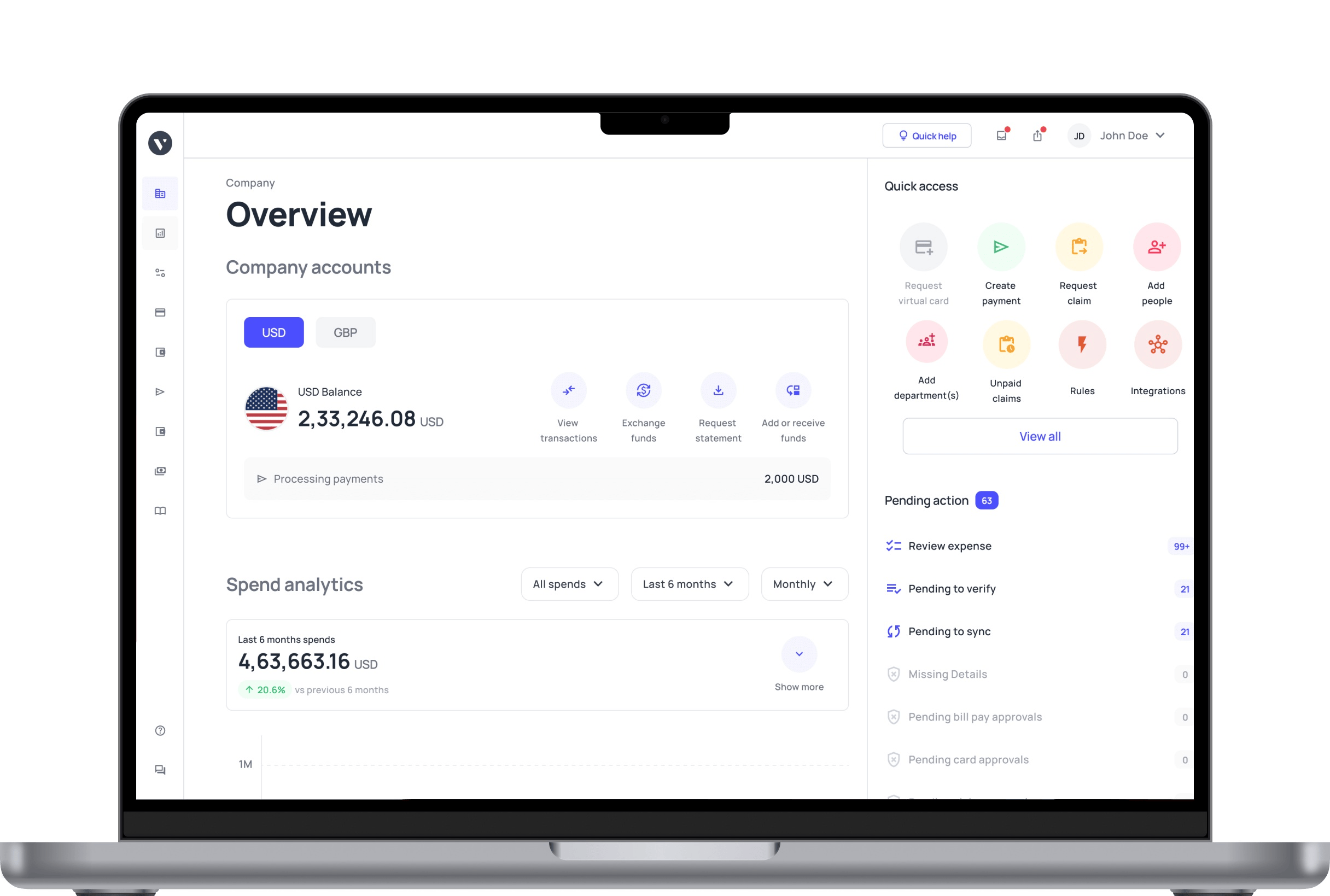
10 Pleo alternatives for scaling businesses in 2026
Pleo is a good expense management software for some businesses in Europe. But as your company grows, so do your financial requirements. Many of these requirements for managing expenses and making payments are not accessible to every Pleo user.
Some of the most essential features your business might need as you are scaling are locked behind a tiered pricing system, making Pleo not a very compelling option. In fact, many important features like flexible card limits, approval workflows, reimbursements, and the ability to create separate budgets are all locked behind higher-tiered pricing.
Most Pleo alternatives that you can find on the market will provide you with these features at no extra cost from their base plans. Out of all the alternatives to Pleo, here are 10 of the best ones to help you when scaling your business.
Quick summary of the Pleo alternatives
● Volopay: Best choice for APAC and globally expanding startups and SMEs needing an all-in-one platform.
● Spendesk: Good for European SMEs and growing startups that want a structured, procure-to-pay platform.
● Airwallex: Best for fast-growing businesses looking to scale globally.
● Payhawk: Great for multinational mid-market and enterprise-level companies operating with multiple entities and currencies.
● Navan: Best for mid-market and enterprise companies with frequent business travelers.
● Airbase: Best for mid-market companies [200–5,000 employees] that want a single procure-to-pay system.
● Zoho Expense: Best for SMBs and startups, particularly those already using software in the Zoho ecosystem.
● Ramp: Good option for US-based small and mid-market businesses that want to actively reduce spending.
● Brex: Best for venture-backed tech startups and high-growth US companies.
● Soldo: Best for UK and European businesses with large teams looking to control spending.
| Tools | Best for | Expense automation | Card type | SaaS spend control | Global support | Reporting & analytics | Integrations |
|---|---|---|---|---|---|---|---|
Volopay | Global teams & growing businesses | Prepaid | |||||
Spendesk | European SMBs | Prepaid | |||||
Airwallex | Global teams with payment collection requirements | Prepaid/Debit | |||||
Payhawk | Mid-market & Enterprise | Credit + Debit | |||||
Navan | Travel booking & expense management | Credit | |||||
Airbase by Paylocity | Mid-sized companies | Credit | |||||
Zoho Expense | For businesses already in the Zoho ecosystem | Supports corporate cards, does not issue their own | |||||
Ramp | For US-based businesses | Corporate charge cards | |||||
Brex | For mid-market & enterprises with high cash flow | Corporate charge cards | |||||
Soldo | For European SMBs | Prepaid cards |
Best overall platform
1. Volopay
Best for: SMEs and mid-market companies in the APAC region, the UK, and the US needing a unified spend management platform.
Solutions: Tech, SaaS, healthcare, logistics, retail, education, construction, D2C, hospitality, F&B, and manufacturing.
Pros:
● All-in-one platform - Corporate cards, bill pay, reimbursements, AP automation, vendor management, procurement, global business account, and integrations.)
● Payments to 130+ countries in over 60+ currencies.
● Up to 5-level approval workflows for strict compliance.
● Unlimited virtual cards to manage online expenses with safety measures.
● Real-time expense tracking on the centralized dashboard.
● Dedicated customer success manager for each business using Volopay.
Cons:
● Pricing information is available after signing up for a demo.
● Fewer integrations compared to larger enterprise platforms.
Key features:
● Corporate cards (physical & virtual)
● Multi-currency wallets
● Vendor management
● Automated AP workflows
● OCR receipt capture
Integrations: NetSuite, Xero, QuickBooks, Tally, MYOB, and Deskera, plus Universal CSV for any other accounting tool.
Additional features:
● Mobile app - Volopay’s seamless functionality of making payments and managing expenses will always be available on the go, thanks to the iOS and Android mobile app. It makes it easier for users to manage and handle all their cards, expenses, and make approvals on the go.
● Bulk vendor payouts - Rather than processing payments to vendors one by one, Volopay gives finance teams the ability to process bulk vendor payments after the necessary checks and approvals are completed for the payments.
● Recurring payment scheduling - A major part of AP automation within Volopay is the ability to schedule recurring payments for different vendors based on your contracts. This allows users to make sure that no payments are missed and conduct smooth business operations without any hiccups.
Why is it a better Pleo alternative?
For businesses that need a comprehensive payment and expense management platform, Volopay is the obvious choice. While Pleo has limited presence in markets outside of the EU, Volopay supports payments to 130+ countries with a global business account that allows transactions in 60+ currencies.
Volopay also offers multi-currency wallets that allow businesses to further save on already competitive FX fees by holding and transacting in multiple currencies. Additionally, Volopay is a one-stop platform that includes full AP automation, vendor management, and procurement, and operates across the world.
For businesses operating globally, especially in the US and the APAC region, it offers wide coverage, unlike Pleo, which benefits more EU-centred businesses.
Best for startups and high-growth companies
2. Brex
Best for: US-based venture-backed startups, high-growth tech companies, and scaling enterprises operating globally.
Solutions: Technology, eCommerce, life sciences, fintech, and SaaS.
Pros:
● No personal guarantee required.
● Credit limits higher than traditional cards.
● AI-powered expense automation.
● Operates in 120+ countries.
Cons:
● Requires a minimum cash balance, $50,000 for startups with funding and much higher for mid-market companies and enterprises.
● Not suitable for non-US businesses
● Limited customer support responsiveness based on our research & findings.
Key features:
● Corporate cards (physical & virtual)
● AI expense automation
● Bill pay
● Travel booking
● Reimbursements
● Real-time reporting
Integrations: NetSuite, Xero, QuickBooks, Slack, Workday, Rippling, Coupa, SAP Concur, and Expensify. Also supports Microsoft Dynamics 365.
Pricing: Essentials: free; Premium: $12/user/month; Enterprise: custom pricing.
Why is it a better alternative to Pleo?
Startups and high-growth companies need to pick tools that address their rapid scaling needs. Users often refer to global presence and credit capabilities as some of the critical factors while choosing their spend management platform. In both these areas, Brex offers features that businesses benefit from.
Compared to Pleo's 14 European markets, Brex operates across 120+ countries. This automatically makes it a better choice for businesses operating outside the EU. Brex also offers higher credit limits with no personal guarantee.
When bundled with banking, travel, and AP automation into one free-to-start platform, it provides valuable cost-saving avenues for businesses that are in the growing stage. These are features Pleo cannot yet match for US or global startups.
Best for region-based
3. Ramp
Best for: US-based small businesses and mid-market companies seeking maximum finance automation and measurable cost savings.
Solutions: Technology, SaaS, eCommerce, professional services, nonprofits, and education.
Pros:
● Free core plan.
● AI-powered duplicate detection and savings insights.
● Proactive spend controls.
● Easy-to-use platform.
Cons:
● US-only corporate card program with some international spending capabilities.
● Advanced ERP integrations and procurement require paid plans.
● Credit limits are tied to daily cash balance.
Key features:
● Corporate cards
● Expense management
● Bill pay, procurement, & AP automation
● Travel booking
● Real-time reporting
● AI receipt matching
Integrations: QuickBooks, Xero, NetSuite, Sage Intacct, Workday, and Oracle, plus 200+ additional tools, including Slack, HRIS platforms, and Ironclad.
Pricing: Free (core); Ramp Plus at $15/user/month; Enterprise at custom pricing.
Why is it a better alternative to Pleo?
One of the key differences between Pleo and Ramp is the regions within which they operate. For businesses focused on a US entity or US market, Ramp is a clearer choice.
For starters, Ramp is free, which means that businesses are able to onboard without investing heavily and can test drive its capabilities to ensure they meet business needs.
It also covers the full US finance stack (cards, AP, procurement, travel), and is purpose-built for American businesses. In comparison, Pleo is limited to 14 European countries. It also charges per user on all meaningful plans, and lacks Ramp's AI-driven cost-savings engine.
If your business is solely operating in the US, Ramp is a better option than Pleo, in terms of operating regions as well as operating costs.
Best for enterprises
4. Payhawk
Best for: Mid-market and enterprise companies managing multi-entity, multinational spend across 32+ countries.
Solutions: Technology, manufacturing, logistics, professional services, aviation, and retail.
Pros:
● AI-native platform covering cards, expenses, bills, travel, and procurement in one place.
● Supplier payments in 150 countries across 115 currencies with FX markup from just 0.3%
● Dedicated AI Office of the CFO - A beta testing program of AI agents to help finance teams.
● J.P. Morgan-backed payment infrastructure.
Cons:
● No pricing transparency.
● Some users report UX friction at lower tiers.
● Setup complexity for large organizations.
Key features:
● Corporate cards
● Multi-entity management
● AP automation & procurement
● AI expense agents
● Real-time budget tracking
Integrations: NetSuite, Microsoft Dynamics, Sage Intacct, Xero, QuickBooks, Workday, SAP SuccessFactors, ADP, and 50+ HRIS systems.
Pricing: Modular, custom pricing based on plans, add-ons, seats, cards, and transaction volume.
Why is it a better alternative to Pleo?
For enterprise-level businesses, scalability is critical. Not only do they need a system that can handle the workload of thousands of users and payment data, but also one that operates in multiple locations to be able to pay international vendors and employees.
Payhawk operates in 32+ countries versus Pleo's 14, which makes it the preferred option for global enterprises. It also has more advanced features for larger-scale businesses, enabling it to support true multi-entity management.
It offers enterprise ERP integrations that Pleo does not, and includes AI agents that autonomously handle receipts, approvals, and anomaly detection. These capabilities are more complex than Pleo's current SMB-focused feature set.
Best for travel expense management
5. Navan
Best for: Mid-market to enterprise companies with frequent business travelers needing unified travel booking and expense management.
Solutions: Technology, professional services, financial services, healthcare, and global enterprises across all industries.
Pros:
● Travel booking and expense management.
● Customers recorded a 16% average reduction in annual travel spend per a 2025 Forrester study.
● 96% platform CSAT as per their own claims, with a 7-minute average booking time.
Cons:
● Steeper learning curve for small teams.
● Some users report limited inventory flexibility outside major routes.
● Support delays for complex cases.
Key features:
● Unified travel booking (600+ airlines, 2M+ properties)
● Integrated corporate cards
● AI expense automation
● Real-time policy enforcement
● 24/7 agent support
Integrations: NetSuite, QuickBooks, Sage Intacct, Microsoft Dynamics, SAP, and Xero. Also supports 30+ HRIS systems.
Pricing: Free tier for companies up to 300 employees; custom enterprise plans available.
Why is it a better Pleo alternative?
While Pleo offers an array of card management tools, it has no travel booking capability at present. For companies with heavy T&E management requirements, it functions as one part of a larger tech stack instead of providing all modules in a single, accessible place.
Navan, on the other hand, unifies flight, hotel, and rail booking in one spot. Combined with expense management, corporate cards, and real-time AI policy enforcement in one platform, Navan is the definitive choice for any business where employee travel is a major expense category.
Customers no longer need to rely on manual information gathering, and instead have an end-to-end management tool for all their employee travel needs.
Best for mid-sized companies
6. Airbase by Paylocity
Best for: Mid-market companies with 200–5,000 employees needing a unified procure-to-pay platform to replace fragmented finance tools.
Solutions: Technology, SaaS, financial services, healthcare, and professional services.
Pros:
● Praised for intuitive UX.
● Unified cards, AP, procurement, and reimbursements in one platform.
● Now integrated with Paylocity's HCM for payroll + spend in one system.
Cons:
● Mobile app has limited functionality versus the desktop version.
● Steeper learning curve for complex workflows.
● Pricing not publicly listed.
Key features:
● Guided procurement
● AP automation
● Corporate cards (virtual & physical)
● Expense management
● 3-way PO matching with AI receipt capture
● Multi-entity support
Integrations: NetSuite, QuickBooks Online, Xero, Sage Intacct, Slack, Salesforce, Google Workspace, and Microsoft Teams.
Pricing: Different plans available based on your company’s needs, such as Payroll, HR, Workforce management, etc.
Why is it a better alternative to Pleo?
For businesses whose needs have outgrown basic startup and small business tools, Airbase is more attractive. It delivers a more customized experience for scaling business needs as compared to Pleo.
For instance, its Paylocity integration uniquely connects spend management with HR and payroll in a single system, something an SMB tool like Pleo does not yet offer.
Moreover, mid-sized companies often look to scale globally. Whether that’s entering new markets, hiring internationally, or setting up multiple entities, a tool like Airbase that can handle multi-entity management, large-scale payroll, and guided procurement becomes a preferred option.
Best for European SMBs
7. Spendesk
Best for: European startups and SMBs with up to 1,000 employees seeking a structured, all-in-one procure-to-pay platform with strong governance.
Solutions: Technology, marketing, education, professional services, and SaaS.
Pros:
● First European platform to fully integrate procurement and spend management for businesses up to 1,000 employees.
● Multilingual support.
● Visa/Adyen-powered payment infrastructure.
● Processes €20 billion annually.
Cons:
● Pricing not publicly listed.
● Some users report slow offboarding and account closure support.
● Limited native automations for third-party receipt sync.
Key features:
● Corporate cards (virtual & physical)
● AP automation
● Procurement
● Expense reimbursements
● Invoice workflows
● Multi-entity management
● Real-time spend dashboard.
Integrations: NetSuite, Xero, Slack, Google Workspace, plus QuickBooks and 40+ accounting, HR, and ERP tools.
Pricing: Two tiers, called Foundations and CFO Connect Pro plans available. Procurement and AP available as add-on modules.
Why it's a better alternative to Pleo?
Spendesk’s capabilities extend beyond basic spend management. It incorporates modules to create an entire ecosystem that can take care of diverse customer needs.
This includes procurement (for users wishing to manage vendors from within the spend platform), invoice automation (for accelerated invoice processing), and multi-entity management (for teams operating in different countries). While Pleo does offer some of these capabilities as well, they are restricted to higher tiers.
Another benefit of Spendesk is that it offers multilingual support that Pleo presently lacks, and is backed by a licensed European payment institution. This gives finance teams more governance, depth, and regulatory confidence than Pleo's card-centric approach.
8. Soldo
Best for: UK and European SMEs and enterprises with large, decentralized teams needing real-time card-based spend control across departments and locations.
Solutions: Media buying, marketing agencies, logistics, hospitality, professional services, and retail.
Pros:
● Used by 25,000+ organizations across 31 countries.
● Proactive pre-spend controls via prepaid Mastercard cards.
● Automates up to 80% of financial processes.
● FCA-regulated.
● Supports fuel cards and non-nominative cards.
Cons:
● FX markup of 2% on non-held currencies
● Pricing can scale steeply for larger teams.
● Mobile app has fewer features than desktop.
Key features:
● Physical & virtual cards
● Real-time spend tracking
● Customizable card rules
● Automated reconciliation
● Team/department budgets
● Mobile receipt capture
Integrations: Xero, NetSuite, Sage, Microsoft Dynamics 365, QuickBooks, TravelPerk, DATEV, Amazon Business, plus open API for custom builds.
Pricing: Three plans, including Standard, Plus, and Unlimited. Custom-quoted beyond the base price depending on team size and transaction volume.
Why it's a better alternative to Pleo?
Soldo's proactive model prioritizes early intervention and prevention rather than relying on expense reviews.
For businesses that have very rigid budgets, it’s beneficial to opt for a product that sets and enforces spending rules before money leaves the account, rather than reviewing after the fact.
Compared to Pleo, Soldo also uniquely supports non-nominative cards, fuel cards, and department-level budgets. This type of granular control makes it a stronger fit for businesses with field teams, vehicles, or complex distributed spending structures.
9. Zoho Expense
Best for: SMBs and growing businesses — especially those already using the Zoho ecosystem — needing affordable, multi-currency expense management across 150+ countries.
Solutions: Consulting, sales, field services, manufacturing, retail, and any organization with traveling employees.
Pros:
● Highly affordable.
● Free plan available.
● Deep native Zoho ecosystem integration.
● Available in 150+ countries.
● Flexible active-user pricing.
Cons:
● Interface can be confusing for new users.
● Xero integration is reported as buggy by some users.
● Limited card issuance.
● Mobile app less polished than competitors.
Key features:
● AI receipt autoscan
● Multi-currency support
● Mileage tracking
● Per diem management
● Corporate card reconciliation
● Approval workflows
● Real-time reporting.
Integrations: QuickBooks, Xero, Sage, Microsoft Dynamics, Oracle NetSuite, Zoho Books, Zoho CRM, and travel platforms like Uber and Delta.
Pricing: Free (up to 3 users); Standard at $3/user/month; Premium at $5/user/month; Enterprise custom pricing.
Why it's a better alternative to Pleo?
Zoho Expense operates in 150+ countries compared to Pleo's 14 EU markets. This makes it an attractive option for businesses that operate outside the EU, or those that wish to scale beyond the EU in the future.
Another factor that makes Zoho Expense a preferred option is the payment structure. It starts completely free, offering per-diem management and travel booking. This gives businesses a seamlessly connected financial ecosystem, all at a fraction of Pleo's cost.
It is beneficial for businesses operating with lower budgets. It is especially economical as a choice if the business already uses other products within the Zoho ecosystem (such as Zoho Books or Zoho CRM), since looping in Zoho Expense takes less time and effort compared to signing up for an entirely different product.
Best for global payments
10. Airwallex
Best for: Fast-growing businesses, eCommerce companies, and global enterprises needing a unified platform for international payments, multi-currency accounts, and spend management.
Solutions: Travel, wholesale, manufacturing, financial services, and e-commerce — particularly businesses expanding across multiple regions.
Pros:
● 80+ licences globally.
● Interbank FX rates.
● Supports 200,000+ businesses.
● Supports 130+ currencies with the ability to collect, hold, and pay in 20+ currencies.
● AI-powered receipt matching.
● Zero forced currency conversions.
Cons:
● Some users report account freezes without notice.
● FX markup of 0.5–1% applies.
● Not available to sole traders in some markets.
Key features:
● Multi-currency business accounts
● Global payouts (180+ countries)
● Corporate cards
● Expense management
● Bill pay
● AP automation
● Purchase orders
● Payment acceptance
Integrations: Xero, QuickBooks, NetSuite, Shopify, WooCommerce, Magento, plus Workday, SAP SuccessFactors, UKG, and BambooHR.
Pricing: Offers a “Free” $0 per user monthly plan, $12 per user monthly “Grow” plan, and a custom pricing plan called “Accelerate”.
Why it's a better alternative to Pleo?
Pleo is a spend management tool largely focused on the EU region. Without the presence of global payment rails or payment acceptance capabilities, businesses that operate in multiple markets or have global teams tend to face drawbacks.
It also makes it harder for companies to use if they intend to scale beyond the EU. Airwallex’s multi-currency capabilities and global payment options help businesses that wish to expand.
It combines this with spend management in one platform, making it the definitive choice for any business that collects revenue globally, pays international suppliers, or operates across multiple currencies.
How to choose the right Pleo alternative for your business
Pleo works well for basic card-based expense management within Europe. But if your business has outgrown its limitations, here are the five most critical factors to evaluate when choosing an alternative:
1. Global payments, not restricted to EU
Pleo operates in only 14 European countries. If your business pays international vendors, operates across APAC, the Americas, or Africa, it needs multi-currency wallets with SWIFT and non-SWIFT payment rails.
You need a platform built for cross-border operations, not one that stops at European borders. Look at tools that have payment coverage as well as spend management features covering the areas you operate in or plan to operate in.
2. Complete AP module
Pleo is card-first. Most growing businesses need far more. Automated invoice capture, purchase order matching, vendor payment scheduling, and full accounts payable workflows.
Look for platforms where AP automation is a core module, not a bolt-on feature restricted to higher pricing tiers. If you intend to manage receivables as well, it’s good to look for a tool that also offers AR automation.
3. Payroll module
Very few spend management platforms touch payroll. Having salary processing, reimbursements, and corporate card spend in a single dashboard eliminates reconciliation headaches and reduces your dependency on separate HR or payroll tools.
It also ensures timely payments to your employees and contractors. Look for tools with full payroll modules, or at least ones that enable payroll management without excessive hassle.
4. Unlimited virtual cards
Pleo restricts virtual card issuance on lower-tier plans. For businesses running SaaS subscriptions, digital advertising, or distributed remote teams, unlimited virtual cards with per-card spend controls are non-negotiable.
They’re also an excellent tool for spend management and SaaS management. Look for platforms that offer free or low-cost virtual card creation with customizable options.
5. Dedicated customer success managers
When a vendor payment fails or a card is declined, you need a named human, not a chatbot queue. Smooth operations and delivery rely on timely payments.
Prioritize platforms where dedicated CSMs are included, not reserved for enterprise contracts. Also consider which tools offer the type of support you need: email, chat, phone, text, etc.
FAQs
Volopay is probably the best Pleo alternative as it combines an all-in-one expense management and payment platform into a single software experience. You get the ability to set up a global business account to make payments in over 130+ countries and 60+ currencies, corporate cards, AP workflows, and accounting automation.
Pleo has limited capabilities when it comes to global transactions and more complex AP workflows. Add to that pricing plans that get quite expensive with growing business needs. These factors make businesses look for alternatives to Pleo.
Look for platforms that give you the ability to create unlimited virtual cards for online expense management without having this feature restricted behind a higher-tiered pricing plan. As a business operating globally, you may also want to make sure that the software has a dedicated payroll module along with multi-currency support for salaries to employees in different countries and payments to vendors across the border.
Volopay and Airwallex stand out as the premier choices for global teams due to their vast capabilities to manage expenses and make payments. Both support payments across multiple countries in different currencies and have the necessary tools to keep track of all expenses in real-time.
Yes, all alternatives to Pleo have integration capability with accounting software. In many cases, there are even more options than Pleo provides to integrate with different tools.
Yes, many of the alternatives, such as Volopay, Zoho Expense, and Airwallex are much cheaper alternatives to Pleo and at the same time also provide more functionality.