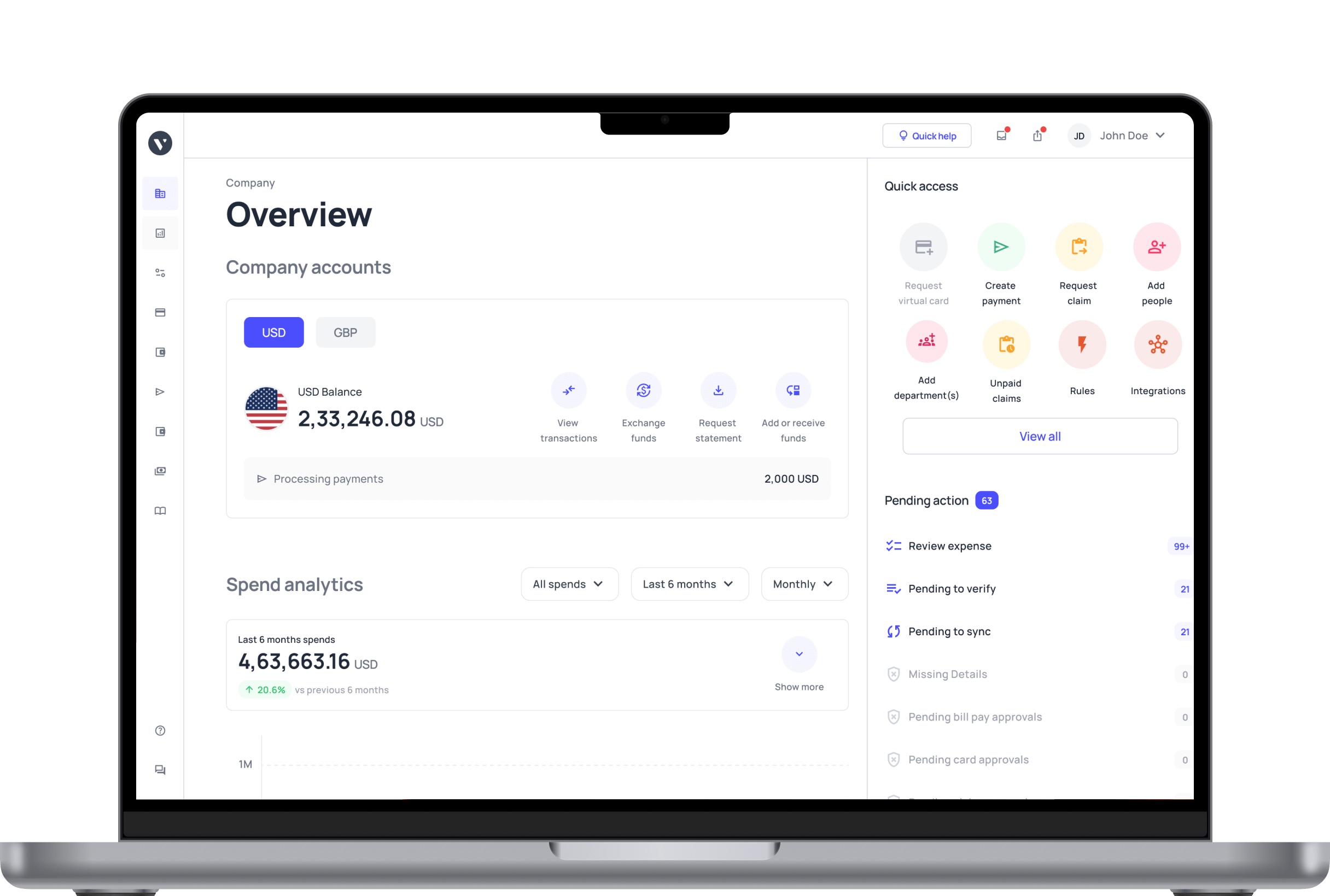
Best prepaid business cards for business expenses
Finding the best prepaid business cards means looking beyond the card itself. A prepaid card is a funded payment tool you load in advance. There is no borrowing, no bank account linking.
The right business card should offer a variety of benefits: real-time spending controls, instant issuance, merchant restrictions, and seamless accounting integration. We compared the leading options across spending controls, reporting, fees, and ease of use.
Here, we reviewed and compared the leading options across spending flexibility, control features, and ease of management.
Whether you are equipping a distributed team, managing vendor payments, or tightening departmental budgets, the cards featured below represent the strongest choices available to businesses right now.
Best prepaid business cards
1. Volopay prepaid business card
Volopay stands out among the best prepaid business cards for finance teams needing granular spending control. With virtual prepaid card transactions in the B2B sector projected to grow from $3 trillion in 2024 to $11 trillion by 2030[1], platforms like Volopay are increasingly in demand.
Volopay lets you issue unlimited virtual cards with per-card merchant restrictions, spending caps, and time-based limits, ideal for travel, vendor, and subscription management. Real-time card freezing, instant fund loading, and approval workflows keep finance teams in control. Native integrations with Xero and QuickBooks automate reconciliation end-to-end.
Users on platforms like G2 and Capterra consistently praise Volopay's responsive support and seamless Xero integration. On Capterra, users highlight that Volopay's virtual cards have been critical for finance, procurement, and engineering teams with global ambitions, as well as adding context directly to receipts.
● Ratings on G2: 4.3/5 (Based on 106 reviews)[2]
● Ratings on Capterra: 4.5/5 (Based on 33 reviews)[3]
Pros:
● Unlimited virtual and physical card issuance
● Granular per-card spending controls and merchant restrictions
● Real-time card freezing and fund loading
● Native accounting integrations
Cons:
● Requires an initial set up for team members.
● Better suited for mid-size to larger teams than solo operators.
Best for: Growing businesses needing policy-driven, multi-department spend management.
2. Emburse card
Emburse offers prepaid cards built for organizations that require strict budget enforcement and expense policy compliance. Prepaid business cards are issued instantly as virtual or physical cards, each tied to a specific budget, project, or employee.
Spending limits are enforced at the card level, stopping overspend before it occurs. Administrators can configure one-time or recurring load schedules, making it effective for contractor payments and departmental allocations. Receipt capture and ERP sync are built directly into the platform.
Users consistently highlight how Emburse simplifies card issuance and automates receipt tracking, though some note that unexpected account reviews and a learning curve for new administrators can slow initial onboarding.
● Ratings on G2: 4.4/5 (Based on 6137 reviews)[5]
● Ratings on Capterra: 4.5/5 (Based on 42 reviews)[6]
Pros:
● Project- and budget-level card controls
● Automated receipt capture and ERP sync
● One-time and recurring load flexibility
Cons:
● Advanced features may require higher-tier plans
● Interface can have a learning curve for new administrators.
Best for: Finance-conscious organizations prioritizing policy enforcement and real-time spend visibility.
3. PEX prepaid expense card
PEX is a prepaid expense card solution built for nonprofits, field teams, and businesses managing distributed workforces. Administrators issue cards with preset limits and merchant category restrictions, ensuring funds are used only for approved purposes, particularly valuable for grant-funded or restricted budgets.
Real-time fund transfers, instant card issuance, and transaction-level visibility keep distributed spend fully accountable. Their customers consistently praise PEX for its ease of use, real-time bookkeeping, and seamless QuickBooks integration, though some flag the absence of automatic tagging reminders as a workflow gap.
● Ratings on G2: 4.6/5 (Based on 175 reviews)[7]
Pros:
● Strong category-level merchant controls
● Excellent fit for nonprofits and field-based teams
● Real-time fund transfers and spend tracking
Cons:
● Monthly fees apply regardless of spend volume
● Less robust integrations compared to some enterprise alternatives
Best for: Organizations distributing controlled, accountable funds to employees in the field.
4. U.S. Bank prepaid card for businesses
The U.S. Bank prepaid card for businesses is a reliable, bank-backed solution for companies that prefer institutional stability over fintech complexity.
U.S. Bank's broader reputation among business users is mixed, while its institutional infrastructure and fraud protection are consistently acknowledged as strengths. Independent reviewers note that customer service quality can vary significantly by branch, and dedicated support resources for newer card products remain limited.
The card supports payroll disbursements, per diem allocations, and one-time project spend without exposing core bank accounts, backed by broad merchant acceptance and strong fraud monitoring.
Pros:
● Backed by a nationally recognized financial institution
● Broad merchant acceptance domestically and internationally
● Strong fraud monitoring and customer support
Cons:
● Fewer software integrations than fintech-native alternatives
● The feature set may feel limited for technology-forward finance teams
Best for: Businesses that prioritize institutional trust and straightforward prepaid management over advanced automation.
5. Dash prepaid Mastercard
The Dash prepaid Mastercard is designed for small to mid-sized businesses seeking a straightforward, low-barrier prepaid card solution. Cards can be loaded and reloaded easily, with individual spend limits assignable per cardholder to maintain budget discipline across teams.
Accepted everywhere Mastercard is recognized, Dash offers flexibility for employee purchases, vendor payments, and business travel. The prepaid structure eliminates the need for personal liability or lengthy approval processes, making card distribution fast and accessible.
Pros:
● Wide Mastercard acceptance network
● Simple load and reload process
● No personal liability required for employees
Cons:
● Limited advanced controls compared to fintech-focused platforms
● Reporting and integration capabilities are basic
Best for: Smaller businesses needing a practical, no-frills prepaid card for everyday employee spending.
6. Netspend prepaid card
Netspend offers a flexible prepaid card program that businesses can use to manage employee spending without linking to a central bank account. Funds are loaded directly onto individual cards, giving each cardholder access to a defined budget for purchases, travel, or operational expenses.
Netspend supports direct load, reload at retail locations, and online fund transfers. The card is accepted wherever Visa or Mastercard is recognized, providing broad usability. Businesses can monitor balances and transactions through an online portal, keeping oversight centralized without complex infrastructure.
On SuperMoney, the Netspend Small Business Prepaid Mastercard is rated as mostly recommended across verified user reviews, with users citing ease of use and multiple reload options as key strengths. On G2, users praise Netspend for providing a flexible prepaid payroll solution that beats traditional banking services, with built-in mobile account management, anytime alerts, and earned wage access for employees.
Ratings on G2: 4.4/5 (Based on 20 Reviews)[8]
Pros:
● Broad acceptance via Visa and Mastercard networks
● Multiple reload options, including retail and online transfers
● No bank account linkage required
Cons:
● Fee structure can be complex and accumulate quickly
● Limited business-grade spend controls and policy enforcement tools
Best for: Businesses seeking basic prepaid functionality with minimal setup for short-term or project-based spending.
| Card | Best for | Card types | Spending controls | Reporting | Pricing |
|---|---|---|---|---|---|
Volopay | Distributed teams & vendor payments | Physical & virtual | Per-card limits, merchant category blocks | Real time | Custom quote |
Emburse | Expense management workflows | Primarily virtual | Budget-linked, expiration controls | Automated matching | Tiered plans |
PEX | Non profits & field teams | Physical & virtual | Merchant blocking, scheduled loading | Real-time alerts | Monthly fee per card |
U.S. Bank | Established businesses | Physical | Per-transaction & daily limits | Standard portal | Contact bank |
Dash Mastercard | Small teams & contractors | Physical | Card-level limits | Basic | Contact issuer |
Netspend | Small businesses & sole proprietors | Physical | Basic load controls | Standard | Monthly + transaction fees |
Simplify expenses with Volopay prepaid cards
Prepaid credit card vs debit card for businesses explained
Many business owners search for prepaid business credit cards without realizing that prepaid cards occupy an entirely different category.
● A regular credit card extends a line of credit that you repay later.
● A debit card pulls funds directly from a linked bank account.
● A prepaid card does neither. It only works with money loaded onto it in advance, with no borrowing and no bank account connection.
This makes it a standalone spending tool, not a variation of the other two. The distinction matters when choosing the right financial instrument for your business.
Why is a prepaid card better for your business compared to a regular credit or debit card?
Fund security
The financial exposure from a compromised payment method can be devastating. A hacked credit card can rack up thousands in unauthorized charges before your bank intervenes. A breached debit card can empty your entire checking account within minutes, leaving critical payments in jeopardy.
The best prepaid business cards significantly reduce this risk because only the loaded amount is ever at stake. If a card is compromised, the loss is capped at whatever balance remains, nothing more.
Prepaid cards add a structural layer of protection that credit and debit cards simply cannot match. This is not a small concern. According to the Association of Certified Fraud Examiners, businesses lose an estimated 5% of their annual revenue to fraud each year.
Spending controls
Unlike a credit card, where an employee can unknowingly exceed a policy limit and trigger an uncomfortable conversation with finance, prepaid cards are hard-capped by design. Once the balance reaches zero, the card declines automatically.
There are no overages, no policy violations slipping through, and no surprise charges waiting at the end of the billing cycle. This creates a spending environment that is enforced by the card itself, not by an employee's memory of the company expense policy.
Managers can load exactly what is needed for a trip, a project, or a monthly department budget, and the card does the enforcement work from there. For businesses scaling their teams, this removes the dependency on trust alone and replaces it with a system that holds firm regardless of who is holding the card.
No credit risk
Credit cards come with a dangerous comfort, the ability to spend money you do not have yet. For businesses operating on tight margins or seasonal cash flow, that comfort can quietly become a liability.
Interest charges compound, minimum payments create a false sense of control, and revolving debt builds in the background while the business appears to be functioning normally.
A reloadable prepaid card keeps spending anchored to actual available funds. There is no credit line to exceed, no interest to accrue, and no monthly statement that arrives with unpleasant surprises.
Every dollar spent is a dollar that was already allocated, which keeps your cash flow picture accurate and your financial statements clean. For early-stage businesses or those actively working to reduce financial liabilities, this is a meaningful structural advantage that a credit card model cannot offer.
Better accounting
When you issue department-specific prepaid cards, every transaction is automatically categorized by team, project, or vendor from the moment it is posted. Marketing spends on its card, operations spends on its own, and field teams carry theirs.
There is no ambiguity, no month-end receipt chasing, and no internal debate over whether that one charge belonged to one budget or another. This structure turns expense tracking from a reactive task into an automated one. Finance teams spend less time sorting and more time analyzing.
Department heads get a clear view of their actual spend against their allocated budget throughout the month, not just after the fact. For businesses running multiple projects simultaneously, card-based budget separation is one of the most practical and lowest-effort ways to maintain clean financial records without adding headcount to the accounting function.
One-time or limited-use cards
Sharing your main business account details with a new vendor or issuing a full-access card to a short-term contractor introduces unnecessary risk. A prepaid card eliminates that exposure entirely.
You load only the amount required for that specific job or purchase, hand over the card details, and the transaction is complete.If the vendor relationship does not work out, or a charge comes through that exceeds what was agreed, the financial damage stops at the card balance. There is nothing further to dispute, no account to freeze, and no downstream payments affected.
This approach is particularly valuable for one-off projects, freelance engagements, event-based spending, or any situation where you need to extend purchasing access without granting broader financial trust. It gives businesses a controlled way to work with new or unverified parties without putting core finances at risk.
Simplified reconciliation
One of the quieter advantages of prepaid cards is what they do for your budget over the course of a year. Prepaid business credit cards issued by a department or cost center generate a categorized, transaction-level record from day one.
Every purchase is tied to a specific card, which is tied to a specific team or budget line, creating a paper trail that builds throughout the year. By the time your accountant or bookkeeper sits down in Q1, the heavy lifting is already done.
There is no manual categorization to work through, no missing receipts to chase down, and no ambiguous charges requiring context from employees who may no longer remember the details. This also reduces the risk of errors during tax preparation.
Clean, pre-categorized data moves faster through accounting software, flags anomalies more clearly, and gives your finance team a more accurate picture of where money actually went across the year.
Get more control over expenses with Volopay cards
Best practices for using prepaid business cards
Using prepaid cards effectively comes down to structure and consistency. Here is how businesses get the most out of them.
1. Set clear loading policies
● Decide in advance how much goes on each card and for what purpose
● Avoid overloading cards as a buffer. Load only what the task or period requires
● Schedule reloads in advance for recurring expenses to avoid operational disruption
2. Assign cards with intent
● Issue cards by department, project, or individual role rather than sharing a single card across a team
● Using the best prepaid cards this way creates an automatic spending trail that requires no extra tagging or categorization later
3. Define acceptable use upfront
● Communicate clearly what each card can and cannot be used for before it is issued
● Pair card issuance with a brief written policy so employees understand boundaries without ambiguity
4. Monitor transactions in real time
● Do not wait for the month-end statements to review spending
● Real-time alerts and dashboards catch irregularities early, before small issues compound
5. Integrate with your accounting tools
● Connect prepaid business cards to your accounting software from day one
● This eliminates manual data entry and ensures every transaction flows directly into the correct budget line
6. Review and adjust limits regularly
● Business needs to shift. A card loaded for a Q1 campaign may need a different ceiling in Q3
● Schedule quarterly reviews to ensure card limits reflect current operational priorities
7. Deactivate cards that are no longer in use
● Dormant cards sitting with a balance are an unnecessary risk
● Build a routine of reviewing active cards and deactivating any tied to completed projects, former contractors, or one-time vendors
Prepaid cards to streamline expense reporting
FAQs
There are several leading options if you’re looking for prepaid business card solutions, Volopay being one of them.
Each serves different business sizes and needs, from distributed team spending to simple single-user expense control.
Volopay is widely regarded as a strong option. We offer real-time controls, instant card issuance, and accounting integrations that make it a dependable choice for businesses prioritizing spending oversight and operational efficiency.
Volopay is particularly well-suited for project-based budgets. Both allow you to assign cards to specific projects, set fixed spending limits, and track transactions in real time without waiting for end-of-month reports.
Volopay stands out as a comprehensive solution. The prepaid cards work in sync with its expense management system, giving finance teams unified control over budgets, approvals, reconciliation, and reporting from a single platform.
Yes. Volopay offers a reloadable prepaid card that finance teams can top up instantly from a central account.
This makes it practical for recurring departmental expenses, ongoing vendor payments, and employee spending that requires consistent budget replenishment.
Volopay simplifies tax reporting by automatically categorizing transactions and integrating with accounting platforms, ensuring every expense is accurately recorded and audit-ready without manual intervention at year's end.
Volopay is purpose-built for finance teams, offering real-time transaction visibility, per-card spending limits, merchant controls, and direct integration with tools like Xero and QuickBooks for efficient, accurate financial management.
Volopay is one of the few providers that offer the most flexibility, allowing businesses to issue physical and virtual cards, set individual limits, restrict merchant categories, and reload balances remotely, adapting to varying employee spending needs across departments.
Volopay is a strong fit for accountants, offering per-user spending limits, instant transaction alerts, and automated reconciliation features that reduce manual work and keep financial records accurate throughout the month.
Volopay is well-suited for fulfillment center expense tracking. It allows category-specific card issuance, real-time monitoring, and detailed reporting, making it straightforward to track operational costs across high-volume purchasing environments.
Volopay is known for fast onboarding, with instant virtual card issuance available shortly after account setup. Businesses can begin issuing and loading cards to employees without lengthy approval or activation delays.
Volopay supports real-time expense controls, enabling administrators to set spending limits, block merchant categories, receive instant transaction alerts, and freeze cards immediately when unusual activity is detected.